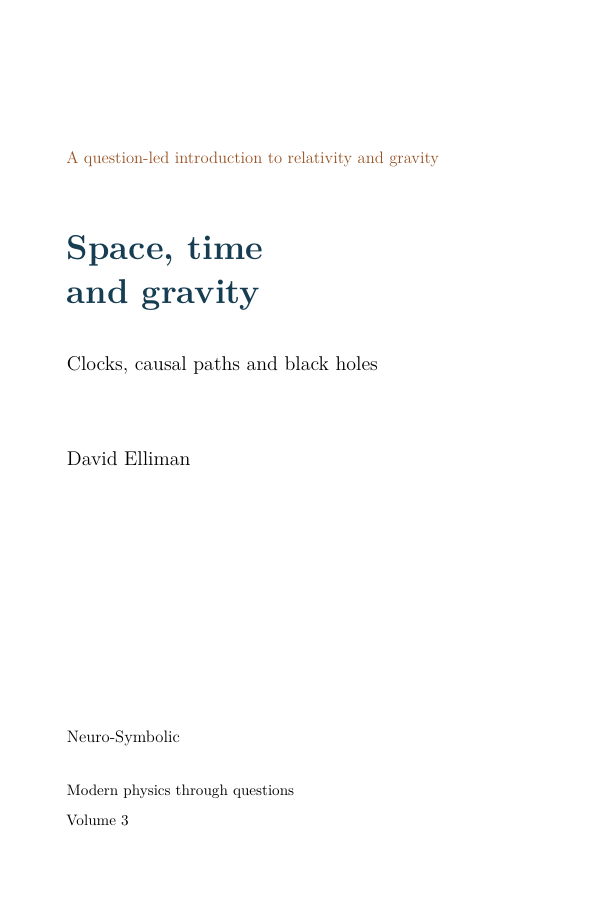
A question-led introduction to relativity and gravity
Space, time and gravity
Clocks, causal paths and black holes
David Elliman, Neuro-Symbolic Ltd · October 2026 · 16 questions · 37 pages
Read Space, time and gravity — free PDF, 37 pagesAbout this book
The book starts with measurements. A clock records elapsed time along its own path. Light connects an emitter and a receiver. A galaxy image tells us about light that has travelled through an evolving universe. These are concrete observations before they become equations about spacetime.
Part one asks how clocks and light lead to relativity. Part two examines photon time, acceleration, gravitons and the limits of a classical gravitational source. Part three treats black holes as causal structures and asks about quantum radiation and accelerated detectors. Three optional bridges then introduce the light-clock arithmetic, what Einstein's equation relates, and why black holes connect information with area. Each opening asks for a prediction; worked answers are at the back.
No tensor calculus is needed. A few formulas are introduced only after their arithmetic and meaning have been established, and schematic diagrams are labelled as such. The companion volumes supply the quantum and particle background, and cosmology has its own fourth volume. Throughout, tested gravitational physics, controlled quantum approximations and open questions about quantum gravity are kept distinct.
The questions
16 questions in 4 parts. Each part opens with its physical setting; each question asks for a prediction before the explanation.
What clocks and light measure
- Why do inertial observers agree on the speed of light?
- If light has no rest mass, why does gravity bend it?
- Why is gravity so weak?
- Is space continuous or made of pieces?
Clocks, signals and quantum limits
- Does a photon experience no time?
- Is gravity acceleration, or is it curvature?
- Does light-speed gravity prove that gravitons exist?
- Why are there three dimensions of space and one of time?
- Does uncertainty make Einstein's equation impossible?
What a horizon allows
- Why can't light escape a black hole?
- Do space and time swap inside a black hole?
- Why do black holes evaporate?
- Can acceleration make empty space feel warm?
Optional: three bridges to the equations
- How does the light-clock arithmetic work?
- What does Einstein's equation relate?
- Why do black holes connect information with area?
At the back: Answers to the Try questions, and a closing section of words and further reading.
Two sample answers
The opening of two answers, as they appear in the book. Each question is preceded by a prompt to make a prediction before reading on.
Question 3 · What clocks and light measure
Why is gravity so weak?
Before reading on. Does comparing two constants with different units give a meaningful ranking of force strengths?
A number changes when its unit changes. The same distance can be one metre or one hundred centimetres. Comparing the numerical values of dimensional constants without their units cannot tell us which interaction is physically stronger.
Instead, compare forces or dimensionless couplings in a specified situation. Consider two protons sufficiently far apart that their strong interaction is negligible, moving slowly enough for a static force comparison. They attract gravitationally and repel electrically. In the simple inverse-square comparison, both forces have the same distance dependence, so their ratio does not depend on that separation.
The gravitational attraction is extraordinarily small in that comparison. The proton mass, its electric charge and the gravitational and electromagnetic constants enter the ratio. Changing to different particles changes the comparison. The word weak needs those inputs.
The answer continues in the book.
Question 10 · What a horizon allows
Why can't light escape a black hole?
Before reading on. Must light slow down locally at a horizon for escape to become impossible?
The defining feature of a black-hole event horizon is causal. It separates events that can send signals to the specified distant future from those that cannot. In the ideal classical black-hole geometry, escape from inside is not among the future-directed lightlike paths.
Light still travels locally at the invariant speed. The obstruction is the arrangement of possible future paths in the geometry, not a local friction that slows the photon.
An event horizon is not generally a material surface that an infalling observer strikes. For a sufficiently large, quiet black hole, local tidal effects at the horizon can be small enough that crossing has no special local drama. Later conditions can be very different.
The answer continues in the book.
Read the book
The complete book is a free PDF with extractable text and no registration. It is best read a question at a time, making a prediction before each explanation. All four volumes are also combined into one Kindle book for 99p, if you would rather read them in your e-reader or on your phone.