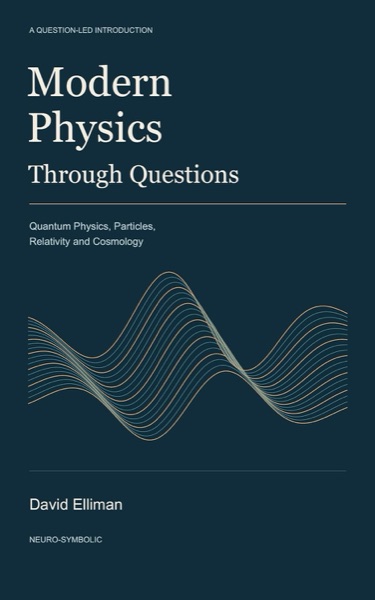
Question-led introductions to quantum physics, particle physics, relativity and gravity, and cosmology, by David Elliman, Neuro-Symbolic Ltd.
Modern physics is fascinating, often surprising, and sometimes hidden behind unfamiliar mathematics. Popular accounts can awaken curiosity without showing enough of the reasoning to satisfy it. University textbooks supply that reasoning, but often assume mathematical fluency that a reader has not yet acquired, or has not used for some time.
At Neuro-Symbolic we needed material to help able graduates understand the physics relevant to their work. These four books are our attempt to meet that need. They may also interest undergraduates, researchers entering a new field, and readers who want to understand more than a memorable analogy.
Each book uses questions and answers. A concrete puzzle gives a reason to examine an idea; each opening asks for a prediction before the explanation, and explanations use experiments, diagrams and simple arithmetic before introducing symbols. Established results, assumptions of an example and unsettled proposals are identified separately. Mistakes are our responsibility, and we welcome corrections from researchers and readers.
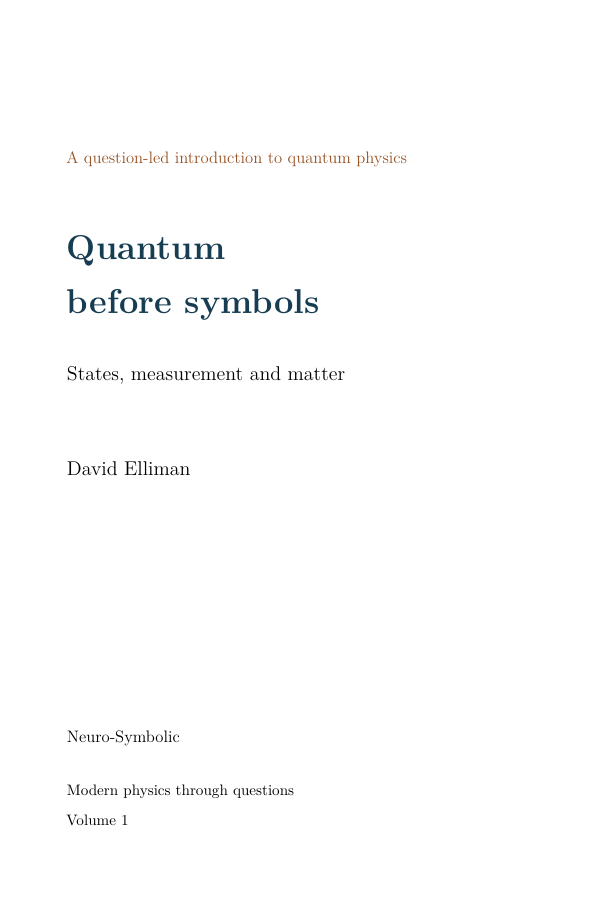
A question-led introduction to quantum physics · 27 questions · 65 pages
One two-route experiment, taken one question at a time, leads to amplitudes, states, measurement and the no-cloning rule, and then to particles, spin, entanglement and the probability rule. No calculus: arithmetic and a right-angled triangle are enough.
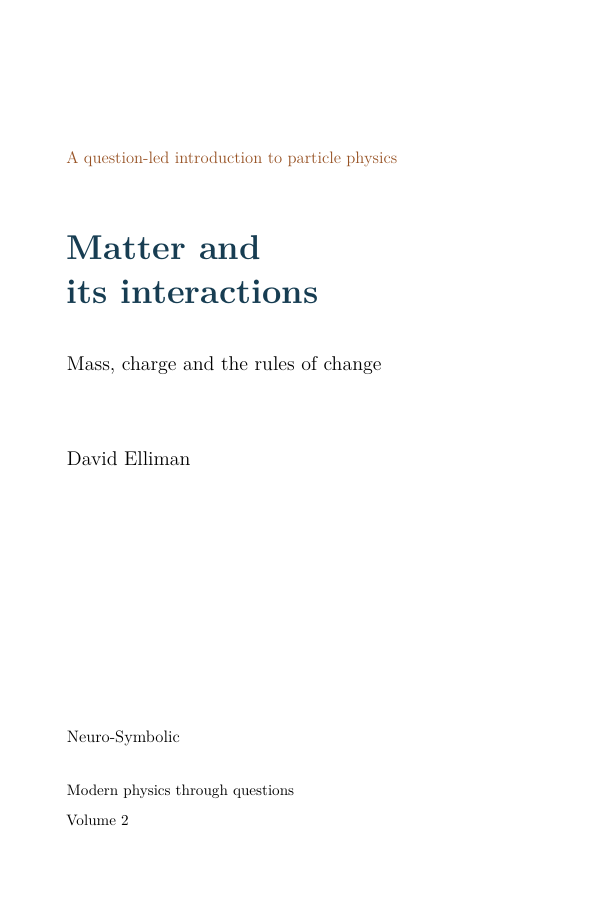
A question-led introduction to particle physics · 31 questions · 65 pages
Mass, generations, colour and charge; what the weak interaction changes; why neutrinos are so hard to catch; what makes a particle stable; and the open questions behind the Standard Model's familiar answers. Uses the ideas of Volume 1 with the arithmetic kept visible.
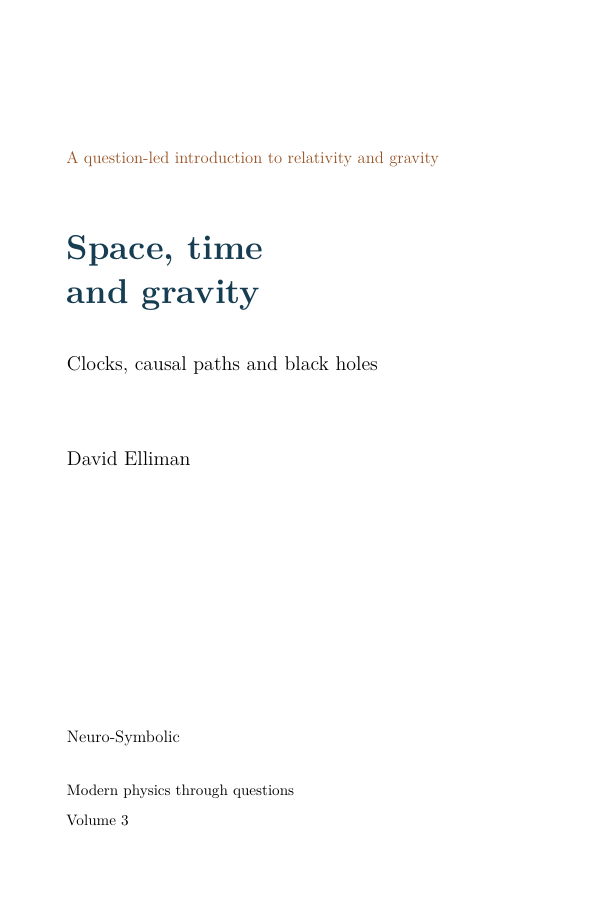
A question-led introduction to relativity and gravity · 16 questions · 37 pages
Why observers agree on the speed of light, why gravity bends light and why it is so weak; photon time, gravitons and the limits of a classical source; black holes as causal structures, evaporation, and whether acceleration can make empty space feel warm. No tensor calculus.
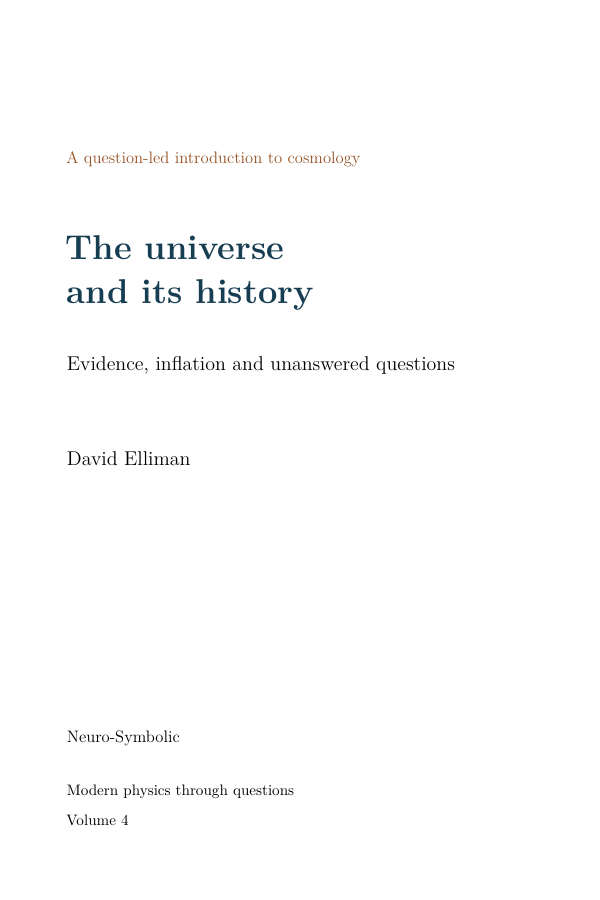
A question-led introduction to cosmology · 13 questions · 35 pages
Why the universe is expanding and what the hot Big Bang actually explains; what inflation would explain and what could convince us it happened; what the dark components mean; and why the history has a direction. Observation, inference and proposal are kept apart.
The volumes can be read in any order. Volume 1 supplies the quantum vocabulary the others use; Volume 3 supplies the relativity background for Volume 4. Each PDF has extractable text and needs no registration.
All four books in one, for your e-reader or phone
The four volumes are also combined into a single Kindle book, Modern Physics Through Questions: Quantum Physics, Particles, Relativity and Cosmology, priced at 99p, so you can read them in your e-reader, or in the Kindle app on a phone or tablet, with your own bookmarks and notes.