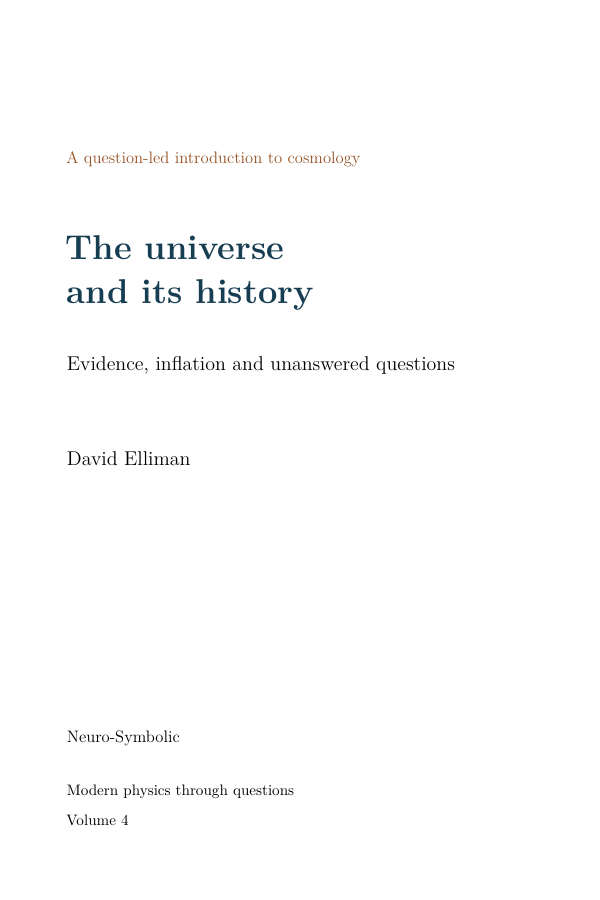
A question-led introduction to cosmology
The universe and its history
Evidence, inflation and unanswered questions
David Elliman, Neuro-Symbolic Ltd · October 2026 · 13 questions · 35 pages
Read The universe and its history — free PDF, 35 pagesAbout this book
How could anyone know what happened before the first stars? Could the region we see really have grown from something smaller than a proton? Does faster-than-light expansion break relativity, and do other universes follow? These questions deserve explanations before equations. The book begins with the records (spectra, nuclear abundances, background radiation and the distribution of matter) and then asks how far a cosmological model can take us backwards, and where an additional hypothesis enters.
The hot Big Bang history, an inflationary mechanism and a multiverse proposal do not have the same evidential status, and the book keeps them apart: what was observed, what was inferred within a model, and what remains a proposal. Numerical examples illustrate a relationship; their invented values are not measurements of the early universe. Common-sense objections are treated as useful when they help locate a missing assumption.
Each part opens with physical context, and each question asks for a prediction before the explanation. The companion volume Space, time and gravity explains clocks, light cones and Einstein's equation; the quantum and particle volumes supply the background for amplitudes, fields, nuclei and matter. Worked answers and a glossary are at the back.
The questions
13 questions in 4 parts. Each part opens with its physical setting; each question asks for a prediction before the explanation.
Reading the cosmic record
- Why is the universe expanding?
- What does the hot Big Bang actually explain?
What inflation would explain
- Why propose inflation in the first place?
- Could our universe once have been smaller than a proton?
- Can cosmic expansion outrun light?
- Did inflation create matter and energy from nothing?
- What could convince us that inflation happened?
- Does inflation mean there are other universes?
What the dark components mean
- Why infer so much matter we cannot see?
- Is dark energy the same thing as inflation?
- Why is the gravitational vacuum contribution so small?
Why the history has a direction
- Why was the early universe so orderly?
- Why does time have a direction?
At the back: Answers to the Try questions, and a closing section of words and sources.
Two sample answers
The opening of two answers, as they appear in the book. Each question is preceded by a prompt to make a prediction before reading on.
Question 1 · Reading the cosmic record
Why is the universe expanding?
Before reading on. If every large-scale separation increases by one per cent, do nearby and distant pairs gain the same extra distance?
Take two separations in an ideal homogeneous universe: 10 units and 20 units. A one per cent increase adds 0.1 unit to the first and 0.2 unit to the second. More distant pairs separate faster because the same fractional change acts on a larger distance.
Cosmology describes this behaviour with a scale factor. It tells us how distances between locations following the idealised cosmic flow change. Locations following that flow are called comoving: their map labels stay fixed while their physical separation changes. Nearby galaxies can also have motions relative to the flow, so not every measured velocity follows the simple expansion rule. Homogeneity means statistical similarity from place to place on large scales; it does not deny galaxies, voids or local structure.
The answer continues in the book.
Question 5 · What inflation would explain
Can cosmic expansion outrun light?
Before reading on. Must the rate of change of a distance between very distant comoving locations obey the same bound as a nearby object's speed measured in one laboratory?
They are different measurements. The relativistic speed limit concerns local motion and signalling: an object or message cannot overtake a neighbouring vacuum light signal in its local inertial frame. A distant separation requires a convention for comparing locations across an extended spacetime.
In the usual cosmological description, we compare distances on slices of common cosmic time. The proper distance is the distance assigned by that same-time spatial geometry, as if local ruler lengths along the route were added together. It is not the distance obtained by multiplying a photon's travel time by its speed. Between comoving locations it changes as the scale factor changes. Its rate can exceed the invariant light speed for sufficiently distant locations, without either location passing a local light ray.
The answer continues in the book.
Read the book
The complete book is a free PDF with extractable text and no registration. It is best read a question at a time, making a prediction before each explanation. All four volumes are also combined into one Kindle book for 99p, if you would rather read them in your e-reader or on your phone.