Ledgers, stacks and cells: a geometric picture of one family of quarks and leptons
David Elliman · Neuro-Symbolic Ltd · 13 November 2026
Summary and scope
The particles of one family of matter (the up and down quarks, the electron and its neutrino, each in a left-handed and a right-handed form) are normally described in the language of symmetry groups. This paper offers a picture that can be drawn instead. Each particle is a ledger: a short list of whole numbers, for colour, for being a lepton, for being of the upper or lower kind, and for handedness and spin. Ledgers add when particles are combined and must balance when they interact. Each ledger is drawn on one solid, two square pyramids joined at their bases, copies of which fill space. In the drawing, colour is the direction of the solid's axis; quarks and leptons differ in whether the two pyramids are aligned or turned through 45°; and the twist between marks on the two pyramids records handedness and kind. From a few such rules the picture reproduces known facts: electric charges in whole sixths of the electron's charge; sixteen states per family, including a right-handed neutrino; eight gluons; the observed small families of mesons and baryons; a weak force that acts on one handedness only; and the steps by which a known extension of the Standard Model, the left–right symmetric model of Pati and Salam, reduces to the Standard Model itself. If the steps of the picture are combined by the ordinary quantum rule for amplitudes, they give the Dirac equation for a free particle in the limit of small steps, together with a magnetic moment twice the classical value (g = 2). On one further assumption, three spin states that the picture already contains also reproduce Koide's relation, an unexplained empirical rule linking the masses of the electron, muon and tau, following a construction due to Brannen; the same assumption gets the individual masses wrong. None of this is new physics, and the picture predicts no masses. Its main value may be pedagogical: it gives a student a model that can be imagined, rather than a purely mathematical description. It also goes somewhat beyond that, in tentatively suggesting a few limited physical interpretations, which are set out together with their difficulties.
Keywords
How to cite
Elliman, D. (2026). Ledgers, stacks and cells: a geometric picture of one family of quarks and leptons. Neuro-Symbolic Ltd technical report. https://doi.org/10.5281/zenodo.24209786
@techreport{elliman2026ledgersstacksandcells,
  author      = {Elliman, David},
  title       = {Ledgers, stacks and cells: a geometric picture of one family of quarks and leptons},
  institution = {Neuro-Symbolic Ltd},
  year        = {2026},
  doi         = {10.5281/zenodo.24209786},
  url         = {https://neusym.ai/papers/ledgers_stacks_and_cells/}
}
Full text
The complete paper, rendered as HTML with the mathematics set at build time. The PDF above is the typeset version of record; equation, theorem and reference numbers match it.
1 Introduction
Students meet the Standard Model of particle physics as a list of labels (colour, weak isospin, hypercharge, chirality) whose meaning lies in the representation theory of the groups , and . The bookkeeping is exact, but there is little in it to picture. This paper describes a picture in which the labels of one family become entries in a ledger, and the ledgers are drawn on a single space-filling solid.
The drawing represents relationships between labels; it is not a claim that particles are small objects with a shape. It could not be physical as drawn. Colour is tied to three directions, and if those were directions in real space the strong force would pick out preferred axes, which experiment excludes to very high precision. So the diagram encodes the features listed below; it does not explain them. With the standard quantum rules supplied, it illustrates charge conservation and the coherent colour combinations of quarks and antiquarks. It does not calculate masses or binding, and its only law of motion is for one free cell. Some of its assignments, including a right-handed neutrino, are speculative rather than observed.
Where the picture succeeds it lands on structures that physicists already know (section 10.1): the lepton as a fourth colour and the left–right symmetric unification of Pati and Salam [60], whose group theory is set out accessibly by Baez and Huerta [6]. Other attempts to give the same labels a concrete or algebraic form include the rishon models [43, 68], the braided-ribbon model of Bilson-Thompson [11, 12], and the division-algebra approach of Dixon and of Furey [22, 32, 33]. The relation between a single cell’s steps and the Dirac equation is that of the lattice quantum walks of Bialynicki-Birula [10] and of D’Ariano and Perinotti [18]. The lepton mass formula discussed in the appendix is Koide’s relation [52] in the form given by Brannen [15]; section 16.4 follows Brannen’s later construction [16], in which the relation comes from three spin states that the present model contains for independent reasons.
The model may therefore have pedagogical value chiefly by offering a picture that a student can imagine (a cell with an axis, two halves and a twist between them) in place of a purely mathematical description, while remaining faithful to that description. The idea goes somewhat beyond a mnemonic, however. The labels and steps of one cell turn out to be those of the Dirac equation, which emerges from the cell’s own steps in a limit; the moves of the diagram close on the Pati–Salam algebra, and two steps the model already needs reduce it to the carriers of the Standard Model; and the picture suggests limited physical readings, for example of mass as the rate of a reversal of handedness, and of Koide’s relation among the charged-lepton masses as a consequence of three mutually unbiased spin states (section 16.4). These readings are offered tentatively, with their difficulties, and none amounts to a new prediction.
Organisation. Part I (sections 2–14) is the teaching picture: the ledger, the shape, the map between them, the particles, two worked examples, what the model encodes and what it does not, and a quantum representation. Part II (sections 15–19) collects proposals and wider suggestions, which contain no results. Section 20 concludes, and the appendix records some numerical coincidences.
Conventions. Natural units, , are used throughout. Electric charge is counted in sixths of the elementary charge , and spin in half-units of . Lengths in the diagram are in units of the edge of the cell’s square. Each claim carries one of the following labels.
| [stated] | a rule or assignment put in by hand |
| [checked] | computed by a short script in the supplementary code (section 21) |
| [argued] | reasoned in the text, not computed |
| [number] | arithmetic on measured masses |
| [lead] | a match noticed after the fact, with no mechanism; no evidential weight |
Part I: the teaching picture
2 Overview of the picture
A particle is a ledger: a few slots, each holding a whole-number balance that can be a credit or a debt. Ledgers at one place form a stack, where balances add. A few rules say which stacks can exist alone.
The ledgers are drawn on one shape, the oblate square bipyramid, called a cell: two square pyramids (halves) joined at their square. Six halves meet at every apex point. A particle is a whole cell, and its properties are relationships between its parts:
| Property | Where it sits in the diagram |
|---|---|
| Colour | the cell’s axis (one of three), when the two halves are aligned |
| Quark or lepton | halves aligned (colour on) or misaligned by half a quarter-turn (colour off) |
| Handedness | the sense of the twist between marks on the two halves |
| Up-type or down-type | the size of that twist |
| Direction | which way the engaged half points: a velocity, not the momentum |
| Spin | direction times handedness |
| Particle or antiparticle | the sense of the vertex ordering |
| Chirality, which the W reads | twist times ordering |
What comes out. The correct charges, in whole sixths. Sixteen states per family, including a neutrino that responds to no light carrier. Eight gluons from six. Mesons, baryons and helium-4 in their observed families. A W that acts on one handedness only, totally. Mirrors of the diagram that turn particles into antiparticles, as the combined operation CP does. A proton that is three quarks exchanging colour through three bridging places. A single cell whose labels and steps are those of the Dirac equation, with mass as the strength of the turn-back. That equation as the limit of the model’s own steps, and with it a magnetic moment of twice the simple value. And an algebra of moves in which the Standard Model’s carriers are exactly what survives two steps the model already needs (section 14).
What does not come out. Any mass or strength. Three generations. Why the second, right-handed carrier is so heavy. Spin one-half proper. Confinement as a computed fact. Gravity. Any time evolution beyond one free cell. Section 11 lists these in full.
3 The ledger
3.1 Slots
| Slot | Values | Meaning |
|---|---|---|
| Colour (three slots) | whole numbers | red, green, blue; an anti-unit is |
| Lepton | or | for leptons (colour off), for antileptons |
| Kind | or | upper kind (up quark, neutrino) or lower kind (down quark, electron), for both handednesses |
| Twist label | L or R | the sense of the twist; called handedness in this paper. Chirality is twist times ordering (section 5.3) |
| Spin | for matter; , for carriers | in half-units, along the cell’s own axis. Adds only for cells on one axis (section 9) |
| Ordering | or | particle or antiparticle |
Charge is counted in sixths of the electron’s charge unit, so every charge is a whole number.
3.2 Charge is derived
Let be the sum of the three colour slots, the kind and the lepton slot. The charge, counted in sixths of the elementary charge , is
| Particle | ||||
|---|---|---|---|---|
| up quark | 1 | 0 | ||
| down quark | 1 | 0 | ||
| neutrino | 0 | 1 | ||
| electron | 0 | 1 |
Why a quark sits four sixths above its lepton partner. Suppose that a unit in each of the four slots red, green, blue and lepton contributes , , and sixths to the charge, so that the three colours are treated alike and a full set of four is neutral. The neutrino has , and no charge, so and : a colour unit adds one sixth and a lepton unit subtracts three. Replacing a quark’s colour unit by a lepton unit therefore lowers the charge by sixths, which is why the coefficients in (1) are and . [argued] Inputs: the set of four is neutral; the neutrino is neutral.
is not weak isospin. In the Standard Model weak isospin, , belongs only to the handedness the W acts on; the other handedness has . Here has the same value for both handednesses. It is twice the sum of the left and right isospins of the left–right symmetric models, , in which a left-handed particle has and a right-handed one . Writing also , where is baryon number ( for each quark), and dividing (1) by six gives
Colour. Equal entries in the three colour slots, such as , count as no colour. An anticolour, such as anti-red , differs from the other two colours together, , only by , and so is equivalent to them.
3.3 Carriers are transfers
A carrier’s content is the difference between a ledger before and after a move. Charges are in sixths and spins in half-units.
| Carrier | Charge | Colour | Spin | What it moves |
|---|---|---|---|---|
| gluon | 0 | in one slot, in another | 2 | one colour unit between slots |
| W | none | 2 | kind, with one quarter-turn of twist | |
| photon | 0 | none | 2 | nothing; registers charge |
| Z | 0 | none | 2 | nothing; has mass |
| Higgs | 0 | none | 0 | handedness (section 15) |
3.4 Stack rules
Balances add.
Exclusion. No two identical ledgers in one place.
Free condition. A stack can exist alone only if its three colour totals are equal. This is necessary, not sufficient.
Stable pattern. The physical object is a coherent superposition of fillings with definite signs. A meson is , where , , denote a quark of each colour and , , the corresponding antiquarks. A baryon is , the sum over the six assignments of the three colours to three quarks, with sign for an even ordering of and for an odd one; in ledger language the exchange sign supplies those signs (section 9).
Spin of a stack. An odd spin total makes a fermion; an even total makes a boson. Only odd or even is used: the labels of cells on different axes do not add to a spin projection.
Conservation. Totals in equal totals out, for every slot. Every basic event is one ledger emitting or absorbing one transfer.
All [stated]. Rule 3 gives charge quantisation: any stack satisfying it has a charge that is a multiple of 6, that is, a whole number of electron charges. If each colour total is then and , with and now the stack’s totals; every quark, antiquark, lepton or antilepton adds to , the number of quarks and antiquarks has the parity of and hence of , and the number of leptons and antileptons has the parity of , so is even. [argued]
4 The shape and its relationships
The cell is an oblate square bipyramid: two square pyramids, each of height , joined at a common square base of edge 1, so that the distance between the two apexes equals the edge. Copies of it fill space, with apexes at the points of a cubic lattice, here called meeting points. Only the shape and the way copies of it meet are used; nothing depends on the cells being physical solids.
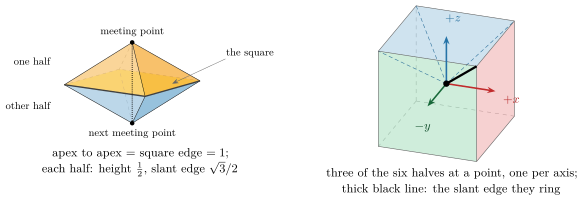
| Fact | Basis |
|---|---|
| Cells come in three orientations: axis along , or | checked |
| Six halves meet at each apex point, one each way along each axis | checked |
| Among those six there are 12 triangular contacts; each joins halves on different axes | checked |
| Two halves on the same axis touch only at the point | checked |
| Each half has one square; it joins the half to its partner on the same axis at the next point | checked |
| Three cells ring each slant edge, one per orientation, and the ring closes flat | checked |
| A cell has four pairs of parallel opposite faces; one half alone has none | checked |
Triangles and squares do different jobs. A triangle joins two halves on different axes at the same point. A square joins two halves on the same axis at neighbouring points. So triangles are relationships within a stack, and the square is blind to colour and is the route by which a cell reaches the next point.
Eight relative positions. Two halves can sit in eight relative positions about their shared axis, in steps of half a quarter-turn.
| Aligned | Misaligned | |
| , , , | , , , | |
| Pairs of parallel opposite faces | 4 | 0 |
| Positions that are their own mirror image | 2 | 0 |
| Mirror pairs | 1 | 2 |
[checked] The same eight positions describe the offset between a mark on one half and a mark on the other.
5 The whole-cell map
| Ledger feature | In the diagram | Basis |
|---|---|---|
| Colour | the cell’s axis | stated |
| Quark | halves aligned: four pairs of opposite faces, colour on | stated |
| Lepton | halves misaligned: no opposite faces, colour off | stated |
| Handedness | the sense of the offset between the marks on the two halves | stated |
| Chirality | twist times ordering | checked |
| Kind () | the size of that offset: upper, lower | stated |
| Direction | which way the engaged half points along the axis; the velocity component along it | checked |
| Spin | direction times handedness | checked |
| Antiparticle | reversed vertex ordering; the removal of a ledger | stated; checked |
| Two-colour gluon (six) | a transfer through a triangular contact | stated |
| Neutral gluon (two) | arise from the six by combination (section 14) | checked |
| W | a quarter-turn of the offset that changes kind; the carrier takes the turn | stated |
| Mass step (turn-back) | a quarter-turn that reverses handedness and direction and keeps kind and spin; the standard mass operator | checked |
| Photon | couples to charge times velocity. Across a cell’s axis that reverses direction and spin label and keeps the twist | checked for the labels; the coupling is supplied |
| Three-quark stack | a ring of three at a point, with three bridging places | checked |
| Meson | a quark and antiquark on one axis | checked |
5.1 The twist
Each half carries a mark. For a quark the two halves stay aligned and the marks are of different types (one at a corner, one at a face). For a lepton the halves are misaligned. Either way the offset between the two marks takes the four misaligned values, and those four are the four states of a particle.
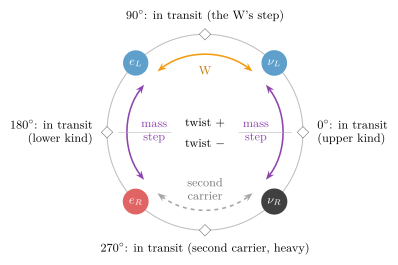
| Finding | Basis |
|---|---|
| Every turn of the diagram keeps the twist; every mirror reverses it. It reads the same from either end, like a screw thread | checked |
| Of the three ways to split the four positions into two kinds, only “by size” is left alone by every mirror | checked |
| Going round, quarter-turns alternately change kind and reverse handedness; each changes exactly one of the two labels | checked |
| The same change of kind is an anticlockwise turn for one handedness and a clockwise turn for the other | checked |
| The four unused aligned offsets are exactly the half-way points of the four steps | checked |
5.2 Spin
A natural first guess puts spin on the direction in which a half points. But a direction behaves as an arrow under mirrors, whereas spin, being an angular momentum, should behave as a sense of rotation, which a mirror reverses differently.
| Candidate for spin along the cell’s axis | Behaves correctly under |
|---|---|
| Pointing direction alone | 8 of 16 symmetries; wrong under every mirror |
| Twist handedness alone | 8 of 16 |
| Direction times handedness | 16 of 16 |
[checked] In the Dirac equation this is an identity: the velocity component along an axis is chirality times the spin component along it (section 5.3). A cell that turns back while keeping its spin label must reverse its twist label.
This is a spin label, not spin one-half. What has been checked is that one two-valued label, read along the cell’s own axis, changes correctly under the 16 symmetries of a cell. Spin one-half proper is more: a quantity with three components that responds to every rotation, by any angle, and returns to itself only after two full turns. The model has no continuous rotations. With each label read along its own cell’s axis (red along , green along , blue along ), and one fixed frame supplied for each axis, all 48 symmetries of the diagram act on the labels as relabellings with definite phases. They compose correctly, up to the overall sign that marks spin one-half, and the 24 mirrors include the swap of particle and antiparticle. [checked] The phases matter: a check of single labels alone could not detect a wrong relative sign, and a map that reads every label against one diagonal fails even that weaker test. But only those 48 rotations exist in the diagram, and saying how “up along ” is made of “up and down along ” needs the algebra of spin one-half, which is supplied. So the model is consistent with spin one-half under its own symmetries and carries its bookkeeping; it does not produce spin itself.
Direction is not an independent label. Each choice of colour, kind and spin arises from exactly two combinations of direction and handedness, which differ by reversing both. So direction equals spin times handedness, and a quark is colour kind spin handedness. A quark at rest at a meeting point is taken to be the even combination of the two under the turn-back step: definite spin, equal parts of both handednesses, and present in both halves on its axis. With the Dirac equation supplied this follows rather than being stated: at rest the energy is the mass times the turn-back, and the even combination is the particle (section 5.3). The rule gives twelve resting quark ledgers: three colours, two kinds and two spin labels.
5.3 One cell and the Dirac equation
Physics has two properties that are both called handedness. Helicity is the spin measured along the direction of motion. Chirality says which of the two two-component parts of a relativistic spin- field is meant, and it is what the W selects. The two agree only for a particle with no mass, so a single twist label cannot stand for both.
The following dictionary resolves this. It maps the labels and steps of one cell onto the Dirac equation [20], which is supplied. In Hamiltonian form, for a free particle of momentum and mass ,
| In the model | In the Dirac equation |
|---|---|
| Spin label along the cell’s axis | the spin component along that axis |
| Twist times ordering | chirality |
| Direction | the velocity component along the axis. Its only values are plus and minus the speed of light |
| Momentum | separate, and able to take any value |
| The turn-back step: reverses direction and twist, keeps spin | the mass operator, which is also the spinor part of the ordinary mirror, parity |
| A reversal of direction and spin label that keeps the twist | a velocity component across the axis. It is one part of what the photon couples to |
| Travel along the axis | direction times momentum |
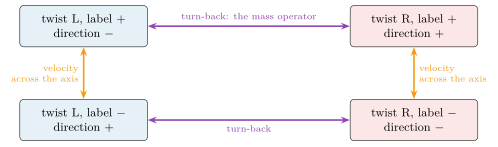
What follows. Each item is [checked] unless marked otherwise.
Two labels, two jobs. Chirality is twist times ordering. “The W acts on particles of twist L and antiparticles of twist R” is one statement: the W acts where that product has one sign. It is the one combination that every symmetry of the diagram leaves alone. Helicity is the spin label times the sign of the momentum, and agrees with the twist only when there is no mass.
“Spin is direction times twist” is exact, with or without mass. It is the identity velocity chirality spin. The apparent difficulty comes from reading direction as the direction of the momentum, which it is not. For a particle of momentum along the axis and energy the mean velocity is , so the weight on direction is : one half at rest, and one in the massless limit.
The resting rule follows. At rest the energy is the mass times the turn-back, and the even combination has energy . It has equal parts of both twist labels. In motion the weight on twist L is , where is the spin label.
The map does not have a label too many. The lowest state has the odd combination filled. Filling the even combination adds a particle. Emptying the odd one adds an antiparticle, with every slot of the removed ledger reversed. So the four antiparticle ledgers of a cell are the removals of its four particle ledgers, and four ledgers give two particle and two antiparticle states at rest, with none left over.
The pion’s parity comes out. A particle has mirror value and an antiparticle , so a quark and an antiquark at rest have . With no orbital motion between them, that is the measured parity of the pion and the rho. Three quarks at rest have , as the nucleon has. [argued] The existence and binding of these states are not obtained.
The model has a parity operation. No symmetry of the drawing is parity. But the turn-back applied to every cell acts on the labels exactly as parity does. It exchanges the two chiralities, so the W’s rule is not unchanged by it, which is as it should be.
A law of motion on one axis. For motion along the axis, (3) reads : energy is direction times momentum plus mass times turn-back. Because and , the cross terms cancel in , giving . The spin label along the axis is conserved for motion along that axis, and not for motion across it.
The pion’s decay. A spin-0 parent forces the charged lepton’s spin to lie along its motion. The W reads twist L, and the weight on twist L in that state is . For a lepton of mass from a pion at rest, and , so the weight is , which vanishes for a massless lepton. With the phase space of a two-body decay supplied, this gives the standard lowest-order ratio of electron to muon decays,
The measured ratio is [3, 71], and the full standard prediction, with corrections beyond lowest order, is [17]. The complete prohibition for a massless lepton (section 10) is the limit of the same factor.
What this does not do.
In this section the equation is put in. The dictionary shows that the model’s labels and steps are those of the Dirac equation. Section 5.4 obtains the equation as a limit of the model’s steps.
The cell’s axis fixes the frame in which its spin label is read. It does not fix where the cell can go. The full equation uses all three velocity components for every colour. Along the cell’s own axis the velocity changes no label; across it the velocity reverses the spin label. Travel off the axis therefore needs no change of axis, nor, for a quark, a change of colour: in each colour’s own labels all three velocity components act inside that colour and commute with the colour operators. [checked]
“A particle at rest keeps reversing” remains a picture, the zigzag picture of this equation [61], which goes back to Schrödinger’s trembling motion [65]. A particle at rest is stationary: it has equal weight on both directions and both twist labels, and those weights do not change in time.
A filled lowest state is the old picture of the vacuum as a sea [21]. Modern treatments do not need it literally. It is used here because it matches the ledger’s language of credits and debts.
Elsewhere in this paper “handedness” means the twist label.
5.4 The equation as a limit of the model’s own steps
The dictionary of section 5.3 was checked against an equation that was supplied. The equation can instead be obtained from the diagram’s own moves, once one rule of quantum theory is supplied: that steps compose as amplitudes. [checked] No state is evolved in time; the checks are made on the unitary operator for one step, at fixed momentum. Units are chosen so that one lattice step and one tick of time are both 1, and so the maximum speed is 1.
| Step | What it does, in the cell’s own labels |
|---|---|
| Travel | moves the cell one place along its own axis, in the direction twist times spin label. No label changes |
| Turn-back | reverses direction and twist and keeps the spin label. Taken with a small amplitude at each tick |
| Step across the axis | the same step along another axis, in the direction twist times the spin component along that axis. In the cell’s own labels it mixes the two spin labels. No change of axis or colour is needed |
One axis. Compose the travel step with a turn-back of small angle , so that one tick is , where moves each direction one place along the axis and is the turn-back. For a state of momentum (a phase from one place to the next) the eigenvalues of are , where , the phase gained per tick, plays the part of the energy. Exactly, at any and ,
So the law of motion of section 5.3 is the limit of two of the model’s steps. The mass is the turn-back angle per tick, and the speed limit is one step per tick. This is Feynman’s checkerboard [28], in which each reversal contributes a small imaginary amplitude. It has since been treated as a quantum walk [13, 48, 55, 69].
Three axes. Let a cell take one step along each axis in turn, then then , each in the direction twist times its spin component along that axis. With momentum and twist , and no turn-back, the phase per cycle satisfies exactly
For each twist this is the quantum walk found by Bialynicki-Birula [10], who reaches the body-centred lattice by the same product of three steps. D’Ariano and Perinotti [18] later showed that, of the three simplest lattices, only this one admits such a walk for a field of two components, and they give the same relation between energy and momentum. Their version with mass pairs the walk of one twist with the same steps undone in reverse order; that differs from the pairing used here at a finite step and agrees with it in the limit. The coincidence is not imposed. Two rules the model adopts for other reasons are exactly the rules of that walk: each spin label is read along its own cell’s axis (adopted so that the diagram’s symmetries act correctly), and direction is twist times spin label (adopted so that spin behaves correctly under mirrors).
A number that was not put in. Let charge enter as a phase on each step, proportional to the charge and to the electromagnetic vector potential along the step. That is the standard coupling of charge to velocity, and it is supplied. In a uniform magnetic field of strength the lowest levels of the walk, computed numerically, fit
With the magnetic-moment operator used for the proton and neutron in section 9 need not be supplied separately. The ratio then needs only equal masses for the two kinds, and quarks at rest.
What is supplied.
That steps compose as amplitudes. This is the quantum rule, and nothing in the diagram gives it.
The turn-back angle. It is the mass, and it is a free number.
A fixed order in which a cell takes the three axes, and a step across a cell’s own axis. A colour is not confined to travel along its own axis; such a restriction would spoil both isotropy and colour symmetry.
Charge as a phase on a step.
What this is, and what it is not.
It is a known construction. The one-axis walk is from 1965 and the three-axis walk from 1994. The model reproduces them; it does not discover them. Its claim is that its own rules, reached by another route, coincide with them.
The equation appears only in the limit of small steps. At a finite step the walk picks out the axes. Expanding (6) to the next order gives . Along a body diagonal, , this is , so the two twists travel at speeds , in units of the step. If the steps were physical that would be an observable difference. This paper does not claim that they are.
The order of the axes is a handedness. Taking them in the opposite order reverses that correction, and so does a quarter-turn of the diagram.
It is one free cell. No interaction is obtained. For a quark the walk acts inside one colour and commutes with all eight colour operators, so colour symmetry is kept exactly. [checked]
6 The particles
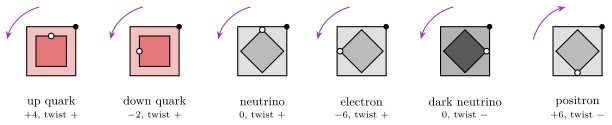
Up quark. A whole cell with its halves aligned, so it has opposite faces and carries the colour of its axis. Its marks are offset by . Charge sixths. It is never found alone, because one cell cannot have equal colour totals.
Down quark. The same, with the marks offset by . Charge . A quarter-turn of the offset turns one into the other, and the W carries away the charge and the turn.
Neutrino. A whole cell with its halves misaligned by half a quarter-turn. It has no opposite faces, so nothing of colour can run through it. Offset . Charge . With twist it responds only to the W.
Electron. The same, with offset . Charge . Misaligning a quark’s halves lowers its charge by 4 sixths, so the down quark’s partner is the electron and the up quark’s is the neutrino.
Dark neutrino. The neutrino with twist . It has no charge, no colour, and the wrong twist for the W. Of the sixteen states it is the only one that responds to no light carrier; it does respond to the heavy second carrier. The model requires it, because the four offsets come as two kinds times two handednesses. [checked] It is the particle physicists call the right-handed or sterile neutrino.
Antimatter. An antiparticle is the same cell with its vertex ordering reversed. Every slot changes sign. Every mirror of the diagram reverses the ordering and the twist together, so the mirror image of a left-handed particle is a right-handed antiparticle, never a right-handed particle. [checked] That is the operation physicists call CP, not the ordinary mirror (parity), which would leave an electron an electron. No symmetry of the drawing is parity. The turn-back step applied to every cell does act on the labels as parity does, and it is not a symmetry of the model, because the W’s rule changes under it (section 5.3). In real space a mirror does not turn matter into antimatter, which is one more reason the diagram is not space. In ledger terms an antiparticle is the removal of a ledger, a debit where the particle is a credit. A particle and its antiparticle have totals that cancel in every slot, which is why they can appear and vanish as a pair.
Gluon. A unit of one colour and an anti-unit of another, passing through a triangular contact, which always joins two different axes. Six of these exist. The two neutral gluons are not extra assumptions: they arise when the six are combined (section 14).
W. The carrier of a kind-changing quarter-turn. It has charge and carries one quarter-turn of twist. Because the same change of kind is a clockwise turn for one handedness and an anticlockwise turn for the other, the carrier that serves one handedness cannot serve the other at all. The other handedness has its own carrier, which must be far heavier, since it is not seen.
Photon. Zero in every slot except 2 half-units of spin. A cell that reverses its direction and keeps its twist changes its spin by 2 half-units; the carrier balancing that has exactly the photon’s ledger. In the dictionary of section 5.3 that move is a velocity component across the cell’s axis, and charge times velocity is what the photon couples to in standard theory. [checked] It is one part of that coupling and not a definition of the photon: the velocity component along the cell’s axis changes no label, so not every meeting with a photon reverses a spin label. The move does not know about charge, and the photon acts only on charge. The weighting by charge is supplied; section 14 gives a reason why charge is singled out.
Z and Higgs. The Z is the neutral partner of the W. The Higgs is the carrier that would balance a handedness-reversing quarter-turn: no charge, one quarter-turn. That quarter-turn is the turn-back, the mass operator, which is what the Higgs acts through in standard theory. Neither is developed.
6.1 Stacks
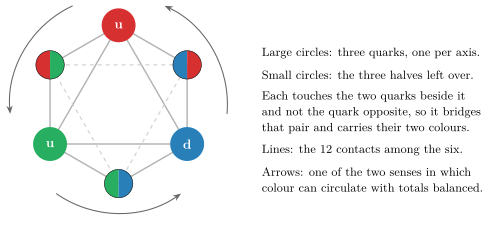
Proton. Three quarks (up, up, down) in a ring of three at one point, one on each axis, in the colourless combination of rule 4. The other three places at the point are the same axes with direction reversed. Each bridges exactly one pair of quarks, and its axis names the colour its gluon leaves out. [checked]
The clump is not static. Three quarks go on six places in 20 ways: 8 rings and 12 lopsided placements in which a quark has passed through a contact and a gluon carries the difference. The 8 rings and the 12 one-gluon clumps form one family joined by single moves, and every move keeps the totals balanced. An exchange between two quarks changes which way one or two of them point. [checked] That count places one quark in each half. Section 9 shows this cannot be an exact rule. A fair picture is three coloured ropes rotating their colours so fast that the whole looks white, with the caveat that the quantum state is all colourings at once with fixed signs, not one colouring changing quickly.
Neutron. Up, down, down. It has the same totals as a proton, an electron and an antineutrino together, and that set is lighter by MeV. So it can decay, by one down quark changing kind; only the W does that, so it is slow.
Meson. A quark and an antiquark on the same axis. Sixteen colourless states exist: four of spin 0 (the pions and an eta-like state) and twelve of spin 1 (the rhos and an omega-like state). [checked]
The twenty three-quark states. Spin at charges (the four particles) and spin at and only (the proton and neutron). [checked] Section 9 works the example through.
Helium-4. Twelve resting quark ledgers (three colours, two kinds, two spins) fill one point. That filling is a single state: colourless, spin 0, charge . No thirteenth resting quark fits. Six quarks at a point have 50 colourless states, one set of them with the deuteron’s spin and isospin, and nine have 20. The six-quark list is the classification of Dyson and Xuong [26]. [checked] These are counts of capacity with the right totals. They say nothing about how nuclei are built or bound: a real deuteron is two nucleons well apart, not six quarks at a point. The capacity of twelve depends on the resting rule; without it a point holds twenty-four.
Caution on weight. Any model with three colours, two kinds, two spins and an exclusion rule gives these families. The counts show the diagram carries the standard structure correctly. They are not evidence for the diagram.
7 Decays and stability
A stack survives if nothing lighter has the same totals. “Lighter” is taken from measurement; the model supplies only the list of which stacks share totals.
| Grade | What blocks decay | Examples | Lifetime |
|---|---|---|---|
| Conditional | nothing lighter has the same totals | proton, electron | effectively forever |
| Slow | a lighter option exists but needs the W | free neutron (and the muon, which is outside the model) | 15 minutes; 2 microseconds |
| Fast | colour reshuffling reaches a lighter option | , rho | about s |
The proton is the lightest stack with colour sum 3. Its stability here is conditional (hence the name of the grade) on that total being conserved and on the measured ordering of masses. A neutron inside a stable nucleus does not decay because the test applies to the whole stack.
Fermions and bosons. Spin totals add, so two odd totals make an even one and even totals only make even ones: fermions can combine into a boson, and bosons can never combine into a fermion. A carrier is the difference between two states of one ledger, so its spin total is always even. A boson can turn into fermions only in pairs. [argued]
8 A worked example: the meson
This section follows one stack, a quark and an antiquark, from ledgers to states. Each step is checked in the supplementary code.
Step 1: the ledgers. A resting quark has a colour (3), a kind (2) and a spin label (2): twelve ledgers. So does an antiquark. There are pair configurations.
Step 2: balanced totals are not enough. The free condition asks for equal colour totals. An antiquark with the anticolour of the quark passes; of the 144 configurations do (three colours, times four kind-and-spin choices for each of the two). But for each choice of spin and kind there are three such fillings, and only one combination of the three is colourless.
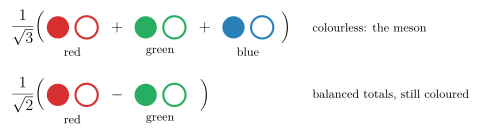
Step 3: spin and kind. Two spin labels combine into one state of spin 0 and three of spin 1. Two kinds combine into two charged and two neutral combinations. With the one colourless combination that gives states. These are states, counting the three orientations of spin 1; they are four spin-0 mesons (the three pions and an eta-like state) and four spin-1 mesons (the three rhos and an omega-like state). With the dictionary of section 5.3 the quark is an even turn-back combination filled and the antiquark an odd one emptied, so all sixteen have mirror value , the measured parity of these mesons. [checked]
Step 4: the dictionary. A spin label is read along its own cell’s axis: red along , green along , blue along . To turn labels into states one frame per axis must be supplied, from the standard algebra of spin one-half. With the frames fixed, every symmetry of the diagram acts on the labels consistently, and a gluon move that leaves the spin alone carries a quark to both halves of the new axis with equal chance.
Step 5: levels. Write the interaction as a sum of the model’s operators with strengths left as symbols: for the gluon operators that change colour, for the neutral ones, and and for the two parts of the spin–spin coupling, along the colour’s own axis and across it. The energies in the table are the eigenvalues of that operator on the colour part and on the spin part of the state.
| Combination | Energy | Number |
|---|---|---|
| Colourless | 1 | |
| Coloured, zero totals | 2 | |
| Coloured, non-zero totals | 6 | |
| Spin 0 | 1 | |
| Spin 1 | , , | 3 |
The colourless combination is lowest exactly when and : it lies below the second row when , and below the third when . The eight coloured ones are alike only if . [checked]
The spin rows are for one colour’s filling taken alone, with the label strength along that colour’s axis. With they are and (three times), the familiar eigenvalues of for two spins of one-half. One might expect the three spin-1 states to be alike only if . For the colourless combination that is not so: the turns of the diagram keep the three together whatever the strengths. What unequal strengths do is make the spin-1 meson slightly coloured. So is still required, for exact colourlessness (section 9, step 6). [checked]
What the example leaves unspecified. Every strength, so every mass; why the pion is much lighter than the rho; how the quarks move; and any decay rate. The picture supplies the states and the form of the operators, and no more.
9 A second worked example: three quarks
The same exercise for three quarks, again with every step checked in the supplementary code.
Step 1: the ledgers. There are twelve resting quark ledgers. Fill three of them, no two alike: configurations. The free condition asks for one quark of each colour, and pass (four kind-and-spin choices for each colour).
Step 2: the exchange sign decides what exists. The colourless combination of three colours changes sign when two colours are swapped. The exchange sign (section 14) says the whole state changes sign when two identical quarks are swapped. So kind and spin together must be left unchanged by a swap.
| With the exchange sign | Without it | |
|---|---|---|
| Three-quark states on twelve ledgers | 220 | 364 |
| Colourless | 20 | 4 |
(Without the sign, repeated ledgers are allowed and there are configurations.) The twenty are sixteen states of spin (the four particles, four orientations each) and four of spin (the proton and the neutron). Without the sign there would be a nucleon-like set and no at all. [checked] The of charge is three up quarks with their spins alike; it is the particle that first showed a third label was needed [39, 42]. In the diagram, three identical quarks can share a point because the point has three axes, and a fourth cannot.
Step 3: the signs come free. Rule 4 gives the baryon as a sum over six colour assignments with alternating signs. In ledger language a configuration is a set of filled ledgers, and the exchange sign has already supplied those signs: one filling with the same kind and spin on all three colours is colourless as it stands. What has to be combined is which colour holds which content, with every sign plus. A proton with spin up is nine such fillings: three with contents up, up, down, each of weight , and six with up, up, down, each of weight ; the squared weights sum to . [checked]
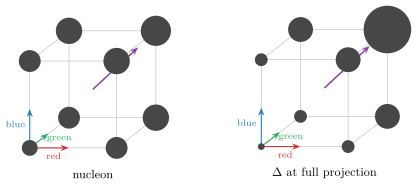
Step 4: the dictionary. Here the whole-cell map matters. Each spin label is read along its own cell’s axis, and the three quarks lie on three different axes. A filling is therefore three spins along , and , and its three labels name a corner of a cube.
| Finding | Basis |
|---|---|
| A filling’s mean spin points at a corner of the cube and has length . Every filling is half spin and half spin | checked |
| The sum of the three labels is not a spin projection | checked |
| No single filling is colourless. Its colourless weight is if the three kinds are alike and otherwise | checked |
| A nucleon with spin along the unit vector has weight on the corner : each colour’s label carries a third of the spin | checked |
| The product of the three labels says whether the three spins make a right-handed or a left-handed frame. It is the sign of the 45-degree phase of one branch round a ring of three (section 12); a nucleon sits equally on both signs | checked |
| The 24 turns of the diagram act on the twenty states as physical rotations, and the 24 mirrors give the antiparticles. The turns tell spin from spin and cannot tell higher spins apart, a limit that calculations on a cubic grid also meet [7, 49] | checked |
Adding the three spin labels as if they were projections on one axis also gives twenty states, because a count does not depend on how the states are listed; but the method is not valid. The ledger’s spin slot adds only for cells on one axis.
Step 5: levels. With the meson’s symbols, and one spin strength on each pair:
| Combination | Energy | Number |
|---|---|---|
| Colourless | 1 | |
| Coloured, families of eight | ; | 4; 12 |
| Coloured, family of ten | ; ; | 1; 6; 3 |
| Spin | 4 | |
| Spin | 4 |
The colourless combination is lowest exactly when and , a stricter condition than the meson’s (the binding conditions for the other rows then follow). Each of the three pairs is bound exactly half as strongly as the pair in a meson, whatever the two strengths: with , for example, the colourless level is , or per pair, against for a meson. The spin levels are the eigenvalues of , which is for total spin and for total spin . [checked]
Step 6: colour-blind and direction-blind are one requirement. A colour is an axis. So a spin coupling that knows which axis a cell lies on is not blind to colour, and a coupling blind to colour cannot prefer a direction. The most general pair coupling the diagram’s turns allow has two strengths, one along the pair’s own two axes and one along the third. If they differ, the four orientations of spin still stay together, because the turns hold them; what is lost is colourlessness. The same is true of the three orientations of a spin-1 meson. [checked] So the model needs one spin strength for every direction, and the reason is colour.
Step 7: three numbers. The first uses the magnetic moment that section 5.4 obtains. The other two use the model’s states with an operator from standard theory.
| Quantity | Operator supplied | From the states | Measured |
|---|---|---|---|
| Proton’s magnetic moment over the neutron’s | none beyond (section 5.4); equal quark masses | ||
| The W on a neutron: spin-dependent part over spin-blind part | kind change with and without spin, quarks at rest | ||
| ( minus nucleon) over (rho minus pion) | spin coupling weighted by the colour strength of the pair |
The third follows from step 5: the –nucleon gap is , the rho–pion gap is , and a pair in a baryon is bound half as strongly as in a meson, , so the ratio is . The first is a known success of the picture of quarks at rest [8], and the other two are known shortfalls of it; the third is the estimate of De Rújula, Georgi and Glashow [19]. Measured values are from the Particle Data Group [71]. Any model with three colours, two kinds, two spins and the exchange sign gives all three, and the counts of steps 1 to 3 as well. What belongs to the diagram is steps 4 and 6 and the list that follows.
What the example exposes.
A blind move does nothing. A colour move that cannot tell the three quarks apart, summed over them, gives exactly zero on every colourless state. The clump’s lopsided configurations are reached only by a move that knows where a quark is, and the model has none.
One quark per half is not exact. Every colourless three-quark state has one quark in each of three halves. But a colour move that leaves spin alone lands a quark on an occupied half with probability . The ledger rule (no two identical ledgers) is the consistent one. The diagram has no picture of two quarks in one half.
The odd combinations. Counting without the resting rule gives 120 colourless three-quark states: 20, 40, 40 and 20 with none, one, two and three quarks in the odd turn-back combination. The extra hundred are not further three-quark states: the odd combination is filled in the lowest state and emptying it is an antiquark (section 5.3), so only the twenty are three-quark states.
[checked]
10 What the model encodes
“Encodes” means the feature follows from the rules and assignments above. It does not mean the model explains why nature is that way: most rows restate a known arrangement in the diagram’s terms. The last column says how much is put in by hand.
| Oddity of the Standard Model | How it is encoded here | Standing |
|---|---|---|
| Charges come in thirds, and the proton’s charge cancels the electron’s exactly | one formula for charge; free stacks have charge in multiples of 6 | argued, from two inputs |
| Quarks are never seen alone | the free condition; the colour transfer makes the colourless combination lowest when the strengths satisfy and | rule stated; lowest state checked under that condition |
| There are eight gluons, not six or nine | the six transfers combine to give exactly two neutral ones | checked |
| Leptons do not feel the strong force | their halves are misaligned, so they have no opposite faces | assignment; geometry checked |
| The W acts on one handedness only, and totally | the carrier takes the twist, so each handedness needs its own carrier | checked, given that the twist is conserved |
| The ordinary mirror (parity) is not a symmetry, but the mirror combined with the antiparticle swap (CP) nearly is | the turn-back applied to every cell acts as parity, and the W’s rule changes under it; each mirror of the drawing reverses twist and ordering together and so acts as CP | checked; the identification of ordering with antiparticle is stated |
| Quarks and leptons feel the same weak force | within a handedness both use the same carrier | checked |
| The weak force is weak | its carrier is costly; the effect goes as strength squared over cost | form checked; cost not derived |
| The carriers that remain are eight, three and one | they are exactly what survives two steps the model needs (section 14) | checked |
| Charge is singled out among the neutral totals | charge is the one total that both of those steps conserve | checked. Reading this as the photon staying massless uses the standard theory of carriers, which is supplied |
| Sixteen states per family, one of them invisible | four offsets times lepton-or-three-colours | checked |
| Three identical quarks can share one place, as in the of charge , and a fourth cannot | the meeting point has three axes; with the exchange sign there are twenty three-quark states and not four | checked; the exchange sign is supplied |
| The proton is stable and the neutron is not | the counting rule | masses are input |
| Neutrinos are extremely light | if the dark neutrino has a large cost of its own, its partner’s mass is link squared over that cost | needs a relaxed rule; cannot be combined with the dark-matter role (section 15) |
| Something exists that responds to none of the known forces | the dark neutrino | checked, under the assumptions of section 12; see section 15 for the conflict with its other job |
| The spin label reverses correctly under mirrors | the label is direction times handedness, which in the Dirac equation is the identity velocity chirality spin | checked for one component under 16 discrete symmetries; not spin one-half proper |
| A particle with mass is a mixture of both handednesses | mass is the strength of the turn-back, which exchanges them | checked, with the Dirac equation supplied |
| A quark and an antiquark at rest have odd parity, as the pion and the rho do | the particle is the even turn-back combination filled, the antiparticle the odd one emptied | checked, with the Dirac equation supplied |
| Carriers always have even spin totals | a carrier is a difference of two ledger states | argued |
| Force acts by changing directions of travel | a gluon exchange changes which way a quark points half the time | checked |
| The charged pion would not decay to a lepton at all if the lepton had no mass | the W reaches a lepton pair only with spin total half-units, and a spin-0 parent needs zero | checked for the massless limit. With mass, the suppression is the weight on twist L in a lepton whose spin lies along its motion, . With two-body kinematics supplied this gives the lowest-order electron-to-muon ratio, |
10.1 Where these are already known
The successful parts are not new physics. They reproduce, in a picture, arrangements that were proposed long ago:
The lepton as a fourth colour, the charge formula, and the move that turns a quark into a lepton: Pati and Salam [60]; see Baez and Huerta [6] for an accessible account of the algebra.
A second, right-handed W, with the left-right difference coming from that carrier being heavy: the left-right symmetric models of Mohapatra, Pati and Senjanović [57, 58, 67].
Light neutrinos from a heavy partner: the seesaw [35, 56, 59, 76].
The right-handed neutrino as dark matter: Dodelson and Widrow [23] and later work [14].
The labels and steps of a single cell: the equation of Dirac [20]. Mass as a continual reversal is the zigzag picture of that equation [61], which in one dimension is Feynman’s checkerboard [28].
The equation as the limit of a walk on a lattice: Bialynicki-Birula [10], and D’Ariano and Perinotti [18].
The background the model is measured against. Quarks [34] and their colour [30, 39, 42]; the weak force acting on one handedness [54]; the unified account of the weak and electromagnetic forces [74]; and mass from a field that fills the vacuum [27, 45].
What the model adds is a single diagram in which these appear together from a few assignments, and a vocabulary (ledgers, stacks, twists) for teaching them. That is its claim to interest.
10.2 What could be tested
Because the model reproduces the left-right symmetric arrangement, it inherits that arrangement’s predictions. None is new.
| Implied by the model | Status in experiment |
|---|---|
| A second, right-handed W | not found; LHC searches exclude masses up to about 5–6 TeV, the bound depending on the assumed mass of the heavy neutrino [1, 70] |
| A second neutral carrier, the partner of that W | not found |
| A carrier for the colour on/off move, turning a quark into a lepton | not found; the absence of certain rare decays puts it far higher still |
| A right-handed neutrino | not found; a narrow window remains for it as dark matter [14] |
10.3 Nearest relatives
Two earlier proposals build the particles from a few sub-units carrying thirds of charge. The table compares them in outline with this model.
| Rishons [43, 68] | Braids [11, 12] | This model | |
|---|---|---|---|
| Building block | two kinds of sub-particle, three per fermion | three ribbons, braided, each able to carry a twist | one cell of two halves |
| Charge | a third of a unit on one kind | a third of a unit for each twist on a ribbon | a formula in sixths from kind, colour and lepton |
| Colour | the order of the three sub-particles | which ribbon carries the odd twist | which of three axes the cell lies on |
| Handedness | not built in | the handedness of the braid | the sense of the twist between the two halves |
| Antiparticle | anti-sub-particles | the mirror-image braid with opposite twists | reversed ordering, which the diagram’s mirror reverses together with the twist |
| Generations | not accounted for | proposed as more complicated braids | not accounted for |
| Dynamics | none | later placed in a theory of quantum space | none |
The braid model is the closest: it too uses twists and their handedness, and it too is topological, with no solids. The main differences are that it derives charge from counting twists where this model uses a formula, and that this model lands on the left-right symmetric arrangement with its second W and right-handed neutrino, which the braid model in its original form does not contain. An algebraic rather than pictorial route to the same labels is the division-algebra approach of Dixon and Furey [22, 32, 33], discussed in section 17.
11 What it does not encode or explain
| Gap | State |
|---|---|
| Three generations | no working account. The model contains one family. Wherever this paper mentions the muon, the tau or the heavier quarks, they are taken from measurement and are not objects of the model. For a lepton the axis is free and could carry generation; for a quark the axis is the colour. The one construction tried failed its mass test: with one free number per family fitted to the heavy-to-middle mass ratio, it gives middle-to-light ratios of about 34 for the up-type and 33 for the down-type quarks, against about 490 and 20 measured. A proposal, with what the checks say about it, is in section 16 |
| Every mass and every strength | none predicted |
| Why the second carrier is so heavy | tied to the dark neutrino’s own cost (section 14), which is itself supplied. The asymmetry between left and right has been moved, not removed |
| Why the up kind is lighter | the stepping-stone idea fits two of two pairs inside the model and four of six with the heavier families (section 15) |
| Confinement | a stated rule. Not computed |
| Why the pion is so light | open |
| Hadron mass differences | open, for example the 290 MeV between the and the proton. The form of the spin coupling puts the above the nucleon; with a supplied colour weighting it gives of the rho–pion difference, where is measured |
| The slight failure of CP | the diagram’s mirrors are exact. In the standard theory the failure needs three families [51], and the model has one |
| The excess of matter over antimatter | the model gives exact cancellation: its mirror is exact and its colour sum is conserved. Both would have to fail for an excess to arise [63] |
| Why the photon weighs its move by charge | section 14 says why charge is special, not why the coupling to velocity is weighted by it |
| The Z’s mass and the mixing of the neutral carriers | only a conditional starting value of for the mixing, which holds in arrangements of this type when all strengths are equal, before corrections [36, 37] |
| Neutrino mixing | not treated |
| Dark matter’s amount; the dark neutrino’s mass | no account. With one family the dark neutrino cannot be both dark matter and the light neutrino’s partner |
| Gravity; dark energy’s size | suggestions only (section 19) |
| Any time evolution | one free cell has the standard law of motion, as the limit of the model’s steps (section 5.4). There is nothing else, and nothing has been evolved |
| A grid by the back door | the tiling is a grid. A version built only on relationships needs nearness defined from the moves themselves |
12 Stated, derived, and at risk
12.1 Stated: put in by hand
| Assumption | Comment |
|---|---|
| The slots, and the sixth as the unit of charge | the starting point |
| The Dirac equation, and its reading of the antiparticle as a removed ledger | supplied; it makes the resting rule a consequence rather than a separate assumption. Section 5.4 obtains the equation as a limit, given the next row |
| Steps compose as amplitudes; a cell takes the three axes in a fixed order; charge is a phase on a step | the quantum rule and two conventions, supplied |
| The set of four (three colours and lepton) is neutral; the neutrino is neutral | gives the charge formula |
| The free condition and the stable pattern | stand in for confinement |
| Colour is the cell’s axis | three axes, three colours |
| Aligned halves carry colour; misaligned do not | motivated by the idea that strain runs between opposite faces |
| A quark’s two marks are of different types | needed so quarks have the same four offsets as leptons while their halves stay aligned. The least natural assignment in the map |
| Kind is the size of the offset | forced once the label must survive every mirror of the diagram |
| The twist is conserved at the W’s step, where the carrier takes it, and gluon moves leave it alone | by analogy with the other slots. It is not conserved by the turn-back: mass changes it with no carrier, as in the Dirac equation |
| The second carrier is far heavier than the first | where the left–right difference resides. Section 14 ties its weight to the dark neutrino’s own cost |
| The dark neutrino may step to its own mirror image | breaks two totals, keeps charge; needed for it to be heavy |
| Mass is the cost of error correction | a hypothesis with no numbers |
12.2 Derived: checked by computation
| Result | Script |
|---|---|
| Six at a point; 12 contacts, 6 same-direction and 6 opposite; ring of three closes flat | , |
| pair configurations, 48 pass the totals test, 16 colourless | |
| The ledger’s colour operator equals the standard one when the two gluon strengths are equal; the colourless state is lowest exactly when and | , |
| With a fixed frame per axis, all 48 symmetries of the diagram act as relabellings with phases, compose up to a sign, and the mirrors include the antiparticle swap. With one reference diagonal they fail (25/81) | |
| Spin-blind colour transfer uses all twelve contacts equally, with definite phases. Round a ring of three, one selected branch has a phase of an eighth of a turn; the complete transfer is the identity | |
| In the massless limit the W reaches no lepton pair with spin total zero | |
| three-quark configurations, 64 pass the totals test, 20 colourless (16 of spin , 4 of spin ); without the exchange sign, 4 | |
| With labels on three axes no single three-quark filling is colourless (weights , ); a nucleon’s weight on label corner is | |
| The three-quark colourless combination is lowest exactly when and ; each pair is bound half as strongly as in a meson | |
| Unequal spin strengths do not split the orientations of a colourless stack; they colour it (meson and three quarks) | |
| Colour moves that leave spin alone do not respect one quark per half | |
| Stacks of 3, 6, 9 and 12 resting quarks at a point have 20, 50, 20 and 1 colourless states | |
| With the Dirac equation supplied: the turn-back is its mass operator on all three axes, direction is the velocity component along the axis, and chirality is twist times ordering | |
| A resting particle is the even turn-back combination; the odd one is filled in the lowest state and emptying it is the antiparticle; a particle and antiparticle at rest have mirror value | |
| The pion’s suppression is the weight on twist L; with two-body kinematics supplied the electron-to-muon ratio is at lowest order | |
| One strength is the coupling between the two twist labels and half the gap between the even and odd combinations. A particle at rest keeps a constant weight of one half on each twist | |
| On the three axes, operators unchanged by all 24 turns have two of three levels equal; a lepton’s six states (axis times label) are a pair and a set of four; under the 12 cycling turns they are three pairs that are not alike | |
| One axis: travel step and turn-back composed give , and in the limit the Dirac equation with mass | |
| Three axes in turn: one cycle moves a cell along a body diagonal; the limit is the Dirac equation in three dimensions, the same in every direction | |
| With charge as a phase on a step, levels in a magnetic field sit at , : | |
| With the axis kept as a label, each state of the walk comes in three copies with phases apart and equal masses | |
| For a quark the walk acts inside one colour and commutes with all eight colour operators | |
| A cell crossing its square keeps colour and reverses direction | |
| Twist: kept by turns, reversed by the diagram’s mirrors (CP); twist times ordering unchanged by all 16 symmetries | |
| Spin as direction times handedness: correct under 16 of 16 | |
| Clump of six: 3 quarks, 3 bridges, 12 contacts; 60 balanced clumps; 20 joined by moves | , |
| Two carrier sets for the two handednesses, sharing nothing | |
| One state of sixteen responds to no light carrier | |
| Unused offsets are the half-way points; link squared over cost | |
| Moves generate 21 operators; 12 survive the dark neutrino’s step; 9 survive the mass steps | |
| Octonion: 14 symmetries; 8 fix a unit; 6 respect the two quaternion halves | |
| A cut colourless bond carries bits | |
| All nine anomaly sums vanish; is twice the sum of left and right isospin | |
| One dark neutrino as the light neutrino’s partner has mixing near | |
| The three spin frames of the dictionary are pairwise unbiased; their overlap matrix has eigenvalues and 0; any three pairwise unbiased states give Koide’s ratio ; the phase is at most a step |
Most of these are exact counts. They show that the model is consistent with itself and with standard structure; they do not show that it is true.
12.3 At risk: numerology or weak evidence
| Item | Why it is at risk |
|---|---|
| The lepton mass formula itself (appendix) | Brannen’s form [15] of Koide’s relation [52]; three families, which the model lacks. Its ratio has an origin in the three spin frames (section 16.4), on one assumption; its phase and unit have no mechanism |
| The lepton phase as in the ring of three | found after the fact; seven natural lengths give eleven such ratios, all small fractions. exact would put the muon-to-electron mass ratio 442 standard deviations from its measured value |
| matching the Koide ratio | same standing |
| The as the tangent of an angle in the cell | found after the fact, in a shape full of and |
| Fluctuation amplitude near , the first correction to the electron’s magnetic moment [66] | one of four conventions, chosen after the target was known; still 9 standard deviations out |
| Lepton base unit 313.84 MeV against a third of a nucleon, 312.97 MeV | 0.28% apart, far outside measurement error |
| The three charged leptons weigh 6.000 units | arithmetic consequence of the formula’s form |
| Up kind lighter than down kind | two of two inside the model; four of six with the heavier families |
| The overlap matrix of the model’s three spin frames is the lepton formula’s matrix, with ratio and phase (section 16.4) | the ratio gives Koide’s relation, which holds within measurement; the phase gives a massless electron and the wrong muon-to-tau ratio; rests on one assumption, chosen with the target known; the construction is Brannen’s [16]; it fails for quarks |
| The step-size effects of the walk of section 5.4: a twist-dependent speed along body diagonals, with coefficient 0.385 | real only if the steps are physical, which this paper does not claim |
| per cut bond, and Planck areas | a number that has appeared before in black-hole counting and did not survive |
| Dark energy’s scale near the neutrino mass scale | a known coincidence |
13 What is missing before anything can be tested
| Missing piece | State |
|---|---|
| Which states are the same | settled for one cell by the dictionary of section 5.3, with the Dirac equation supplied: direction is a velocity component, a resting particle is the even turn-back combination, and the odd one emptied is the antiparticle. The map does not have a label too many |
| A law of motion | for one free cell, the Dirac equation as the limit of the model’s steps, given the quantum rule (section 5.4). For everything else none: moves are listed and nothing says how often each happens |
| Motion off the cell’s axis | settled: a step across the axis acts on the spin component there and needs no change of axis or colour (sections 5.3 and 5.4) |
| Strengths and costs | all symbolic |
| Carriers as things | treated for one gluon only: emission with strength of a carrier of energy cost lowers the colourless state by at second order |
| An outlet for energy | carriers that exist, or nothing |
| Exchange signs | stated in words; section 14 gives the standard construction |
| Nearness without a grid | the square crossing gives a step, but on a supplied tiling |
| Spin one-half and physical rotation | the model has a two-valued spin label only. Turning the drawing is a relabelling, not a rotation |
| The three-quark stack | done (section 9). It exposes the next three rows |
| A move that knows where a quark is | none. A colour move blind to place does nothing to a colourless stack |
| Two quarks in one half | the ledger allows it and the diagram has no picture of it. The lowest state is not an empty cell (section 5.3), and the diagram has no picture of that either |
| The spin slot across axes | adds only for cells on one axis; three quarks need the supplied dictionary |
| Chirality and helicity | resolved: chirality is twist times ordering, and helicity is the spin label times the sign of the momentum (section 5.3) |
| Generations | a proposal, with requirements and two candidates (section 16); no mechanism |
14 A quantum representation
This section asks how the diagram might be written as a quantum system: whether its state space factorises naturally, how cells compose into hadrons, and whether an algebra expresses its operations sensibly. Quaternions and octonions are taken up in Part II (section 17).
14.1 The state space of one cell
The components of one family multiply out as
| Part of the diagram | Quantum system | Size |
|---|---|---|
| The square (the twist dial) | two qubits: kind and chirality | |
| The triangles (the axis, or colour off) | one four-level system, or two qubits | 4 |
| The spin label | one qubit, read in each colour’s own frame | 2 |
| The vertex ordering | not a factor: adding or removing a ledger | |
| Generation, which the model does not contain | if supplied, one three-level system. It has to be independent of the axes and of colour (section 16) | 3 |
With three generations supplied the space has components: one three-level system and five qubits, with no level unused.
The square is two qubits, not one. The four states sit at the corners of the dial and the four quarter-turns are its edges. Each quarter-turn flips exactly one of the two qubits, alternately kind and handedness. [checked] The four in-between positions are the edges themselves.
What the dictionary adds. A cell of a given colour and kind has four ledgers: twist label times spin label. Direction is their product, so it is not a further label. [checked]
The square as operators. Two edges of the dial change kind at fixed chirality, one for each chirality. The other two change chirality at fixed kind, and they are the mass terms of the upper and the lower kind, which may differ. The diagram allows both kind-changing edges. Keeping only the left one is the choice the Standard Model makes, and it is supplied. A kind-changing edge conserves the total charge of matter and carrier together; half-way through, the matter alone has a charge that is spread between two values, not a new fractional charge. [checked]
14.2 The algebra of moves
Write each move as an operator on the sixteen particle states and ask what the moves generate when combined.
| Moves included | Operators generated |
|---|---|
| The six two-colour gluon moves | 8 |
| plus the kind-turning move for twist | 11 |
| plus the kind-turning move for twist | 14 |
| plus the six moves that switch colour on or off | 21 |
[checked]
The neutral partners come for nothing. Six gluon moves generate two neutral ones; each pair of turning moves generates its neutral partner. This is the counting rule for slots, transfers and neutral partners, giving in all, now as a consequence; for the three colours it is .
Charge is not among the 14. It appears once the count of “colour on or off” is included, and is generated automatically if the colour on/off moves themselves are allowed.
The 21 are a known algebra, that of Pati and Salam [60]: , the generators of , where treats lepton number as a fourth colour.

What survives. Two steps in the model are not among the 21: the dark neutrino’s step to its own mirror image, and the handedness-reversing mass steps. Ask which of the 21 are left unchanged by each. [checked]
The dark neutrino’s step leaves 12: all eight gluon operators, the three turning operators of twist , and one neutral operator. None of the turning operators of twist survives, and none of the colour on/off moves.
The mass steps then leave 9: the eight gluon operators and the charge operator.
So the three things the model had to put in separately are one thing. If the dark neutrino has a cost of its own, then: the second carrier acquires a cost and the first does not, which is the left-right difference; the ordinary neutrino is light; and the carriers that remain are exactly eight, three and one. After the mass steps, charge is the only neutral total left standing.
What this does and does not establish. The calculation finds which internal operators commute with matter terms that were supplied. It does not contain carriers as things, and it computes no carrier’s mass. Reading “survives” as “stays massless”, and so identifying the surviving charge operator with the photon, uses the standard theory of carriers and of how their symmetries are broken. That framework is supplied.
This is the standard account of how the left-right symmetric arrangement reduces to the Standard Model. The model has reproduced it, not discovered it.
The anomalies cancel. A set of particles and carriers is consistent as a quantum theory only if certain sums over the particles’ labels vanish. These are sums over all left-handed states (counting each right-handed particle through its left-handed antiparticle) of products of charges, such as the sum of the cubes of the hypercharges. With the model’s labels all nine relevant sums are exactly zero: four involving hypercharge, the colour sum, and four involving baryon number minus lepton number. [checked] The four hypercharge sums vanish with or without the dark neutrino; the others need it. One of the conditions, that three quark pairs and one lepton pair have hypercharges summing to zero, is the same statement as the input of section 3.2 that red, green, blue and lepton form a neutral set of four. So that input is not arbitrary: it is what consistency requires. This is a property of the known arrangement the model reproduces, not a new result.
Is the algebra sensible? Yes, in three respects. It is closed and finite. It supplies the neutral carriers without separate assumptions. And if the law is required to be unchanged by the whole generated set, it fixes relative strengths: one strength for all eight gluons, , an equality that the ledger alone does not supply (section 8).
14.3 Composing cells into hadrons
Stack. The state space of several cells at one point is the product of their spaces.
Free stack. The allowed states are those every gluon operator leaves unchanged. This replaces rules 3 and 4 by one condition. For three quarks it gives 1 state; with one, two and three gluons, 2, 6 and 22. [checked]
Exchange signs. Use one creation operator per ledger, and supply the rule that any two of them anticommute. A move is then “destroy one ledger, create another”, which is exactly the ledger language of a transfer, and identical ledgers then exclude one another and change sign on exchange. The anticommutation rule is an input; creation operators alone do not give it. A pair of such operators is even, which is why a carrier has an even spin total, but a pair is not an ordinary boson operator, and carriers that propagate as particles need more than this. [checked] The operators that destroy a ledger are then the antiparticle ledgers of section 5.3.
Entanglement. A colourless stack is an entangled state. Cutting one quark from a meson or from a baryon leaves bits of entanglement entropy, because the colourless state is an equal superposition of three colour assignments. [checked]
Part II: proposals and wider suggestions
The content of this part is hypothetical. In places, notably sections 18 and 19, it treats the cells as if they were physical, which section 1 does not; it does so only to ask what would follow. Nothing in this part is needed for the teaching picture of Part I, and nothing in it is a result about nature. Where a check is cited, it is a check of arithmetic or of the diagram’s symmetries, not of the proposal. Each item says what the model offers and what stands in the way.
15 Mass as the cost of a stepping stone, and the dark neutrino
15.1 Mass as the cost of a stepping stone
The turn-back step, which reverses a cell’s direction and its twist label together, is the mass operator of the Dirac equation, and mass is its strength (section 5.3). “A cell at rest keeps turning back” is a picture of that; the exact statement is that a resting particle has equal weight on both directions and both twist labels. Each kind turns back through its own in-between position (figure 2): the upper kind through , where the two marks coincide, and the lower kind through , where they are opposite. A cell found at an in-between position is in error and must be corrected onward. No error-correcting code or recovery operation has been defined, so “error” and “correction” are intuitions here. On the hypothesis, proposed here, that mass is the cost of error correction, mass is the cost of using that stepping stone, and the two kinds have no reason to weigh the same.
Within the model’s one family the upper kind is the lighter in both pairs: neutrino against electron, and up against down (which is what makes the neutron heavier than the proton). Two cases cannot test anything. Bringing in the heavier families from measurement, which the model does not contain, gives four of six: it holds for the two further lepton pairs and fails for charm against strange and top against bottom. [number]
One number, and what it is not. The strength of the turn-back is the coupling between the two twist labels, and it is half the energy gap between the even and the odd combination. [checked] It is tempting to go further and read as the rate at which a cell’s twist flips, since a cell prepared with twist L is found with twist R with probability after a time . That reading does not hold for a real particle. A state of pure twist L at rest is half particle and half the other branch of the equation, and the oscillation is the interference between them. A particle at rest keeps a constant weight of one half on each twist, and nothing flips. [checked] So is a rate in the sense of a frequency (half the gap between the two combinations, and the rate at which a state of pure twist oscillates), but not a rate at which errors occur in a particle at rest. No disturbance, protected information or recovery step has been specified, and until they are, “mass as error correction” is an intuition for a mechanism to look for.
If a stepping stone is real. The in-between positions of figure 2 need no states of their own if they only picture a path. If one is made a real intermediate level of cost , joined to the two twists by links and , it returns more than a mass: the link between the twists is , and each twist is also shifted in energy, by and . A stepping-stone account of mass has to carry all three. These are the standard second-order results of eliminating an intermediate level. Likewise the charges at the in-between positions are averages over a superposition, not new charges. [checked]
15.2 The dark neutrino and the light neutrino
The route through joins the dark neutrino to the ordinary one. That alone makes them one very light particle. For the dark state to be heavy it needs a term of its own, and one step is open only to it: to its own mirror image. That step changes the lepton count by 2 and the kind total by 2 and leaves charge alone. It is what physicists call a Majorana mass. It is a coupling of the dark state to its own mirror image, not an energy penalty on it, and it gives up the conservation of lepton number. With a link and such a term , the mass matrix in the basis (ordinary, dark) is . Its eigenvalues have magnitudes exactly , and the lighter is close to when is much smaller than : this is the seesaw. [checked] For a light neutrino of 0.05 eV, : a dark neutrino at 5,000 eV needs a link of 16 eV, and one at 1,000 GeV needs about 0.2 MeV, roughly half the electron’s mass.
One dark neutrino cannot do both jobs. The link that makes the ordinary neutrino light also mixes the two, and the mixing lets the dark one decay into an ordinary neutrino and an X-ray. The mixing angle is , so . For an ordinary neutrino of 0.05 eV and a dark one of a few thousand eV this is about . [checked] Searches for the X-ray line require a mixing smaller by several orders of magnitude for a dark-matter neutrino in this mass range [14]. So a dark neutrino that gives the ordinary one its mass is too strongly mixed to be the dark matter. Conversely, one mixed weakly enough to be dark matter contributes almost nothing to the ordinary neutrino’s mass. In the standard treatment the two jobs are done by different members of three families of such neutrinos. The model has one family, so as it stands it must choose: the dark state is either the light neutrino’s heavy partner or a dark-matter candidate, not both.
16 Generations as stages of protection
The model has one family and nature has three. This section records a proposal and what the checks say about it. Masses are measured values [71]; they are inputs, and nothing here predicts one.
The proposal. The vacuum perturbs a cell and causes coding errors, and correcting them is mass. Where there is much energy about, a cell develops a protective shield, in two further stages related by turns of . The three stages are the generations. The focal points may move from the periphery of the triangles towards the interior. The mechanism must be reflective and not absorbing, since nothing may be lost.
16.1 Which generation is the shielded one
The proposal has a shield doing two things: reducing the influence of outside fluctuation, and multiplying the energy needed to correct. Section 15 has one number for the turn-back, which is both its coupling and half its gap. If both effects refer to the turn-back they are opposite changes of one number.
One might take the heaviest generation to be the unshielded one, on the ground that a heavier particle’s twist flips more often. That ground fails (section 15): a particle at rest does not flip. The algebra does not decide which generation is better protected, and what can be said is descriptive. The table gives each mass as a fraction of GeV, where GeV is the vacuum value of the Higgs field; that fraction is the particle’s coupling to the Higgs field, .
| First | Second | Third | |
|---|---|---|---|
| Charged leptons | |||
| Up-type quarks | |||
| Down-type quarks |
[number]
In the standard theory a particle’s mass is the strength of its coupling to the vacuum’s field [27, 45, 74]. The masses used here are the Particle Data Group’s [71], with the quark masses in its stated conventions. Only one of the nine couplings has a natural size, and the rest look suppressed in steps. The steps are not uniform: factors of 207 and 17 for the charged leptons, 589 and 136 for the up-type quarks, 20 and 45 for the down-type. If a stage is described by that coupling, the heaviest generation is the least suppressed. That is a choice of description that fits the measured pattern, not a result. The nearest published idea is that of Froggatt and Nielsen [31], in which each lighter generation’s coupling carries further powers of one small number.
What survives of the proposal is the idea of stages, the count of three, and heavy generations appearing only where there is energy to make them. Whether a stage protects, and what it protects, is open until the disturbance and the protected information are specified.
16.2 What a stage label must do
“Stage” here means the label that fixes the mass. It must be kept apart from flavour, which is the label a particle has at the W’s step.
| Requirement on a stage label | Reason |
|---|---|
| Three values, mutually exclusive | three generations with distinct masses. One two-valued label cannot hold them: three states of one qubit at overlap and span only two dimensions |
| Unchanged in free motion, and at the photon’s, the gluon’s and the Z’s steps at lowest order | a free particle keeps its mass. A muon is not seen to drop to an electron by emitting light: the fraction of muon decays that do so is below [2] |
| Independent of the surroundings once made | a muon in empty space weighs what it does in a collider |
| Mixed at the W’s step, slightly for quarks and strongly for leptons | the measured mixing. A muon’s stage is not handed whole to one neutrino stage |
| Independent of the three axes and of colour | see the candidates below |
Two cautions apply. A neutrino does not change its stage in flight: the neutrino made with an electron is a mixture of the three neutrino stages, and what changes in flight is the mixture’s phases. And “only the W changes stage” holds at lowest order: through loops the W also produces rare neutral processes in which the stage changes.
So a stage is a label a cell keeps, not a level it can relax from. The energy about is what it takes to make a heavy stage, not what sustains it.
16.3 Two candidates in the diagram
A. Where the mark sits. This is the focal point moving inward.
| Position of the mark | Halves at the point that share it | Other halves it is exposed to |
|---|---|---|
| Apex | 6 | 5 |
| Slant edge | 3 | 2 |
| Inside a triangular face | 2 | 1 |
[checked]
Every symmetry of the diagram keeps the kind of position, so it can serve as a conserved label. It works for quarks and leptons alike, because it does not use the axis. It contains no turn of , it gives no numbers, and it gives no mixing at the W’s step. Nor does it fix the count at three: inside a half is a fourth kind of position that every symmetry also keeps, exposed to no other half. [checked]
B. The turn of . It cycles the three axes and, through the dictionary, the three spin frames.
| Statement | Result |
|---|---|
| Operators on the three axes unchanged by the 12 turns that cycle the axes | three free numbers: , and a phase . Levels , the form of the lepton formula in section A |
| Operators unchanged by all 24 turns | two free numbers. The phase is forced to zero or a half-turn, and either way two of the three levels are equal |
| A lepton with a free axis has six states, axis times spin label. Under all 24 turns | one pair that turns as spin , and one set of four that cannot be split |
| The same six under the 12 cycling turns alone | three pairs, but not three alike: two of them pick up an extra phase under a turn of |
[checked]
So this candidate has the right form and no more. The diagram’s quarter-turns join two of the three stages together. Even without the quarter-turns the three pairs are not three copies of one particle, because they turn differently. And for a quark the axis is the colour, so unequal masses would break colour symmetry. The conclusion is that generation has to be a label independent of the axes and of colour. The turn of can motivate the form of the mass formula. It cannot supply the three generations.
Two things from section 5.4 bear on this candidate. First, the walk has to take the three axes in some cyclic order, and that order is a handedness which the quarter-turns reverse: the ingredient this candidate lacked. Second, if the axis is kept as a label and a cell takes one axis per step, each state of the walk comes in three copies whose phases per step differ by exactly . [checked] The free walk conserves that three-valued label. But the three copies have exactly the same mass. So the walk meets one requirement on a stage, a conserved label with three values, and not the other, three different masses. Whether the handedness of the order can separate them has not been examined. This label, too, is tied to the axes through the step structure, so the objection above applies to it.
16.4 Koide’s relation from the three spin frames
The lepton formula (14) of the appendix contains an amplitude ratio, the , which is equivalent to Koide’s relation [52], and a phase. This subsection shows that the ratio, though not the phase, can be obtained without fitting from states the model already contains, at the price of one assumption. The construction is Brannen’s [16]; the steps are set out here because the model supplies its ingredients independently. [checked]
Step 1: three states already in the model. The dictionary reads each spin label along its own cell’s axis (section 5). The label read along , along and along gives three states of one qubit. In the basis of spin along ,
Step 2: they are pairwise unbiased. A spin with a definite label along one axis, measured along another, gives either label with probability exactly . So every overlap between two different frames has magnitude . States, or bases, with this property are called mutually unbiased.
Step 3: the overlap matrix is the lepton formula’s matrix. Collect the overlaps , for , into a Hermitian matrix (the Gram matrix of the three states):
Step 4: the assumption, and Koide’s relation. Now assume that the square roots of the three charged-lepton masses are proportional to the eigenvalues of : . Then the Koide ratio is
Step 5: the phases three such states can have. Three unit vectors with pairwise overlaps of magnitude and ring phase exist only if has no negative eigenvalue. Its determinant is
Comparison with measurement. The lepton masses used are MeV, MeV and MeV, from the Particle Data Group [71], whose stated conventions are also used for the quark masses. The fitted phase is obtained by solving (14) for with the measured masses.
| Quantity | From the three frames | Measured |
|---|---|---|
| Koide ratio , charged leptons | ||
| from , and (MeV) | ||
| Phase per step | (fitted) | |
| Koide ratio, up- and down-type quarks | ; |
[number] The measured lepton ratio differs from by standard deviations, the uncertainty coming almost entirely from the tau mass.
So one relation comes out right, within the measurement, and the other numbers do not. The relation that comes out right is the one with no accepted explanation in standard physics, which is why the construction is recorded. Its standing is limited in five ways.
One assumption carries it. The identification of the square roots of the masses with the eigenvalues of the overlap matrix fits the reading of (14) as an amplitude summed over three routes and then squared. But it was chosen with knowledge of the target, and nothing in the model requires it.
It is not new. The same matrix, built from spin- states along three perpendicular axes, with entries of magnitude and the phase , appears in Brannen’s work on spin path integrals over mutually unbiased bases [16], where it is applied to the lepton masses and its three solutions are associated with the generations. What the model adds is only that its dictionary already contains those three states, for independent reasons.
The phase is wrong. With one qubit the phase is forced to , which makes the electron massless and the muon-to-tau mass ratio about 21 per cent too large. The measured phase, , lies within the range that three pairwise unbiased states allow, inside the one-qubit limit; on this reading the electron’s mass measures how far the three states depart from lying in one qubit’s two dimensions. Nothing in the model supplies that departure.
It fails for quarks. The construction gives for every kind of particle, and the quark masses do not satisfy it.
The label is tied to the axes. A label tied to the three spatial axes does not obviously behave as three copies (generations) of one particle (section 16), and for quarks the axes are the colours. At most, therefore, this is a statement about leptons.
Both the ratio and the phase come from one object, the overlap matrix of the three frames; neither is fitted. Koide’s relation thereby acquires an origin in the picture, the pairwise unbiasedness of three states, on the single assumption above. No mass is derived.
16.5 Frequencies and shape
A further suggestion is that, since a set of frequencies can determine the shape of a drum or a cavity, predicted frequencies might lead to shapes, sizes and strain. This is a known question in mathematics [50]. The frequencies do fix the size, from how fast the count of modes grows [75]. They do not always fix the shape: different drums with identical frequencies exist [38], though within a restricted family such as triangles the shape is fixed [25, 40].
| Point | Finding |
|---|---|
| How many frequencies there are | three masses per kind give two ratios, so at most two numbers describing a shape |
| Whether generations could be overtones of one cell | not for a simple cavity with one scale: there the number of modes below a frequency grows as (Weyl’s law in three dimensions), so a mode times the lowest frequency is near mode number . That would put the muon near mode and the tau near if the electron were the lowest tone. [checked] That count is a rule for high tones applied to the lowest, and it does not exclude every mechanism |
| The other direction | the cell’s shape has no free number, so its tones are fixed. That would be a sharp test. Low tones need not differ by factors near 1: a system with one weak link has two tones whose ratio grows without limit as the link weakens (a simple counterexample, checked) |
Where the idea does fit is in the word “reflective” in the proposal. Section 5.3 makes mass the rate of turning back. In the walk of section 5.4 that is the amplitude to be turned back at each tick, and a cell that is never turned back has no mass. Large ratios come naturally from reflection and leakage through a weak link, which depend very steeply on its size. A reflectivity is a pure number, so turning it into a mass needs the time of a tick as well, and a law for how it depends on energy. An actual proposal needs an operator, boundary conditions and a calculation. None has been made.
17 Octonions, and mass as error correction
17.1 Quaternions and octonions
One may ask whether the diagram factorises naturally into quaternion pairs and an octonion.
| Fact about the octonions, built here as pairs of quaternions | Basis |
|---|---|
| The octonion product has 14 symmetries | checked |
| Fixing one of the seven units leaves 8, and the other six units pair into three complex ones | checked |
| Requiring the symmetries to respect the split into two quaternion halves leaves 6: two sets of three | checked |
| One octonion cannot carry independent operators | checked |
An octonion with one unit chosen is “lepton plus three colours”. It splits as one complex number and three, and eight symmetries remain. They are known to have the same structure as the eight gluon operators (Günaydin and Gürsey [41]; see also [5]); the check here confirms the count and the split, not the full correspondence. The model already needs one chosen direction, the diagonal about which the three axes are equivalent.
An octonion is a pair of quaternions, as a cell is a pair of halves. The symmetries that respect the two halves are a pair of quaternion rotations, two sets of three. The model has exactly two sets of three: the turning operators for twist and for twist .
But one octonion is not enough. It cannot hold the eight and the two threes as independent operators at once. The colour part and the turning part need separate factors.
So the answer to “an octonion and a qubit” is: nearly. A workable assignment is an octonion with a chosen unit for the triangles (lepton and three colours), and a pair of quaternions acting on the two qubits of the square (one quaternion for each handedness). Three cautions apply. The quaternions also package spin: a cell’s four ledgers are a left and a right quaternion. The turning of kind and the turning of spin are different operations even though both can be written with quaternions, and must not be identified. And these are packagings of an ordinary complex space of 32 components, not further degrees of freedom: operations still compose as matrices, which the octonion product does not. That is the algebra of complex numbers, quaternions and octonions together, studied by Dixon [22] and by Furey [32, 33] as a home for one family of particles; Baez and Huerta [6] set out how the labels of a family fit the unified algebras. Whether the eight triangular faces can be matched to the eight octonion units in a way that respects the contacts has not been tested; that remains an assignment.
17.2 Error correction
In this language the hypothesis that mass is error correction has a definite form. The four misaligned offsets are the allowed states of the square’s two qubits. The four aligned offsets are error states: a cell found there has left the allowed set. Correcting it onward either completes a step or undoes it. Mass is the rate at which a resting cell must be corrected through its own in-between position. Section 15 gives the two readings of that rate. Nothing else here has been computed.
18 How the four forces might be derived
Suggestions only. The common route is the one already used in physics: identify a closed set of moves; require the law to be unchanged when those moves are applied independently at each meeting point; carriers are then forced, with one strength per closed set.
| Force | Closed set of moves in the diagram | What would have to be shown |
|---|---|---|
| Strong | colour transfers through the triangular contacts: 8 operators | that independence at each point forces the bridging places to carry colour; that the colourless state is lowest for every stack, not only the meson; a number for the strength |
| Weak | kind-changing quarter-turns of twist : 3 operators | why the dark neutrino has its own cost, which is what makes the twist- set heavy; the carrier’s cost |
| Electromagnetic | the one operator that survives every step: charge | why the coupling to a cell’s velocity is weighted by charge |
| Gravity | the relabellings of the diagram itself: turns, mirrors and shifts of position | see below |
Gravity. Two routes suggest themselves.
From the diagram’s own symmetries. The other three forces come from moves on the labels. Gravity would come from requiring that the law not depend on how positions and directions are labelled, independently at each point. Its carrier would have zero in every slot and 4 half-units of spin. At a meeting point the possible strains split into one uniform mode, two imbalance modes and three shear modes. Five of these six form the pattern of a spin-two quantity under rotations. That is not a graviton: the carrier of gravity has two independent states, not five, once its constraints are applied, and a count of modes is not a mechanism. Nothing makes it appear.
From heat. Jacobson [47] derived Einstein’s equation from thermodynamics, using the entropy of a horizon [9, 44] and the temperature an accelerated observer sees [72]. Related proposals are Sakharov’s [64] and Verlinde’s [73]. His premises are more than an area law and a speed limit: entropy proportional to the area of every small horizon; the relation between heat, temperature and entropy applied to each such horizon; and the temperature an accelerated observer sees, all in local equilibrium. The model has a fixed step speed and an entropy for one kind of cut bond. It has none of the other premises (section 19).
The strain between opposite faces must carry direction as well as amount, or light would not bend. There must be no detectable rest frame.
19 Space, time and cosmology
Suggestions only. Each paragraph says what the model offers and what stands in the way.
A cosmological constant. Suppose every cell, occupied or not, carries the same baseline cost from the substrate’s random stimulation and correction. The rocking averages to zero in position, but its energy does not. If space grows by adding cells, with the number of cells and the volume of one, energy and volume grow together, so the density stays constant. If the work relation applies, then, since , it gives : a uniform tension, the behaviour of a cosmological constant. [argued] The “if” matters. The relation assumes no separate source of energy and no term for the creation of cells. When the number of cells changes, that assumption needs its own justification; constant density alone does not establish a cosmological constant. What is missing is the size. The measured value is the energy of about three or four proton masses per cubic metre; simple estimates of the cost of empty space are larger by dozens of orders of magnitude.
Special relativity. A cell moves one step per tick. That sets a maximum speed. A cell that never turns back moves at that speed and has no mass, and the rate of turning back is the mass. Section 5.4 shows that the model’s steps, composed as amplitudes, give the Dirac equation in the limit of small steps, on one axis and in three dimensions. [checked] The obstacle that remains is serious. A grid picks out directions, and at a finite step the walk shows it: the speed depends on direction and on twist at the next order. The absence of any preferred direction or rest frame is tested to extreme precision. Sameness in every direction would have to hold at scales much larger than a cell; the walk has it in the limit, and no bound on the step is claimed here.
General relativity. Either route of section 18. In the heat route, a stack costs the substrate ongoing work; if that slows the stimulation rate nearby, clocks run slower near a mass and things drift towards the slower region, so mass both causes and feels the effect in the same proportion.
An expanding universe. Cells are added. If the constant cost per cell did act as a cosmological constant, the expansion would accelerate; the previous paragraph says why that step is not secure. The obstacle is the model’s own rule of reversibility: adding cells enlarges the state space, and a reversible law does not do that without a further rule for where new cells come from.
Black holes and the firewall. A cell has finitely many states, so any region has finite entropy. The model’s rule of no reset and no sink puts it on the side of information being preserved. The firewall argument is about entanglement: a particle leaving a black hole cannot be fully entangled both with its partner inside and with the earlier radiation. Proposed resolutions treat the interior as encoded in the radiation by an error-correcting code [4]. The reading of mass as error correction speaks the same language, and that is as far as the connection goes. A horizon would first have to exist in the model.
Entropy in a volume. Two measures are available.
Counting. The logarithm of the number of allowed configurations of the cells in a region, given its totals. A whole cell has 5 bits of internal labels, so this grows with volume.
Entanglement. The entropy of the region’s state once the outside is ignored. One colourless bond cut by the boundary contributes bits. Adding that once for each cut bond is exact only when the bonds are independent of one another; it is not a general rule for stacks whose bonds overlap or are correlated. Where it does apply, and the bonds are short, the entropy grows with the boundary’s area.
Gravity by the heat route needs the second kind. The entropy of a black hole is in natural units, where is the area of its horizon and the Planck length [9, 44]. If it were counted by cut bonds, each carrying in the same units, each bond would occupy Planck areas. That number has appeared before in black-hole counting [24, 46] and was later dropped, so it carries no weight.
Position and uncertainty. A cell is at a meeting point and points one way. A particle is in general a superposition over points, which is its uncertainty in position. Because the points have a finite spacing, there is a largest momentum. If the cells generate space, then position is not where a cell sits in a container; it is which cells it can reach in how many steps.
20 Conclusions
A ledger of whole-number slots, drawn on one space-filling solid, carries the bookkeeping of one family of quarks and leptons. From a handful of stated assignments it gives the charges in whole sixths, sixteen states per family including a right-handed neutrino, eight gluons, the colourless mesons and baryons with their observed spins, a weak force that acts on one chirality only, cancelling anomalies, and the reduction of the 21 operators of the Pati–Salam algebra to the 12 of the Standard Model and then to the 9 of colour and electromagnetism. With the quantum rule for composing amplitudes supplied, the steps of a single free cell give the Dirac equation in the limit of small steps, and a magnetic moment with .
Every one of these results is known. The picture reproduces them rather than discovering them, and it predicts no mass or strength. Its value is therefore first of all pedagogical: it offers a student a model that can be imagined and drawn (a cell with an axis, two halves and a twist between them) in place of a purely mathematical description by groups and representations, without departing from that description.
The idea goes somewhat beyond a mnemonic, in limited ways. The labels and steps of one cell are exactly those of the Dirac equation, and two rules adopted for other reasons turn out to be the rules of a known lattice walk. The left–right difference of the weak force, the lightness of the ordinary neutrino and the survival of exactly eight, three and one carriers are tied, within the picture, to a single cost carried by the right-handed neutrino. Mass appears as the rate of a step that reverses handedness. And Koide’s empirical relation among the charged-lepton masses acquires an origin in the pairwise unbiasedness of three spin states that the dictionary already contains, a construction due to Brannen [16]; it rests on one assumption, gives the wrong phase, fails for quarks and derives no mass (section 16.4). These are suggestions about interpretation, not tests: the model lacks three generations, dynamics beyond one free cell and any computed mass (section 11), and its geometry cannot be read literally as the geometry of space. The proposals of Part II indicate where further work would have to begin.
21 Supplementary code
Results labelled [checked] were computed with short Python scripts that use only the standard library and numpy; the scripts and their output logs are provided as supplementary material, and the table in section 12 lists the script behind each result. The more recent scripts assert every result, and the three-quark script has also been run with deliberately planted faults, which it detects; the earlier geometry and counting scripts print their results for inspection. Counts are exact, and statements about masses use published central values [71]. The checks establish internal consistency and agreement with standard structure, not the truth of the model; independent reproduction would be welcome.
The complete support package is archived on Zenodo as version 1.0.0, doi:10.5281/zenodo.24209782 [77]. It contains the 26 calculation scripts, their geometry dependencies, original output logs, a portable runner, file hashes and a fresh replay using Python 3.13.7 and NumPy 2.4.4. All 26 normal executions reproduced their saved output byte for byte; the declared baryon fault control reproduced its saved failure and exited non-zero. The archive also retains historical diagnostics, identified in its README. Only machine-specific import paths were changed for portability; the calculations and coefficients are unchanged.
A Numerical coincidences in the lepton masses
These are not results of the model. They concern the three families of charged leptons, which the model does not contain. Apart from the amplitude ratio, which section 16.4 obtains on one assumption, they are matches between numbers with no mechanism. They are recorded for completeness and are all listed as at risk in section 12.
A.1 The lepton mass formula
Credit. The relation among the three masses is Koide’s [52, 53]. This way of writing it, as a unit times the square of with a phase close to , is Brannen’s, in an unpublished manuscript [15]; his phase is , and the value fitted here agrees with it. The reading of as an angle of is Foot’s [29], and Rivero and Gsponer review the relation [62]. Brannen later built the same matrix from spin states along three perpendicular axes [16], which is the construction of section 16.4. Nothing about the formula is original to this paper. What is added here is only a reading of the three terms as routes round a ring of three, and geometric candidates for and , which are leads only.
A.2 Strain
In the ring of three cells round a slant edge, let be the length of the slant edge and the distance from a cell’s centre to it; then . If the phase is and the cell’s height ratio (apex-to-apex distance over square edge, for the cell used here) varies, the phase is , which equals at . A steady flattening of 1.18 parts per million, or a random fluctuation of about 0.09% root mean square, would account for the shortfall. The fluctuation version has the right sign automatically, because the formula curves downward, and it matches the picture of a substrate under random stimulation (section 19). Its size depends on convention (0.067% to 0.119%) and is not derived. [checked]
Acknowledgements
AI-based tools were used to assist with editing and with checking calculations; the author takes full responsibility for the content.
References
- G. Aad et al. (ATLAS Collaboration), “Search for heavy Majorana or Dirac neutrinos and right-handed gauge bosons in final states with charged leptons and jets in collisions at TeV with the ATLAS detector”, Eur. Phys. J. C 83, 1164 (2023). doi:10.1140/epjc/s10052-023-12021-9
- K. Afanaciev et al. (MEG II Collaboration), “New limit on the decay with the MEG II experiment”, Eur. Phys. J. C 85, 1177 (2025). doi:10.1140/epjc/s10052-025-14906-3
- A. Aguilar-Arevalo et al. (PiENu Collaboration), “Improved measurement of the branching ratio”, Phys. Rev. Lett. 115, 071801 (2015). doi:10.1103/PhysRevLett.115.071801
- A. Almheiri, X. Dong and D. Harlow, “Bulk locality and quantum error correction in AdS/CFT”, J. High Energy Phys. 04 (2015) 163. doi:10.1007/JHEP04(2015)163
- J. C. Baez, “The octonions”, Bull. Amer. Math. Soc. 39, 145–205 (2002); errata 42, 213 (2005). doi:10.1090/S0273-0979-01-00934-X
- J. C. Baez and J. Huerta, “The algebra of grand unified theories”, Bull. Amer. Math. Soc. 47, 483–552 (2010). doi:10.1090/S0273-0979-10-01294-2
- S. Basak, R. G. Edwards, G. T. Fleming, U. M. Heller, C. Morningstar, D. Richards, I. Sato and S. Wallace, “Group-theoretical construction of extended baryon operators in lattice QCD”, Phys. Rev. D 72, 094506 (2005). doi:10.1103/PhysRevD.72.094506
- M. A. B. Bég, B. W. Lee and A. Pais, “SU(6) and electromagnetic interactions”, Phys. Rev. Lett. 13, 514–517 (1964). doi:10.1103/PhysRevLett.13.514
- J. D. Bekenstein, “Black holes and entropy”, Phys. Rev. D 7, 2333–2346 (1973). doi:10.1103/PhysRevD.7.2333
- I. Bialynicki-Birula, “Weyl, Dirac, and Maxwell equations on a lattice as unitary cellular automata”, Phys. Rev. D 49, 6920–6927 (1994). doi:10.1103/PhysRevD.49.6920
- S. O. Bilson-Thompson, “A topological model of composite preons”, arXiv:hep-ph/0503213 (2005), unpublished.
- S. O. Bilson-Thompson, F. Markopoulou and L. Smolin, “Quantum gravity and the standard model”, Class. Quantum Grav. 24, 3975 (2007). doi:10.1088/0264-9381/24/16/002
- A. Bisio, G. M. D’Ariano and A. Tosini, “Quantum field as a quantum cellular automaton: the Dirac free evolution in one dimension”, Ann. Phys. 354, 244–264 (2015). doi:10.1016/j.aop.2014.12.016
- A. Boyarsky, M. Drewes, T. Lasserre, S. Mertens and O. Ruchayskiy, “Sterile neutrino dark matter”, Prog. Part. Nucl. Phys. 104, 1–45 (2019). doi:10.1016/j.ppnp.2018.07.004
- C. A. Brannen, “The lepton masses”, unpublished manuscript, 2 May 2006. https://brannenworks.com/MASSES2.pdf
- C. A. Brannen, “Spin path integrals and generations”, Found. Phys. 40, 1681–1699 (2010). doi:10.1007/s10701-010-9465-8
- V. Cirigliano and I. Rosell, “Two-loop effective theory analysis of branching ratios”, Phys. Rev. Lett. 99, 231801 (2007). doi:10.1103/PhysRevLett.99.231801
- G. M. D’Ariano and P. Perinotti, “Derivation of the Dirac equation from principles of information processing”, Phys. Rev. A 90, 062106 (2014). doi:10.1103/PhysRevA.90.062106
- A. De Rújula, H. Georgi and S. L. Glashow, “Hadron masses in a gauge theory”, Phys. Rev. D 12, 147–162 (1975). doi:10.1103/PhysRevD.12.147
- P. A. M. Dirac, “The quantum theory of the electron”, Proc. R. Soc. Lond. A 117, 610–624 (1928). doi:10.1098/rspa.1928.0023
- P. A. M. Dirac, “A theory of electrons and protons”, Proc. R. Soc. Lond. A 126, 360–365 (1930). doi:10.1098/rspa.1930.0013
- G. M. Dixon, Division Algebras: Octonions, Quaternions, Complex Numbers and the Algebraic Design of Physics (Kluwer, Dordrecht, 1994).
- S. Dodelson and L. M. Widrow, “Sterile neutrinos as dark matter”, Phys. Rev. Lett. 72, 17–20 (1994). doi:10.1103/PhysRevLett.72.17
- O. Dreyer, “Quasinormal modes, the area spectrum, and black hole entropy”, Phys. Rev. Lett. 90, 081301 (2003). doi:10.1103/PhysRevLett.90.081301
- C. Durso, “On the inverse spectral problem for polygonal domains”, PhD thesis, Massachusetts Institute of Technology (1988). http://hdl.handle.net/1721.1/84196
- F. J. Dyson and N.-H. Xuong, “ states in SU(6) theory”, Phys. Rev. Lett. 13, 815–817 (1964). doi:10.1103/PhysRevLett.13.815
- F. Englert and R. Brout, “Broken symmetry and the mass of gauge vector mesons”, Phys. Rev. Lett. 13, 321–323 (1964). doi:10.1103/PhysRevLett.13.321
- R. P. Feynman and A. R. Hibbs, Quantum Mechanics and Path Integrals (McGraw-Hill, New York, 1965), problem 2-6.
- R. Foot, “A note on Koide’s lepton mass relation”, arXiv:hep-ph/9402242 (1994), unpublished.
- H. Fritzsch, M. Gell-Mann and H. Leutwyler, “Advantages of the color octet gluon picture”, Phys. Lett. B 47, 365–368 (1973). doi:10.1016/0370-2693(73)90625-4
- C. D. Froggatt and H. B. Nielsen, “Hierarchy of quark masses, Cabibbo angles and CP violation”, Nucl. Phys. B 147, 277–298 (1979). doi:10.1016/0550-3213(79)90316-X
- C. Furey, “Standard model physics from an algebra?”, PhD thesis, University of Waterloo (2015). arXiv:1611.09182.
- C. Furey, “Three generations, two unbroken gauge symmetries, and one eight-dimensional algebra”, Phys. Lett. B 785, 84–89 (2018). doi:10.1016/j.physletb.2018.08.032
- M. Gell-Mann, “A schematic model of baryons and mesons”, Phys. Lett. 8, 214–215 (1964). doi:10.1016/S0031-9163(64)92001-3
- M. Gell-Mann, P. Ramond and R. Slansky, “Complex spinors and unified theories”, in Supergravity, eds P. van Nieuwenhuizen and D. Z. Freedman (North-Holland, Amsterdam, 1979), pp. 315–321. arXiv:1306.4669.
- H. Georgi and S. L. Glashow, “Unity of all elementary-particle forces”, Phys. Rev. Lett. 32, 438–441 (1974). doi:10.1103/PhysRevLett.32.438
- H. Georgi, H. R. Quinn and S. Weinberg, “Hierarchy of interactions in unified gauge theories”, Phys. Rev. Lett. 33, 451–454 (1974). doi:10.1103/PhysRevLett.33.451
- C. Gordon, D. L. Webb and S. Wolpert, “One cannot hear the shape of a drum”, Bull. Amer. Math. Soc. 27, 134–138 (1992). doi:10.1090/S0273-0979-1992-00289-6
- O. W. Greenberg, “Spin and unitary-spin independence in a paraquark model of baryons and mesons”, Phys. Rev. Lett. 13, 598–602 (1964). doi:10.1103/PhysRevLett.13.598
- D. Grieser and S. Maronna, “Hearing the shape of a triangle”, Notices Amer. Math. Soc. 60, 1440–1447 (2013). doi:10.1090/noti1063
- M. Günaydin and F. Gürsey, “Quark structure and octonions”, J. Math. Phys. 14, 1651–1667 (1973). doi:10.1063/1.1666240
- M. Y. Han and Y. Nambu, “Three-triplet model with double SU(3) symmetry”, Phys. Rev. 139, B1006–B1010 (1965). doi:10.1103/PhysRev.139.B1006
- H. Harari, “A schematic model of quarks and leptons”, Phys. Lett. B 86, 83–86 (1979). doi:10.1016/0370-2693(79)90626-9
- S. W. Hawking, “Particle creation by black holes”, Commun. Math. Phys. 43, 199–220 (1975). doi:10.1007/BF02345020
- P. W. Higgs, “Broken symmetries and the masses of gauge bosons”, Phys. Rev. Lett. 13, 508–509 (1964). doi:10.1103/PhysRevLett.13.508
- S. Hod, “Bohr’s correspondence principle and the area spectrum of quantum black holes”, Phys. Rev. Lett. 81, 4293–4296 (1998). doi:10.1103/PhysRevLett.81.4293
- T. Jacobson, “Thermodynamics of spacetime: the Einstein equation of state”, Phys. Rev. Lett. 75, 1260–1263 (1995). doi:10.1103/PhysRevLett.75.1260
- T. Jacobson and L. S. Schulman, “Quantum stochastics: the passage from a relativistic to a non-relativistic path integral”, J. Phys. A 17, 375–383 (1984). doi:10.1088/0305-4470/17/2/023
- R. C. Johnson, “Angular momentum on a lattice”, Phys. Lett. B 114, 147–151 (1982). doi:10.1016/0370-2693(82)90134-4
- M. Kac, “Can one hear the shape of a drum?”, Amer. Math. Monthly 73 (4, part 2), 1–23 (1966). doi:10.1080/00029890.1966.11970915
- M. Kobayashi and T. Maskawa, “CP-violation in the renormalizable theory of weak interaction”, Prog. Theor. Phys. 49, 652–657 (1973). doi:10.1143/PTP.49.652
- Y. Koide, “A fermion-boson composite model of quarks and leptons”, Phys. Lett. B 120, 161–165 (1983). doi:10.1016/0370-2693(83)90644-5
- Y. Koide, “New view of quark and lepton mass hierarchy”, Phys. Rev. D 28, 252–254 (1983). doi:10.1103/PhysRevD.28.252
- T. D. Lee and C. N. Yang, “Question of parity conservation in weak interactions”, Phys. Rev. 104, 254–258 (1956). doi:10.1103/PhysRev.104.254
- D. A. Meyer, “From quantum cellular automata to quantum lattice gases”, J. Stat. Phys. 85, 551–574 (1996). doi:10.1007/BF02199356
- P. Minkowski, “ at a rate of one out of muon decays?”, Phys. Lett. B 67, 421–428 (1977). doi:10.1016/0370-2693(77)90435-X
- R. N. Mohapatra and J. C. Pati, “Left-right gauge symmetry and an ‘isoconjugate’ model of CP violation”, Phys. Rev. D 11, 566–571 (1975). doi:10.1103/PhysRevD.11.566
- R. N. Mohapatra and J. C. Pati, “‘Natural’ left-right symmetry”, Phys. Rev. D 11, 2558–2561 (1975). doi:10.1103/PhysRevD.11.2558
- R. N. Mohapatra and G. Senjanović, “Neutrino mass and spontaneous parity nonconservation”, Phys. Rev. Lett. 44, 912–915 (1980). doi:10.1103/PhysRevLett.44.912
- J. C. Pati and A. Salam, “Lepton number as the fourth ‘color’ ”, Phys. Rev. D 10, 275–289 (1974); erratum 11, 703 (1975). doi:10.1103/PhysRevD.10.275
- R. Penrose, The Road to Reality: A Complete Guide to the Laws of the Universe (Jonathan Cape, London, 2004), section 25.2, “The zigzag picture of the electron”.
- A. Rivero and A. Gsponer, “The strange formula of Dr. Koide”, arXiv:hep-ph/0505220 (2005), unpublished.
- A. D. Sakharov, “Violation of CP invariance, C asymmetry, and baryon asymmetry of the universe”, JETP Lett. 5, 24–27 (1967).
- A. D. Sakharov, “Vacuum quantum fluctuations in curved space and the theory of gravitation”, Dokl. Akad. Nauk SSSR 177, 70–71 (1967) [Sov. Phys. Dokl. 12, 1040–1041 (1968)].
- E. Schrödinger, “Über die kräftefreie Bewegung in der relativistischen Quantenmechanik”, Sitzungsber. Preuss. Akad. Wiss. Phys.-Math. Kl. (1930), 418–428.
- J. Schwinger, “On quantum-electrodynamics and the magnetic moment of the electron”, Phys. Rev. 73, 416–417 (1948). doi:10.1103/PhysRev.73.416
- G. Senjanović and R. N. Mohapatra, “Exact left-right symmetry and spontaneous violation of parity”, Phys. Rev. D 12, 1502–1505 (1975). doi:10.1103/PhysRevD.12.1502
- M. A. Shupe, “A composite model of leptons and quarks”, Phys. Lett. B 86, 87–92 (1979). doi:10.1016/0370-2693(79)90627-0
- F. W. Strauch, “Relativistic quantum walks”, Phys. Rev. A 73, 054302 (2006). doi:10.1103/PhysRevA.73.054302
- A. Tumasyan et al. (CMS Collaboration), “Search for a right-handed W boson and a heavy neutrino in proton-proton collisions at TeV”, J. High Energy Phys. 04 (2022) 047. doi:10.1007/JHEP04(2022)047
- F. Takahashi et al. (Particle Data Group), “Review of particle physics”, Int. J. Mod. Phys. A 41, 2630011 (2026). doi:10.1142/S0217751X26300115
- W. G. Unruh, “Notes on black-hole evaporation”, Phys. Rev. D 14, 870–892 (1976). doi:10.1103/PhysRevD.14.870
- E. Verlinde, “On the origin of gravity and the laws of Newton”, J. High Energy Phys. 04 (2011) 029. doi:10.1007/JHEP04(2011)029
- S. Weinberg, “A model of leptons”, Phys. Rev. Lett. 19, 1264–1266 (1967). doi:10.1103/PhysRevLett.19.1264
- H. Weyl, “Das asymptotische Verteilungsgesetz der Eigenwerte linearer partieller Differentialgleichungen (mit einer Anwendung auf die Theorie der Hohlraumstrahlung)”, Math. Ann. 71, 441–479 (1912). doi:10.1007/BF01456804
- T. Yanagida, “Horizontal gauge symmetry and masses of neutrinos”, in Proceedings of the Workshop on the Unified Theory and the Baryon Number in the Universe, eds O. Sawada and A. Sugamoto (KEK, Tsukuba, 1979), KEK-79-18, pp. 95–99.
- D. G. Elliman, Supporting scripts for Ledgers, stacks and cells: a geometric picture of one family of quarks and leptons, version 1.0.0, Zenodo (2026). doi:10.5281/zenodo.24209782
The version of record is archived on Zenodo at the DOI above; this page and PDF are the publisher copies at neusym.ai. See the full list of papers for the rest of the programme.