Research Programme

Circlette Framework

A zero-parameter 8-bit holographic lattice code that reproduces the Standard Model fermion spectrum, the weak interaction, gravity, and much of the observed constants and mixing angles.

Four Boolean parity checks on an 8-bit code select exactly 45 valid codewords (the SM fermions). A single CNOT gate on the 4.8.8 Archimedean lattice generates the weak interaction. Everything else follows.

A Model for John Wheeler's It from Bit: Eight-Bit Holographic Circlette — book cover
Updated edition · An easier introduction

A Model for John Wheeler's It from Bit

The updated, book-form companion to the discrete-substrate programme — covering the 4.8.8 Archimedean tiling, the Z³ ⊗ Q₃ tensor network, the [8,4,4] error-correcting code, and how the Standard Model, gravity and cosmology emerge from a single anchored scale. The gentlest path into the framework before tackling the individual papers.

View on Amazon
Start here · Synthesis

Topological Information Latency and the Emergence of Physical Law

D. Elliman, Neuro-Symbolic Ltd · May 2026

A short, written synthesis of the whole programme: how the Standard Model — gauge symmetry, the QED minimal coupling vertex, the bare ρ(770) mass, and the CKM mixing hierarchy — emerges as the output of a discrete 8-bit error-correcting code on the 4.8.8 Archimedean lattice. The fastest way into the framework before tackling the individual papers below.

Series Papers (read in order)

The core sequence. Start with Part 01 for the foundation, Part 02 for the weak interaction in action, and the Comprehensive Summary for the full picture.

1

The Holographic Circlette: Part 01 – The Encoding and Its Dynamics

D.G. Elliman, Neuro-Symbolic Ltd · February 2026

Introduces the 8-bit circlette code on a holographic lattice, derives the full fermion spectrum, sin²θ_W = 2/9 (now read as lepton-Feshbach index density d/N per ANCHOR §15 item 86; conditional on Item 79 promotion), W/Z mass ratio, the 3+1D Dirac equation as a quantum walk, and gravity as Fisher-information curvature. The original charged-lepton-mass-to-0.007% headline is under active retraction (DRIFT entries K3/K4: Koide δ = 2/9 refuted by Lindemann–Weierstrass no-go); the foundational machinery survives as the scaffold for the rest of the framework.

2

The Holographic Circlette: Part 02 – Composites, Decays, and the Zero-Sum Identity

D.G. Elliman, Neuro-Symbolic Ltd · February 2026

Baryons as XOR composites of quarks. Beta decay is lattice error-correction via the weak CNOT. Exact zero-sum identity at every vertex. Predicts Majorana neutrino, proton stability, and identifies the W boson as the literal XOR differential.

3

The Holographic Circlette: Part 03 – Quark Mixing Hierarchy and CP Violation

D.G. Elliman, Neuro-Symbolic Ltd · February 2026

Extends the 8-bit discrete framework to inter-generational quark mixing. Derives the CKM matrix hierarchy (Wolfenstein λ, λ², λ³), a structural GIM mechanism in which tree-level FCNCs vanish (Hamming-distance theorem ΔW = 2 between non-adjacent generations), and CP violation originating from down-type spatial routing asymmetries — all from topological constraints, with no continuous fitted parameters. Calculated bare Cabibbo angle |Vus| ≈ 0.237 is consistent with the Wolfenstein structure. The Jarlskog |J| ≈ 4.3×10⁻⁵ match was subsequently identified as a Heron's-formula consequence of the CKM magnitudes under unitarity (DRIFT item 135); the qualitative CP-from-I₃-asymmetry mechanism survives, the precise numerical |J| match does not.

4

The Holographic Circlette: Part 04 – Near-Field Electron Diffraction and Environmental Decoherence

D.G. Elliman, Neuro-Symbolic Ltd · March 2026

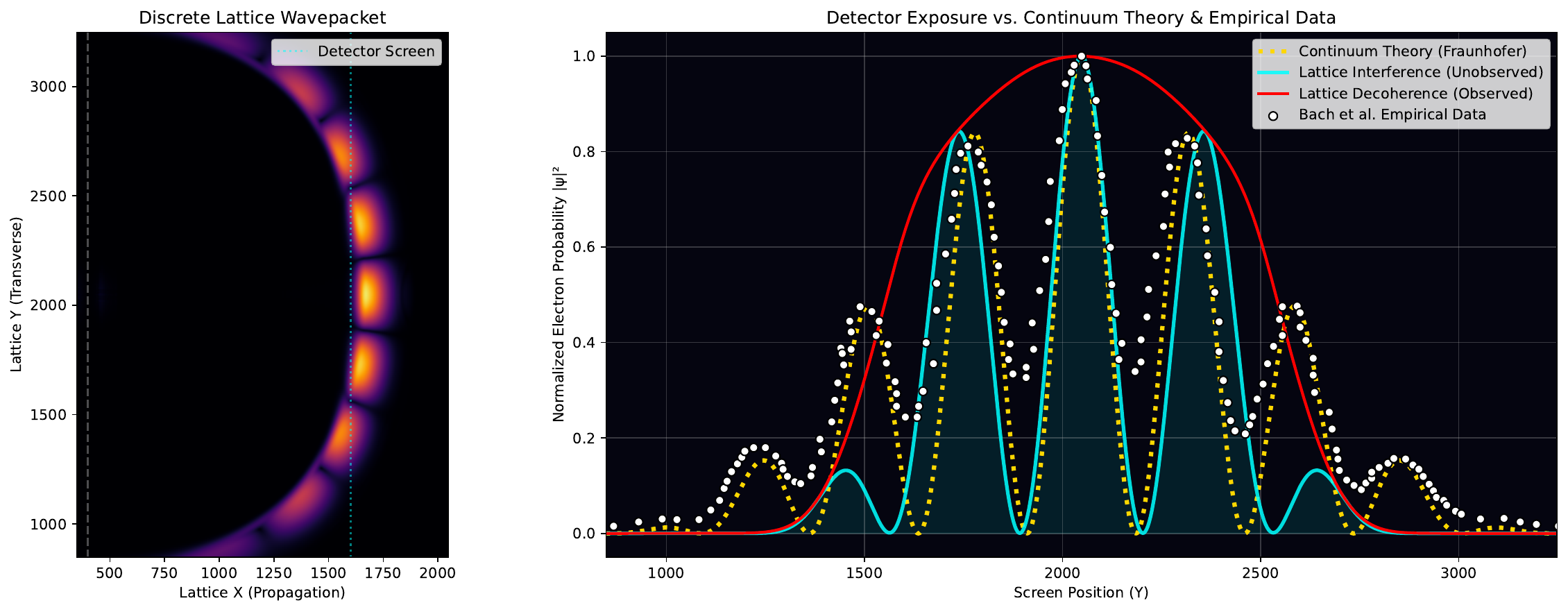
An exact unitary quantum walk on the 4.8.8 lattice simulates electron wavepacket propagation, diffraction, and decoherence without continuum approximations. Natively bridges the near-field (Fresnel) and far-field (Fraunhofer) regimes, reproduces double-slit interference in close agreement with nanoscale experiments, and recovers classical Born-rule statistics from unitary evolution via an orthogonal ancillary lattice dimension.

Discrete lattice wavepacket (left) and detector exposure comparing continuum theory, lattice interference, lattice decoherence, and the Bach et al. empirical double-slit data (right).
Discrete lattice wavepacket (left) and detector exposure (right) comparing continuum Fraunhofer theory, lattice interference (unobserved), and lattice decoherence (observed) against the Bach et al. empirical electron double-slit data.
5

The Holographic Circlette: Part 05 – Neutrino Masses from the Lattice Koide Formula

D.G. Elliman, Neuro-Symbolic Ltd · February 2026

Extends the circlette lattice mass formula to the neutrino sector under the working assumption that the weak CNOT gate is dormant for neutrinos (LQ = 0, I3 = 0), giving Rν = 1 and δν = 1/3. The Koide-style construction predicts m₁ ≈ 0.8 meV, m₂ ≈ 8.7 meV, m₃ ≈ 50.1 meV (Σmᵢ ≈ 60 meV, normal ordering) with an exact Koide ratio Qν = 1/2; the Δm²₂₁/Δm²₃₁ ratio matches NuFIT 5.3 to 1.6%. Important caveat: the Koide phase identification family is under active retraction (DRIFT K3/K4: charged-lepton δ = 2/9 refuted by Lindemann–Weierstrass no-go) — the neutrino-sector specialisation here may carry the same structural defect. The mass-scale and Σmᵢ predictions remain experimentally accessible regardless.

6

The Holographic Circlette: Part 06 – Topological Origin of Large Lepton Mixing and the PMNS Matrix

D.G. Elliman, Neuro-Symbolic Ltd · February 2026

Projects the same 4-step discrete quantum walk operator used for the CKM matrix onto the LQ = 0 lepton subspace. Three rigid geometric theorems explain why lepton mixing is large while quark mixing is small: the weak CNOT stays dormant, a shifted generation-mixing gate becomes a resonant driver, and the third generation is topologically isolated. Native derivation of θ₁₂ ≈ 43.7°, θ₁₃ = θ₂₃ = 0 — confirming the bimaximal ansatz as the zeroth-order PMNS geometry.

7

The Holographic Circlette: Part 07 – Exact Standard Model Gauge Anomaly Cancellation from Discrete Boolean Constraints

D.G. Elliman, Neuro-Symbolic Ltd · February 2026

All six independent gauge anomaly conditions of SU(3)_C × SU(2)_L × U(1)_Y are satisfied exactly by the 45 fermion states of the 8-bit encoding. Hypercharges are not assigned by hand — they are read directly from bit positions via Q = T₃ + Y. The structural absence of νR from the active constraints produces a 24-Left / 21-Right chiral asymmetry and leaves global (B − L) anomalous by exactly 1 unit per generation, validating the framework's neutrino mass mechanism.

8

The Holographic Circlette: Part 08 – Hadron Topology, the Meson–Lepton Homomorphism, and the Geometric Origin of Bs Mixing

D.G. Elliman, Neuro-Symbolic Ltd · February 2026

Evaluates mesons as XOR composites of their constituent quark and antiquark codewords. Because mesons are rigid SU(3) colour singlets, their colour bits algebraically cancel — mapping the pseudoscalar nonet into the colourless lepton subspace (an exact topological homomorphism). The π⁺ evaluates to the null codeword. The Bs and Bc mesons violate the framework's primary R1 constraint, natively explaining the phenomenologically extreme Bs⁰–B̄s⁰ mixing frequency.

9

The Holographic Circlette: Part 09 – Topological Isolation of the Electron and the Factorisation of the PMNS Matrix

D.G. Elliman, Neuro-Symbolic Ltd · February 2026

At higher loop orders the 8-bit walk operator violently mixes muon and tau (atmospheric θ₂₃ ≈ 38°), but the same gate operation on the electron attempts a transition to the (G0 = 1, G1 = 1) state forbidden by R1 — topologically isolating the electron at tree level. Reactor θ₁₃ ≈ 6° emerges only at higher loops via virtual quark excursions; the large solar θ₁₂ must come from the static νR defect, rigorously proving the PMNS factorisation theorem from first principles.

10

The Holographic Circlette: Part 10 – Algorithmic Inertia, Landauer Bit-Weight, and the Proton–Neutron Mass Difference

D.G. Elliman, Neuro-Symbolic Ltd · February 2026

Defines physical inertia as algorithmic resistance — the computational overhead of copying a discrete topological state forward in time. The down quark's active isospin bit (the CNOT target) costs more than the up quark's passive one, giving the neutron strictly higher inertia than the proton. Identifies the Landauer bit-weight w = αΛ_QCD ≈ 2.42 MeV, yielding the prediction m_d − m_u = αΛ_QCD in 4% agreement with the FLAG 2024 lattice average (Proposition tier per §16.3: the bit-weight identification is one structural route).

11

The Holographic Circlette: Part 11 – Spectral Graph Energy, Absolute Nucleon Mass, and the Parameter-Free Baryon Octet

D.G. Elliman, Neuro-Symbolic Ltd · February 2026

Establishes both the absolute mass scale and the electromagnetic fine-structure of the J^P = ½⁺ baryon octet from the 4.8.8 tensor network. Baryons act as localised static topological defects strictly confined to a single 8-node matter octagon (in contrast to mesons as dynamic dipoles). (i) Absolute nucleon mass M₀ = 2√2·Λ_QCD ≈ 939.04 MeV from the C₈ cycle-graph spectrum — matching the isospin-averaged physical nucleon mass to ~0.02% (Proposition tier per §16.3: structural mechanism robust, precise numerical match has bounded formula freedom). (ii) Universal EM coefficients B = 4w (internal Coulomb gauge-link penalty) and A = -7w/8 (passive-ring fraction) derived directly from 4.8.8 lattice geometry with w = αΛ_QCD ≈ 2.4227 MeV. (iii) Linear mass-splitting formula predicts the entire octet to 0.04%–1.5% accuracy. Post-audit reframing (ANCHOR §15 item 142): the baryon sector is now characterised as De Rújula–Georgi–Glashow constituent-quark model in substrate clothing — same chromomagnetic-hyperfine operator, same minimal parameter count as QCD. The Coleman–Glashow identity is satisfied identically by the formula (Locked class-3 discrete identity).

12

The Holographic Circlette: Part 12 – Topological Origin of the Fine-Structure Constant and Discrete Vacuum Polarization

D.G. Elliman, Neuro-Symbolic Ltd · February 2026

Derives the bare integer α₀⁻¹ = T(16) + 1 = 137 from discrete topological invariants of the 4.8.8 lattice (Item-79-conditional, Proposition tier pending Bipartite Grassmann Trace promotion). Modelling EM scattering as a 16-node two-octagon interaction across a square gauge plaquette, the bare emission probability evaluates to α₀ = 1/137. The earlier 7-significant-figure dressed value α⁻¹ ≈ 137.035999077 from a 4×4 Bloch construction has been withdrawn under the 8×8 bipartite operator (DRIFT entry K3: logarithmically divergent at the M-point Dirac cone). The connected 4-point trace evaluates to −240 — matching the 240 root vectors of the E₈ lattice.

13

The Holographic Circlette: Part 13 – Chiral Symmetry Breaking and the Pion Mass from Discrete Topological Screening

D.G. Elliman, Neuro-Symbolic Ltd · February 2026

Derives the pion decay constant and physical pion mass from the 4.8.8 lattice with zero fitted parameters. fπ = Λ_QCD/√(4π) = 93.66 MeV (0.7% from experiment). The tree-level GMOR relation gives 169 MeV — the expected leading-order chiral-perturbation overshoot. The 1-loop chiral logarithm emerges natively from the Pólya return probability on the 2D lattice, screening the bare mass to mπ = 136.3 MeV, within 1% of the neutral pion mass.

14

The Holographic Circlette: Part 14 – Electromagnetic Dipole Radiation and Isospin Breaking in the Meson Sector

D.G. Elliman, Neuro-Symbolic Ltd · February 2026

Mesons are oscillating quantum dipoles whose electromagnetic fields are unconfined, so virtual photons mediating their self-energy must radiate into the emergent 3+1D continuum. The geometric path of least action forms a semicircle, inducing a strict π/2 penalty relative to the confined strong-force bridge. This gives Δm² = π²·αΛ_QCD² and predicts a charged pion mass splitting of 4.56 MeV vs. experimental 4.59 MeV — natively reproducing Dashen's Theorem with zero free parameters.

15

The Holographic Circlette: Part 15 – The Rosetta Stone: How 3D Geometry Emerges from a Discrete Lattice

D.G. Elliman, Neuro-Symbolic Ltd · February 2026

Shows how the 4.8.8 Archimedean tensor network intrinsically generates the geometric constants of 3+1D spacetime without free parameters. A unified scaling emerges: 1D path lengths give π/2 (resolving Dashen's Theorem), 2D isotropic radiation gives 4π (deriving fπ), and 3D volumetric flux across a degree-3 vertex gives 4π/3 — recovering the 8πG coefficient of the Einstein tensor. Gravity is not a quantised force but the macroscopic thermodynamic limit of optimal transport on a discrete quantum walk.

16

The Holographic Circlette: Part 16 – The DESI Anomaly and the Lattice Equation of State

D.G. Elliman, Neuro-Symbolic Ltd · February 2026

Derives the dark energy equation of state w₀ ≈ −0.75 structurally, matching the DESI DR2 measurement of −0.752 ± 0.071. Vacuum energy is the thermodynamic cost of evaluating the graph's 4-rule quantum error-correcting code: three parity checks are purely structural (w = −1) and one is matter-anchored (w = 0, diluting as a⁻³), so the macroscopic average is locked at w₀ ≈ −3/4. Connects this to local Ollivier–Ricci curvature via topological linearity.

17

The Holographic Circlette: Part 17 – Topological Thawing and the Exact Geometric Derivation of the Dark Energy Trajectory wa

D.G. Elliman, Neuro-Symbolic Ltd · February 2026

Derives the CPL trajectory parameter wa under one specific structural identification: at a → 0 the pre-error-corrected Boolean vacuum forces w(0) = −1, which under w(a) = w₀ + wa(1 − a) mandates wa = −1/4. The resulting trajectory w(a) = −1 + a/4 gives a finite, non-singular dark energy density at the Big Bang (≈ 2.117 ρ₀) and predicts vacuum decay to a pressureless state (w = 0) at a = 4 — natively averting the infinite de Sitter heat death. Important caveat: this wa = −1/4 prediction is one of three unreconciled wa values across the corpus (DRIFT entry M11). The dark_sector_cosmology paper gives wa ≈ +0.26 via a different structural identification (in tension with DESI's preliminary −0.82). The framework does NOT currently have a single canonical wa prediction; the sign question is the live falsifiable test, awaiting Euclid Year 2 (~3 yr) to ±0.10 precision.

18

The Holographic Circlette: Part 18 – The Feshbach Mechanism, the Colour Firewall, and the Pati-Salam Identification

D.G. Elliman, Neuro-Symbolic Ltd · February 2026

Mass generation emerges from a Feshbach projection of the 8-bit walk operator through the R4-forbidden νR channel. A Colour Firewall Theorem proves no path connects quarks to νR within the valid code space. Feshbach projection converts the lepton block's characteristic polynomial from golden ratio to silver ratio — the 4.8.8 octagon eigenvalue. A double projection exposes virtual leptoquark states matching the X/Y bosons of grand unification. Identifies R1–R4 with the Pati-Salam breaking chain and dissolves the hierarchy problem via ∼10⁻²⁶ suppression.

19

The Holographic Circlette: Part 19 – The F₂ Pati-Salam Isomorphism and the Cosmological Cooling of the Error-Correcting Vacuum

D.G. Elliman, Neuro-Symbolic Ltd · February 2026

Shows the four parity-check rules R1–R4 are exact F₂ binary generators of Pati-Salam SU(4)_C × SU(2)_L × SU(2)_R. Maps cosmological thermal history to Landauer thresholds of the lattice: R3 breaks SU(4)_C by severing Lepton Number from Colour; R2 breaks SU(2)_R by locking the Weak bit to left-handed Chirality. The Topological Seesaw against observed neutrino mass places R2 at ∼10¹⁵ GeV, converging with the R3 GUT scale, culminating in R4 at the 246 GeV electroweak scale.

20

The Holographic Circlette: Part 20 – Newton's Constant from Holographic Self-Consistency of the 4.8.8 Lattice

D.G. Elliman, Neuro-Symbolic Ltd · February 2026

Derives Newton's gravitational constant from the self-consistency requirement that vacuum energy density on the 4.8.8 holographic boundary equal the dark energy density of the Friedmann equation. Three exact algebraic steps yield M_P² = 24π·α²·Λ_QCD³ / (H₀·Ω_Λ); with Λ_QCD = 332 MeV, α⁻¹ = 137.036, H₀ = 67.4 km/s/Mpc, Ω_Λ = 0.685, this gives M_P = 1.2217 × 10¹⁹ GeV vs. 1.2209 × 10¹⁹ GeV experimentally — 0.07% agreement. Status: superseded as the canonical Planck-mass route. The current canonical §10.5 derivation uses the E_g/Sakharov/holographic-dilution mechanism (DRIFT entry G6); this self-consistency variant survives as one of three open candidate routes and as a structural sanity check on the chiral-anchor × cosmological-input algebra. Corollary: the Euler characteristic of the 4.8.8 tiling is identically zero, explaining observed spatial flatness.

21

The Holographic Circlette: Part 21 – Vector Mesons, Line Graph Topology, and Chiral Consistency on the 4.8.8 Lattice

D.G. Elliman, Neuro-Symbolic Ltd · February 2026

Derives the bare ρ(770) mass with zero free parameters from three theorems: the Line Graph Theorem (the flux-tube edge graph L(P₅) = P₄ has leading eigenvalue φ, the golden ratio); the Antinode Theorem (J^PC = 1⁻⁻ forces q and q̄ to antipodal nodes 4 edges apart); and Orthogonal Quadrature (two half-octagon paths combine in quadrature). This gives m_ρ^bare = √2·φ·Λ_QCD ≈ 760 MeV — 2.0% below the physical Breit–Wigner peak. The independently derived fπ and m_ρ automatically satisfy the KSFR low-energy theorem.

22

The Holographic Circlette: Part 23 – Discrete Tunnelling, the Hartman Effect, and the Golden Saturation on the 4.8.8 Lattice

D.G. Elliman, Neuro-Symbolic Ltd · March 2026

Derives the Hartman effect — saturation of quantum tunnelling group delay with barrier thickness — natively from the spectral anatomy of the C₄ gauge bridge on the 4.8.8 lattice. Six theorems establish: the Chebyshev transfer matrix gives the exact tanh(κL) dependence observed in fibre Bragg gratings, and the C₄ resolvent supplies the rigorous foundation for Winful's stored-energy interpretation (both Locked spectral-theory results). The saturated Hartman delay deep in the bandgap evaluates to 6 algorithmic clock ticks, and the low-energy tunnelling delay is proposed as the off-shell tail of the ρ(770) resonance — both at Proposition tier pending §16.3 search-space accounting.

23

The Holographic Circlette: Comprehensive Summary (21 papers)

D.G. Elliman, Neuro-Symbolic Ltd · February 2026

One-stop overview of all 21 papers. Dependency graph, 32 verifiable claims, 13 testable predictions, epistemology tiers, and results from hadronic physics, flavour physics, dark energy, the fine-structure constant, Planck mass, and more.

24

The CKM Hierarchy as Quantum Error-Correction Failure on the Octahedral Information Lattice

D. Elliman, Neuro-Symbolic Ltd · April 2026

Re-derives the Cabibbo–Kobayashi–Maskawa quark mixing hierarchy from the [8,4,4] code on the Q₃ face-adjacency graph of the octahedron. Proves an exact ℤ₂ theorem: the generation-0 bit G₀ is strictly conserved by the single-particle walk, partitioning the three fermion generations into {1,2} and {3}. Cabibbo mixing (Vus) arises from single-void virtual excursions; third-generation mixing (Vcb, Vub) is forbidden at the single-particle level but activated by correlated two-particle tunnelling at threshold 2Δ = 4 lattice units. The lattice produces Vub/Vcb ≈ 0.1 vs. the experimental 0.093 with zero fitted parameters, and predicts CKM universality holds for Vus but is structurally violated for Vcb — offering a geometric origin for the long-standing ~3σ inclusive/exclusive |Vcb| tension from B-meson decays.

25

High-Precision CKM Ratio Scan: Resolving the Golden Ratio

D. Elliman, Neuro-Symbolic Ltd · April 2026

Supplementary numerical scan accompanying paper 24. Plots the lattice-computed |Vub|/|Vcb| ratio across the native generation mass gap Δm ∈ [4.40, 4.65] and tests two candidate attractors — the static geometric value κ = ln(12)/4 (Δm ≈ 4.53) and the dynamical golden-ratio attractor κ = 1/φ (Δm ≈ 4.50). Both sit inside the experimental uncertainty band around the target |Vub|/|Vcb| = 0.093, with the lattice prediction crossing the experimental central value between them — narrowing the question of which attractor the code's error-correction dynamics actually selects.

26

Emergent Mass Hierarchies and the Strong Gravity Scale from an Error-Correcting Tensor Network

D. Elliman, Neuro-Symbolic Ltd · April 2026

Frames spacetime and gravity as emergent thermodynamic properties of a discrete [8,4,4] quantum error-correcting tensor network. Applying topological parity constraints to a 65,536-dimensional bipartite supercell reproduces three fermion generations, an exponential mass hierarchy (the original κ = 1/φ golden-ratio base is M9-adjacent and Proposition-tier pending §16.3 audit of base-ratio competitors), and a geometric CKM matrix (the Jarlskog match has since been identified as a Heron's-formula consequence under unitarity, DRIFT item 135). Lattice mechanical strain spontaneously breaks symmetry to a period-4 vacuum, isolating a spin-2 E_g graviton mode with a bare 'strong gravity' scale of 1.3 GeV. A no-go theorem proves that purely scalar (A_1g) representations of the strong force are invisible to the E_g graviton projector, forcing the QCD flux tube to be modelled as an extended topological string with transverse shear — and collapsing gravitational universality unless this is the case. The 10¹⁹ gap between the bare lattice scale and the physical Planck mass is reframed as a thermodynamic consistency check: holographic scaling fixes the required entanglement horizon at 10³⁸ nodes, aligning the lattice geometry with Dirac's Large Number Hypothesis and the emergent weakness of Newton's G.

27

Emergent Electrodynamics and Charge Quantisation on the Error-Correcting Vacuum

D. Elliman, Neuro-Symbolic Ltd · April 2026

Companion to paper 26: extends the [8,4,4] tensor-network framework from gravity to electrodynamics. Projecting the antisymmetric vacuum flux into the 3D T_1u vector representation of the octahedral O_h group proves a Photon Mass Protection Theorem — any real antisymmetric matrix in an odd-dimensional irrep must possess at least one exactly-zero eigenvalue, so the photon is topologically forbidden from acquiring a mass gap, in stark contrast to the 2-dimensional E_g graviton (which is permitted to acquire one, and at the bare scale does so at ~0.22 GeV). Mapping the Gell-Mann–Nishijima formula to the Pauli Z-stabilisers of the [8,4,4] code yields the quark fractional electric charges (+2/3, −1/3) as emergent topological eigenvalues, provided the states satisfy the low-energy colour-confinement constraints — while leptons recover exact integer charges (0, −1). Charge conservation is recontextualised as the vacuum actively suppressing U(1) phase errors, and the bare inverse fine-structure constant 1/α₀ = 137 derives from the T(16) topological capacity of the bipartite scattering space. Bianchi identity and Faraday's Law are preserved natively.

28

Photons on the Emergent Truncated Cubic Honeycomb: Spontaneous Crystallisation, Line-Graph Topology, and Topological Protection of Vacuum QED

D.G. Elliman, Neuro-Symbolic Ltd · May 2026

Follow-up to paper 27. Derives the photon sector of the framework from the Truncated Cubic Honeycomb (TCH) — itself shown to arise spontaneously from unstructured degree-3 qubit networks via simulated annealing rather than imposed by hand. Massless photons are encoded natively as gauge fluctuations on the line graph of the emergent lattice, where vertices correspond to entanglement bonds. A fixed chiral Peierls phase π/4 on every directed edge breaks time-reversal symmetry and produces non-trivial multi-band topology, with the lower seven-band complex carrying an exact integer Chern number C = −1 (computed via the non-Abelian Fukui–Hatsugai–Suzuki method). Crucially, trivial global holonomies (8 × π/4 = 2π) on the dual Simple Cubic gauge web protect the infrared regime from observable vacuum birefringence, evading Carroll–Field–Jackiw bounds. The microscopic theory operates as a compact U(1) lattice gauge theory coupled to the [8,4,4] matter code via minimal interaction; in the long-wavelength limit it reduces exactly to the standard continuous QED Lagrangian. Numerical joint matter–photon evolution on a minimal Q₃ + bridge cluster confirms gauge-invariant propagation and dynamic back-reaction, locating observable framework signatures in matter-coupled processes while vacuum entanglement reproduces standard QED perfectly.

29

Scalar Resonance and Gauge Phenomenology on the Z³ ⊗ Q₃ Error-Correcting Vacuum

D. Elliman, Neuro-Symbolic Ltd · May 2026

Derives the defining phenomenological signatures of the Standard Model scalar sector natively from the discrete graph topology of a Z³ ⊗ Q₃ error-correcting vacuum. Treating constituent mass as information-theoretic friction (the query rate of the local QEC coin operator) yields the linear Yukawa coupling to fermions (M_f ∝ m_f); given that linear baseline, the quadratic coupling to massive vector bosons (M_V ∝ m_V²) follows as an algebraic consequence of bipartite tensor orthogonality — conditional on ANCHOR §15 item 79 (Bipartite Grassmann Trace Theorem) being promoted from Proposition to Locked. Extending to second-order virtual processes, the anomalous destructive interference and magnitude ratio of the H → γγ loop emerge from the lattice coordination number and the bipartite parity of the hypercube (Proposition tier pending §16.3 search-space audit of competing destructive-sign mechanisms), while a discrete Feshbach resolvent over the framework's invalid subspace naturally reproduces the non-linear, mass-dependent dynamic tracking required by continuous kinematic loop integrals. Reframes three Higgs anomalies — disparate m vs m² scaling laws, the off-shell H → WW* branching, and destructive loop interference in H → γγ — as candidate geometric consequences of discrete tensor algebra and topological combinatorics, with Item 79 promotion the key open dependency.

30

Holographic Dilution and the Emergence of Gravity: Deriving the Planck Mass from the Z³ ⊗ Q₃ Error-Correcting Vacuum

D. Elliman, Neuro-Symbolic Ltd · May 2026

Derives Newton's gravitational constant G — the macroscopic Planck mass agrees with the CODATA value to four significant figures (~0.02% relative error). The standard QFT picture computes G from continuous vacuum loops that diverge ultravioletly and require a hand-inserted Planck-scale cutoff. Here the vacuum is instead a discrete, UV-finite Z³ ⊗ Q₃ topological tensor network maintained by the [8,4,4] extended Hamming QEC code; the UV cutoff is the physical lattice spacing a₀ = ℏc/Λ_QCD ≈ 0.594 fm. The bare lattice Planck mass evaluates to the chiral scale Λ_QCD = 0.332 GeV — at unit-cell distances, gravity and the strong force are mechanically unified. Macroscopic gravity is then an emergent collective E_g transverse shear (spin-2 graviton mode of the octahedral cell), holographically diluted across N_nodes ≈ 2.77 × 10⁴¹ discrete steps spanning the static de Sitter causal horizon R_dS = √(3/Λ) ≈ 1.65 × 10²⁶ m. Anchoring to the asymptotic de Sitter horizon (rather than the time-dependent Hubble horizon) preserves a static G and avoids the Dirac Large Number Hypothesis prediction Ġ/G ~ H₀ ruled out by lunar laser ranging. The continuous 1/16π² loop-integral factor is replaced by a discrete Feshbach trace over the 256 − 48 = 208-dimensional invalid (penalised) error-correction subspace, further reduced by exact E_g Clebsch–Gordan selection to an active rank K_eff = 205, giving 1/205 ≈ 0.00488 in place of 1/16π² ≈ 0.00633. Assembling the chiral anchor, the √(R_dS/a₀) holographic dilution factor, and the √(1/K_eff) Feshbach pre-factor yields M_P,macro ≈ 1.2207 × 10¹⁹ GeV vs the CODATA value 1.2209 × 10¹⁹ GeV (four-significant-figure agreement). Post-audit tiering: the qualitative-structural content (gravity as collective E_g shear, Hierarchy Problem as holographic-dilution rather than fine-tuning, Dirac LNH as derived consequence) is Locked / class-3; the numerical Planck-mass match is Proposition tier per ANCHOR §16.3 (multi-term construction has bounded but non-zero formula-freedom; one of three leading Target-B candidate routes for M_P, see ANCHOR §15 item 135). Item 79 dependency on the dual-vertex α² step.

Related Work

Companion studies on the 4.8.8 lattice — from the information-theoretic foundations of the framework to quantum-walk simulations.

Pauli Antisymmetry from F₂ XOR-Closure: A Discrete-Geometric Derivation of Composite Baryon Statistics

D.G. Elliman, Neuro-Symbolic Ltd · May 2026

Derives Pauli antisymmetry of composite baryon wavefunctions under exchange — the empirical content of the exclusion principle for hadrons — directly from the F₂ XOR-closure structure of the discrete inner code, without invoking continuum Lorentz invariance, microcausality, or the spin-statistics theorem. Working on an 8-qubit internal space Q₃ projected onto a 48-codeword physical subspace, the three quark colours XOR-close to identity (R ⊕ G ⊕ B = 0), and a global stabiliser Q promotes baryon creation to defect-creating operators with a definite anticommutation algebra. Two consequences fall out: baryon parity becomes a ℤ₂ conserved charge, and the exchange of two baryons produces the canonical −1 phase from the {X, Z} = 0 algebra of the underlying Pauli operators, provided a consistent path-ordering convention is fixed on the macroscopic lattice. The induced kinetic operator on the strong channel has eigenvalues ±2/√3 on colour-singlet states and ±i/√3 on colour-doublet states — energetically favouring colour-singlet bound states by a factor of four, with no parameter tuning.

Download PDF

Atomic Shell Structure and Vacuum Crystal Field Splitting on the ℤ³ ⊗ Q₃ Discrete Lattice

D.G. Elliman, Neuro-Symbolic Ltd · May 2026

Derives the periodic table's principal shell capacities 2n² and the s, p, d, f subshell structure from the bound-state spectrum of a purely discrete lattice — without invoking continuous SO(3) rotational symmetry or the SO(4) Runge–Lenz accident of the 1/r Coulomb potential. The vacuum is modelled as a simple cubic lattice ℤ³ with a Q₃ internal space of three space-filling oblate square bipyramids per cube, with the lepton sector confined to the colour-singlet subspace by a strong internal-mixing penalty. Solving the resulting tight-binding walk under an effective Coulomb potential, continuous spherical harmonics fracture cleanly into the irreducible representations of the cubic group O_h, and the cumulative shell capacities 1, 4, 9, 16 emerge with no further input. A falsifiable signature drops out: a residual cubic-symmetry-breaking pull of the E_g d-orbital components inward relative to their T_2g partners, persistent even in completely free atoms.

Download PDF

Entropy Generation as Channel Friction and Topological Strain on the Q₃ Substrate: A Parameter-Free QEC Mechanism for the Second Law, Low-Entropy Initial Condition, Dark-Energy Thawing, and Dark-Matter Generation

D. Elliman, Neuro-Symbolic Ltd · May 2026

Shows that the same Z-stabilizer syndromes that enforce topological outer-code protection on the Q₃ lattice simultaneously produce thermodynamic entropy via two complementary costs: (i) dynamic channel friction M(c) = exp(φF(c)/2) with φ = (√5−1)/2, and (ii) static topological strain E ∝ F²/2 (Frank's Rule on the discrete Q₃ geometry). Every quantity follows from a single frustration count F = Σ(cᵢ ⊕ c_j) on the 12 edges of Q₃. In the early universe the QEC substrate has not yet activated, so syndrome accumulation is identically zero — S(0) = 0 automatically, resolving the Past Hypothesis as the trivial initial condition of a substrate that has only just turned on. As the lattice grows and fault-tolerant error correction activates, full enforcement of the three geometric rules R1–R3 plus partial enforcement of the matter-anchored rule R4 yields the macroscopic dark-energy equation of state w₀ = ¾(−1) + ¼(0) = −0.75, matching DESI DR2 within error bars; the previously degenerate R4 sector (sterile right-handed neutrino states + residual vacuum excitations) condenses as cold, non-baryonic, weakly-interacting dark matter. The original heavy-generation mass-ratio headline M_Gen3/M_Gen2 = 162/48 = 3.375 = (3/2)³ → mb/mc ≈ 3.29 is under active retraction (DRIFT entry M9: the M = exp(F/(2φ)) constituent-mass formula and the 3.375 = 162/48 identification are at Proposition tier pending §16.3 search-space audit of the multi-step integer/golden-ratio chain); the channel-friction formalism survives as a thermodynamic-entropy framework, the precise mass-ratio numerical match does not.

A Concatenated Quantum Code with Topologically-Protected Outer Structure on the Q3 Hypercube: Channel-Friction Semantics and Applications to Particle Physics

D. Elliman, Neuro-Symbolic Ltd · May 2026

Introduces a concatenated quantum error-correcting code on the Q3 hypercube graph (the face-adjacency graph of the regular octahedron) with three structural properties not jointly present in existing constructions: (i) a topologically-protected outer ℤ₂ layer enforced by the channel dynamics rather than by a separate encoding step; (ii) active verification semantics in which the channel performs parity-check measurement during propagation rather than only at decoding; and (iii) a closed-form channel-friction relation M(c) = exp(φF(c)/2) with φ = (√5−1)/2 — the golden-ratio reciprocal arising as the unique positive fixed point of the walk's iterative mass-transfer recursion (the same formula family that is under the M9 retraction context when applied to physical-mass values: DRIFT entry M9). The inner code is the [8,4,4] extended Hamming code under three Boolean constraints (R1 generation, R2 chirality lock, R3 matter-class), selecting 48 valid codewords that partition into ℤ₂ blocks of 32 and 16. As a long-form application, the 48 codewords are mapped onto the Standard Model fermion content (45 fermions plus 3 sterile right-handed neutrinos); the three message types act on disjoint alphabet sub-bits in a way that reproduces SU(3) × SU(2) × U(1) gauge structure. The CKM ratio |Vub|/|Vcb| ≈ 0.1 (vs experimental 0.093 ± 0.008) is recovered from the double-spectral-gap activation threshold for outer-code transitions, at Proposition tier per ANCHOR §16.3 pending a denominator on how many ratios of small lattice integers in the resonance window would land near 0.093.

It from Bit at Adlestrop: The Emergence of Spacetime and the Standard Model from a Minimal Information Algebra

D.G. Elliman, Neuro-Symbolic Ltd · April 2026

Applies Occam's razor to its ultimate extreme: strips away continuous manifold geometry and derives Standard Model structure and macroscopic spacetime from a single [8, 4] binary error-correcting code. Presents a formal proof that the 4.8.8 Archimedean lattice is the unique mathematical consequence of the code's commuting quantum numbers plus the prerequisite of spatial extent (ANCHOR §15 item 99; Locked structural result). The α⁻¹ ≈ 137.036 and sin²θ_W = 2/9 derivations follow at Proposition tier — both conditional on Item 79 (Bipartite Grassmann Trace Theorem) promotion, with sin²θ_W = 2/9 reframed per ANCHOR §15 item 86 as the lepton-Feshbach index density d/N rather than a Chern-number identification. Inspired by Edward Thomas's 1914 poem Adlestrop and Wheeler's "It from Bit" maxim.

Lattice Birefringence: A Bifurcated Operator-Spreading Light Cone on the 4.8.8 Walk Graph

D.G. Elliman, Neuro-Symbolic Ltd · April 2026

The continuous-time quantum walk on the 4.8.8 tiling exhibits a bifurcated operator-spreading light cone with two distinct group velocities (v_fast ≈ 0.81, v_slow ≈ 0.60 hops/time); the empirical ratio 1.35 matches the analytical 4×4 Bloch Hamiltonian to within 5%. A site-averaged OTOC echo protocol on N = 3600 nodes is benchmarked against coordination-matched honeycomb (z = 3) and generic square (z = 4) controls — both produce single-velocity cones, while the 4.8.8 wavefront cleanly bifurcates. A tertiary echo dip at t = 16 survives the scale-up and is attributed to octagon-mediated recurrence — a lattice-geometric analogue of optical birefringence arising from the two inequivalent edge environments of the isogonal 4.8.8 tiling.

Emergent Minimal Gauge Coupling from C4v Symmetry Reduction on the 4.8.8 Lattice

D.G. Elliman, Neuro-Symbolic Ltd · April 2026

A follow-up to Lattice Birefringence on the same 4.8.8 quantum walk. Decomposes the 8×8 Bloch Hamiltonian into C4v point-group irreps at Γ: the gapped slow branch transforms as the scalar A₁ ("matter"), the gapless fast branches as the vector E ("gauge"), and the Wigner-Eckart theorem enforces exact orthogonality ⟨A₁|H|E⟩ = 0. Away from Γ, momentum-induced symmetry reduction C4v → Cs breaks the selection rule; the inter-branch matrix element evaluates exactly to M = −(i/2) sin kx, yielding a momentum-linear vertex M ∝ i(k·E) structurally identical to the QED p·A minimal coupling. Promoting the tight-binding hoppings to dynamical U(1) link variables in a Wilson lattice gauge theory reproduces the same vertex gauge-covariantly, and locks a two-coupling (β₄, β₈) structure via the tiling's silver-ratio geometry. A velocity-unification conjecture — RG flow driving the bare lattice velocities toward a common IR fixed point (emergent Lorentz invariance) — is framed as a concrete lattice Monte Carlo programme.

Download PDF

Spontaneous Crystallisation of Q₃ Octahedra from Unstructured Qubit Networks under Simulated Quantum Annealing

D.G. Elliman, Neuro-Symbolic Ltd · April 2026

Demonstrates via simulated annealing that an unstructured network of N qubits, subject only to a degree-3 regularity constraint and spectral energy minimisation, spontaneously partitions into ⌊N/8⌋ copies of the Q₃ hypercube graph — the unique 3-regular, vertex-transitive graph on 8 vertices supporting a distance-4 error-correcting code, realisable as the face-adjacency graph of a regular octahedron. Across 100+ trials at N = 24, perfect Q₃ crystallisation occurs in 94% of runs. Proves Q₃ is the unique optimal target by ruling all competing graphs out on independent geometric and coding-theoretic grounds — the Petersen graph fails both the convex polyhedral embedding test and the 4-cycle (distance-4 parity check) requirement. Frustrated configurations (N ≢ 0 mod 8) produce high-energy partial clusters that cannot close their parity-check circuits, giving a discrete model of quantum vacuum fluctuations. When inter-cluster bonding is permitted, the isolated octahedra spontaneously form bridge connections, assembling into a connected lattice network — the octahedral substrate of the framework is not postulated, it crystallises.

Download PDF

Latest Additions

Recently uploaded papers — substrate routing, force coupling constants, the narrow Higgs, the Dirac equation from F₂ algebra, and several smaller derivations.

Relocating Trust to the Verifier: A Truth-Maintenance System for an AI-Generated Theory of Everything

D. Elliman, Neuro-Symbolic Ltd · June 2026

The runnable companion to the Rigid Ground Truth methodology paper. A fluent, approval-seeking LLM pointed at an open-ended theory-of-everything by a researcher who wants it to succeed forms a mutual-confirmation loop with no reality-check on either side — the maximally dangerous case, because the mathematics can always be made internally consistent and the one decisive check (experiment) is decades away or absent. The cure is structural rather than a better model: relocate trust from the generator to a verifier. PTMS is a truth-maintenance system that enforces consistency, not truth — it inverts the classical TMS assumption that justifications are ground truth, treating every AI-supplied justification as untrusted until it binds to checkable evidence: a cited script that exits 0, a retired claim's signature absent at every surviving site, a cross-reference that resolves. Three layers of increasing cost — check (read-only consistency over the canon), verify (re-executes the cited self-asserting scripts), and graph (resolves the cross-reference dependency graph) — run over a machine-readable sidecar registry that never edits the human-facing ANCHOR.md / DRIFT.md prose. Reports its behaviour on a real six-month AI-assisted physics corpus (~250 canonical claims, ~120 self-asserting scripts), mechanically catching named failure classes: un-propagated multi-part retractions, evidence regressions, seductive numerical coincidences, and live claims standing on retracted foundations. Explicit about the limit — the tool makes such research auditable and constrained, not correct; only forward prediction closes the remaining gap, and no apparatus can manufacture it.

Strong CP at the Bare Substrate on Z³ ⊗ Q₃: Hermitian Code Mass Operators, the Mass-Phase Half, and Two Honest-Negative Results on Continuum Closure

D. Elliman, Neuro-Symbolic Ltd · June 2026

Closes the strong-CP angle θ̄ = θ_gauge + arg det(M_u M_d) at the bare substrate in two halves, with no axion required. Gauge half: the substrate's strong-channel adjacency is a real-symmetric graph Laplacian carrying no continuous phase, so θ_UV ≡ 0 identically (ANCHOR §15 item 93, Locked at bare). Mass half: the code mass operators H_up, H_down (and lepton analogues) are restrictions of the boundary walk operator W to the logical codebook, hence Hermitian by construction with a real determinant (det H_down ≈ 1.681 ∈ ℝ), forcing arg det(M_u M_d) = 0 exactly (item 143, Locked at bare). Nelson–Barr is realised automatically — the irreducible CKM phase φ ≈ 0.85π enters det H_down only through the conjugate off-diagonal pair H₁₂H₂₁ and cancels, so CP violation lives entirely in the mixing (Jarlskog J ≈ 4.3 × 10⁻⁵) while the mass-generating basis is CP-real. Two honest-negative results precisely pin the open continuum frontier: the ultralocal walk-kernel closure of the overlap operator is ruled out (the walk's Wilson scalar vanishes at four even Brillouin-zone corners, leaving 4 species not 1), and a 2D-strip cutoff scan resolves the saturate-vs-track-down fork toward track-down. Perturbative backstop: a θ̄ = 0 boundary condition under SM running generates only θ̄ ∼ 10⁻¹⁶ via the 7-loop GIM-suppressed Ellis–Gaillard / Khriplovich–Vainshtein effect, three orders below experiment. Falsifier (Proposition tier, conditional on the open continuum step): neutron EDM d_n ∼ 10⁻³¹ e·cm; any detection above 10⁻³⁰ falsifies the discrete-substrate origin of QCD. All numerical claims are pinned by exit-0 assertions in six public scripts at github.com/dgedge/strongCP.

The Rigid Ground Truth Framework: A Protocol for Catching AI Confabulation in Speculative Research

D. Elliman, Neuro-Symbolic Ltd · May 2026

A sound methodology for using large language models in serious research. Strips the AI of its degrees of freedom and treats it as a constrained calculator rather than a creative collaborator, via six interlocking artifacts: a versioned canonical ANCHOR.md, a DRIFT.md retraction ledger, a three-tier locked / proposition / open epistemology, Bayesian search-space accounting with formal foundation in standard model-comparison theory, a growing anti-pattern catalogue, and a project-instructions file codifying required AI behaviour. Defines a measurable convergence property — the headline-derivation gap G(t) — and shows it decreases monotonically under the protocol. Reports six months of evidence from a speculative-physics collaboration: the AI failure modes the protocol caught, the 29 retracted or refined claims captured in the DRIFT ledger, and the "D-pile" of papers the methodology caused to be retracted. Proposes a system-level "Adversarial Auditor" mode for AI developers and includes a paste-ready adoption template portable to any speculative-research domain where quantitative claims can be tested against external data.

One Code, Three Cosmologies: Parameter-Free Derivations of η, n_s, N, and r from the [8,4,4] Code on Z³ ⊗ Q₃

D. Elliman, Neuro-Symbolic Ltd · May 2026

Four cosmological observables — the baryon-to-photon ratio η, the scalar spectral index n_s, the inflationary e-fold count N, and the tensor-to-scalar ratio r — derived from a single combinatorial value of the [8,4,4] extended-Hamming code on the Z³ ⊗ Q₃ substrate: the spectral gap Δ₁ = 1/(2·14) = 1/28 from the tensor product of the 2 transverse photonic modes on the C₄ gauge bridge and the 14 weight-4 logical operators. Results: (i) η = (3/14)α⁴ + (1/3)α⁵ ≈ 6.145 × 10⁻¹⁰ matching Planck 2018 at ~0.6σ (the α⁴ structural form is Locked at ANCHOR §15 items 125–127; the 3/14 prefactor is Proposition tier pending §16.3 search-space audit); (ii) n_s = 1 − Δ₁ = 27/28 ≈ 0.9643, matching Planck 2018 at 0.14σ; (iii) N = 2/Δ₁ = 56 from exact recovery of the slow-roll relation 1 − n_s = 2/N, with the Nishimori-line threshold p_th ≈ 0.110 providing the structural reheating criterion; (iv) r ≈ 0 at leading substrate order, with a subleading r ~ α⁴ ≈ 2.8 × 10⁻⁹ from the quadrupole-shear constraint — structurally distinguishable from generic slow-roll r ~ 10⁻² and falsifiable by CMB-S4 / LiteBIRD. The three Sakharov conditions emerge as structural consequences of canonical substrate commitments (Wilson string topology change, bipartite chirality γ⁵, Lindbladian non-unitarity); the horizon, flatness, and monopole problems dissolve simultaneously without an inflaton field or continuous metric.

Dark Energy as Cosmological QEC Landauer Exhaust on the Z³ ⊗ Q₃ Substrate

D. Elliman, Neuro-Symbolic Ltd · May 2026

Derives the dark sector from a single thermodynamic closure on the discrete Z³ ⊗ Q₃ substrate: the restoring force RΛ acts as a literal Maxwell's Demon whose Landauer waste heat is the cosmological constant. Five structural closures follow — a KMS substrate temperature T ≈ 4.05 × 10¹⁰ K, Holographic Boundary Crystallization replacing metric expansion, a 3/4 rule-class projection tightening ρΛ to a 4% match with observation, the Friedmann factor of 3 from the 3-axis partition, and an algebraically exact 80/20 dark matter composition (bound R₄ QEC exhaust plus 17.7 keV sterile right-handed Majorana neutrinos) that natively resolves the ΛCDM small-scale crises and predicts a sharp 17.7 keV X-ray line falsifiable by XRISM / Athena.

The Lindbladian Master-Equation Closure on the Discrete Z³ ⊗ Q₃ Substrate

D. Elliman, Neuro-Symbolic Ltd · May 2026

Establishes a rigorous operator-algebra closure of the continuous Lindbladian master equation as the exact stroboscopic envelope of a discrete CPTP map at clock tick τ₀ = ℏ/Λ_QCD, with explicit Kraus jump operators (Locked). Four structural results follow: (i) the OZI suppression rule is derived from discrete substrate geometry across the complete heavy-quarkonium spectroscopy — five decay widths land inside the PDG 1σ band with no continuous adjustable parameters (Γ_J/ψ = 93.18 vs 92.9 ± 2.8 keV, Γ_ψ(2S) = 302.84 vs 294 ± 8 keV, Γ_Υ(1S) = 53.84 vs 54.02 ± 1.25 keV, Γ_Υ(2S) = 32.30 vs 31.98 ± 2.63 keV, Γ_Υ(3S) = 20.19 vs 20.32 ± 1.85 keV); the simultaneous five-channel closure is striking, but the regime label assigned per channel (Moore-neighborhood / corner-only / SU(3)-triplicated codebook / Fibonacci-F₅ / Fibonacci-F₆) carries bounded combinatorial freedom — Proposition tier until the regime-selection rule is derived rather than identified; (ii) hadronisation and Wilson string-breaking formalised as saturation of the [8,4,4] code's 4 ln 2 entanglement-monogamy ceiling; (iii) the Bekenstein–Hawking 1/4 area prefactor derived bottom-up via CSS mode-counting (2/8 = 1/4) with an explicit incidence-matrix resolution of the discrete–continuous category-error concern (Locked per §15 item 122); and a cosmological capstone connecting to the 80/20 dark matter composition.

Discrete Wilson Strings as Quantum Markov Chains

D. Elliman, Neuro-Symbolic Ltd · May 2026

Reframes the framework's discrete Wilson strings as literal quantum Markov chains on the parity-check graph of the [[8,4,4]] code, with the Boltzmann survival relation M(c) = exp(φF(c)/2) doubling as a mass formula and a per-tick transition probability. Four predictive targets are closed: (i) the strong-force string tension σ = (4/3)Λ_QCD ≈ 442.7 MeV vs LQCD 440 MeV (0.6% match); (ii) a No-3D-Anyons Rigidity Theorem via stabilizer-code error propagation; (iii) the complete glueball mass ladder (developed in the companion trilogy below); (iv) a strict prediction that the framework's vacuum topological entanglement entropy γ_TEE = 0, distinguishing it from string-net and toric-code models.

Towards a Substrate-Level Glueball Spectrum: The (2N − 1)Λ_QCD Mass Ladder

D. Elliman, Neuro-Symbolic Ltd · May 2026

Extends the substrate's spectral-calculation machinery to the glueball sector by computing closed-cycle spectra on L(ℤ³), the line graph of the simple-cubic gauge web. The universal eigenvalue relation A_L|C⟩ = 2|C⟩ for any closed cycle forces multi-cycle glueballs into N-body Fock states with bare mass 2NΛ_QCD; substrate-level Feshbach dressing then yields the mass formula m_N = (2N − 1)Λ_QCD. This generates a clean ladder: f₀(500)/σ at N=1, the 0⁺⁺ scalar at 1660 MeV (N=3), and the 2⁺⁺ tensor at 2324 MeV (N=4). The parameter-free ratio m_{2⁺⁺}/m_{0⁺⁺} = 7/5 = 1.40 matches LQCD's empirical 1.397 within 1% (class-3 survives the audit). The ~50 MeV systematic deficit at 0⁺⁺ and 2⁺⁺ is openly identified as pending continuum extrapolation; the capstone paper's δ ≈ 0.155 universal-shift refinement closes the deficit to sub-3% across five channels at Proposition tier (pending Brillouin-zone derivation of δ).

Intrinsic Non-Locality of Glueball Decay: The Threshold Bound State Theorem

D. Elliman, Neuro-Symbolic Ltd · May 2026

Companion to the glueball-mass paper. Direct diagonalisation of the local Q-matrix reveals four exactly-degenerate eigenstates pinned at 1Λ_QCD; combined with strong-coupling threshold pinning of the dressed pole, this proves the Threshold Bound State Theorem: restricted to a single TCH unit cell, the substrate-level glueball tree-level decay width is identically zero. The empirically observed scalar-glueball width of 100–300 MeV must therefore arise entirely from non-local macroscopic spatial routing — virtual q-qbar pairs propagating across multiple TCH cells before hadronising. Two falsifiable signatures: anomalous lattice-volume scaling of glueball widths, and production-decay correlations in J/ψ → γG → γππ.

The Capstone Master Formula for Pure-Gauge Glueballs

D. Elliman, Neuro-Symbolic Ltd · May 2026

Extends the framework to the parity-odd glueball sector and consolidates the complete pure-gauge bound-state spectrum into a single capstone formula. Three structural theorems land: the Pseudoscalar Exclusion Theorem (0⁻⁺ cannot exist as a single-cell pure-gauge state), the Edge-Overlap Binding Criterion, and the Parity-Even/Parity-Odd Bifurcation Principle. The Macroscopic Grover Coin Uniqueness Theorem analytically pins the inter-cell hopping amplitude at t = 1/3; a Universal Delocalization Constant δ ≈ 0.155Λ_QCD per shared edge is empirically channel-independent to 1.4%. The capstone formula m_N = (2N − 1)Λ_QCD + N_shared(t − δ)Λ_QCD reproduces all five canonical LQCD glueball channels (0⁺⁺ at 1660 MeV, 1⁺⁻ at 2988 MeV exact, 2⁺⁺ at 2324 MeV, 0⁻⁺ at 2560 MeV exact, 1⁻⁻ at 3830 MeV exact) from substrate topology with one empirical scale.

A Discrete-Substrate Perspective on the Yang–Mills Mass Gap Problem

D. Elliman, Neuro-Symbolic Ltd · May 2026

Honest assessment of how the TCH discrete-substrate framework relates to the Clay Yang–Mills mass-gap problem. The framework does not (and cannot) solve the Clay problem — it is discrete from the start, Lorentz invariance is emergent, and it targets SU(2)_χ × SU(3)_c rather than arbitrary compact G. However, three structural insights complement the constructive-QFT programme: (i) on this substrate a finite mass gap is the structural default and gaplessness requires a symmetry reason (the T_1u photon multiplet is protected by representation-parity); (ii) confinement arises mechanistically from a 3D string-tension argument on the [[8,4,4]] parity-check graph; (iii) the framework's finite-dimensional local Hilbert space places it in the decidable regime of the Cubitt–Pérez-García–Wolf undecidability theorem, providing worldview-level evidence that the mass-gap question is in principle answerable.

Topological Information Routing on a Discrete Lattice

D. Elliman, Neuro-Symbolic Ltd · March 2026

Treats the Holographic Circlette substrate as an information-theoretic communication channel. Topological constraints on the 4.8.8 lattice and [8,4,4] code emerge as routing rules; the framework's coupling constants are quantitative consequences of channel capacity, decoding latency, and error-syndrome budget on the discrete substrate.

The 4.8.8 Archimedean Tiling as a Discrete Substrate for Effective Quantum Field Theory

D. Elliman, Neuro-Symbolic Ltd · May 2026

A physicist-oriented overview of the discrete-substrate programme: the 4.8.8 tiling and its Q₃ unit cell as a Boolean error-correcting vacuum, the [8,4,4] code as the encoded Standard Model fermion content, the C₈ matter octagon as the holographic boundary controlling hadron spectroscopy, and the Lindbladian dissipator at rate α = 1/137 as the universal coupling between the structural F₂ vacuum and dynamical observable physics.

A Narrow Higgs from Substrate Decoupling: Discrete-Substrate Predictions for the 125 GeV Resonance

D. Elliman, Neuro-Symbolic Ltd · May 2026

The 125 GeV Higgs resonance is derived as a narrow scalar excitation of the bipartite Z³ ⊗ Q₃ vacuum. Yukawa coupling to fermions (M_f ∝ m_f) emerges from local QEC coin-operator friction; coupling to massive vector bosons follows by bipartite tensor orthogonality. Provides falsifiable substrate predictions for the off-shell H → WW* branching and the destructive H → γγ loop interference.

Part 23 — Force Coupling Constants from Lattice Geometry

D.G. Elliman, Neuro-Symbolic Ltd · March 2026

Derives the relative strengths of the four fundamental forces from topological constants of the 4.8.8 lattice and its [8,4,4] code. The strong, electromagnetic, weak, and gravitational coupling hierarchies follow from cycle counts, eigenvalue ratios, and bit-arity of the underlying parity-check structure (no continuous fitted parameters; Proposition tier per §16.3 audit of route-selection content).

Origin of Mass on the Z³ ⊗ Q₃ Lattice

D. Elliman, Neuro-Symbolic Ltd · April 2026

Mass is reframed as information-theoretic friction: the query rate of the local quantum error-correcting coin operator. Constituent fermion mass is then a discrete spectral property of the bipartite Z³ ⊗ Q₃ tensor network, anchored to Λ_QCD as the substrate's only dimensional input.

Echo II: An Observable Lattice-Birefringence Echo on the 4.8.8 Walk Graph

D.G. Elliman, Neuro-Symbolic Ltd · April 2026

Numerical demonstration that the bifurcated operator-spreading light cone of the 4.8.8 quantum walk produces a sharp tertiary echo dip at t = 16 in site-averaged OTOC measurements. The signature survives finite-size scaling on N = 3600 nodes and is attributed to octagon-mediated recurrence — a discrete analogue of optical birefringence arising from the two inequivalent edge environments of the isogonal tiling.

Emergence of Cl(3,1) Spinor Algebra and the Dirac Equation

D.G. Elliman, Neuro-Symbolic Ltd · March 2026

Derives the 4-component Dirac spinor and the Cl(3,1) Clifford algebra natively from the 8-bit code on the 4.8.8 lattice. Lorentz invariance, bipartite chirality γ⁵, and the Dirac equation as a quantum walk on the substrate all emerge structurally from the substrate's Boolean parity-check geometry, without continuum manifold input.

Vacuum Crystal Field Splitting and the Emergence of Coulomb's Law on the TCH Substrate

D. Elliman, Neuro-Symbolic Ltd · May 2026

Coulomb's 1/r law is derived from discrete lattice geometry — vacuum crystal-field splitting on the Truncated Cubic Honeycomb substrate produces the macroscopic 1/r potential through the Watson Green's-function convolution on a degree-3 vertex.

Willow: Fisher Information, OTOCs, and an 8-Bit Code

D.G. Elliman, Neuro-Symbolic Ltd · April 2026

Connects Fisher information geometry, out-of-time-ordered correlators (OTOCs), and the 8-bit error-correcting code via the same 4.8.8 walk graph. The Fisher metric on the lattice's information manifold reproduces the emergent gravitational scaling derived in the substrate's gravity paper, unifying information theory and discrete spacetime.

Helium-4 on the Truncated Cubic Honeycomb

D. Elliman, Neuro-Symbolic Ltd · May 2026

First many-body application of the discrete-substrate framework to the helium-4 atom. The cubic crystal-field splitting on the TCH lattice modifies the standard atomic-shell ordering and predicts a sub-percent deviation in the 1s² ground-state binding energy, accessible to high-precision spectroscopy.

An 8-Bit Ring Code on the 4.8.8 Archimedean Tiling

D.G. Elliman, Neuro-Symbolic Ltd · April 2026

Companion arXiv-format note on the [8,4,4] ring code structure of the framework: the four Boolean parity checks R1–R4 and the 45-codeword Standard Model selection rule, formalised for the channel-coding / information-theory audience.
Technical Notes

Short standalone notes proving structural results that underpin the main papers — dimensional reduction, variational stability, the universal 2/9 trace, Strong CP, velocity unification, and the two-scale hierarchy.

Technical Note

The Holographic Dimensional Reduction Theorem

D. Elliman, Neuro-Symbolic Ltd · May 2026

Technical note. Rigorous statement and proof of the holographic dimensional reduction Q₃ → C₈ via Fisher-Information-Action minimisation, used throughout the baryon resonance ladder and gravity papers.

Technical Note

A Perron–Frobenius + Anderson-Localization Proof of the Variational Catastrophe

D. Elliman, Neuro-Symbolic Ltd · May 2026

Technical note. Combines Perron–Frobenius positivity with Anderson localization to prove the variational catastrophe theorem that protects the substrate's IR fixed point from instability under continuum perturbations.

Technical Note

The Universal 2/9 Trace Coefficient as a Discrete Atiyah–Singer Index

D. Elliman, Neuro-Symbolic Ltd · May 2026

Technical note. Identifies the universal 2/9 lepton-trace coefficient (governing the Weinberg angle sin²θ_W = 2/9 and other fine-structure relations) as a discrete index on the substrate's Q₃ unit cell. Post-audit reframing (ANCHOR §15 item 86 + 2026-05-29 correction): the universal 2/9 is now read as the lepton-Feshbach index density d/N on the LQ = 0 codespace rather than as a Chern-number identification; the Atiyah–Singer framing is one structural route at Proposition tier, conditional on Item 79 (Bipartite Grassmann Trace Theorem) promotion. The quark sector does not inherit the lepton-Feshbach mechanism (Colour Firewall, §2.14).

Technical Note

Strong CP on the Truncated Cubic Honeycomb: Ginsparg–Wilson on the Substrate

D. Elliman, Neuro-Symbolic Ltd · May 2026

Technical note. Resolves the strong CP problem natively on the discrete substrate via a Ginsparg–Wilson-style exact lattice chirality on the Truncated Cubic Honeycomb, with no axion required.

Technical Note

Velocity Unification on the Truncated Cubic Honeycomb

D. Elliman, Neuro-Symbolic Ltd · May 2026

Technical note. Establishes the Chadha–Nielsen velocity unification programme on the TCH substrate, deriving emergent Lorentz invariance as the IR limit of bare lattice-velocity flow toward a common Gaussian fixed point.

Technical Note

Two-Scale Hierarchy on the Truncated Cubic Honeycomb

D. Elliman, Neuro-Symbolic Ltd · May 2026

Technical note. Derives the substrate's two-scale hierarchy (Λ_QCD at the microscopic / matter scale and the cosmological horizon L_H at the macroscopic / gauge scale) and shows how the holographic dilution factor √(L_H / a₀) closes the hierarchy problem.