Why Quarks Can't Escape
Colour charge as spatial direction, gluons as binary arithmetic, and confinement as an unbreakable rubber band made of geometry
This is Part 6 of “Eight Easy Pieces: The Information Lattice.” In Part 5, we watched identical qubits crystallise into octahedral voids — the hardware of the [8,4,4] code — tiling three-dimensional space in the orthogonal-octagon honeycomb. Now we put particles into the lattice and watch what happens when they try to move.
The Trillion-Dollar Question
In the year 2000, the Clay Mathematics Institute published a list of seven Millennium Prize Problems — the deepest unsolved questions in mathematics, each carrying a prize of one million US dollars. One of them is the Yang-Mills existence and mass gap problem, which in plain language asks: can you prove, mathematically, that quarks are permanently trapped inside protons and neutrons?
This phenomenon — colour confinement — is the defining feature of the strong nuclear force. Quarks have never been observed in isolation. You can smash protons together at nearly the speed of light (as the Large Hadron Collider does daily), and the debris always consists of bound combinations of quarks, never free quarks. The harder you pull quarks apart, the stronger the force between them becomes — the opposite of every other force in nature, where pulling things apart makes the force weaker.
The Standard Model describes confinement using the mathematics of quantum chromodynamics (QCD), a gauge theory built on the symmetry group SU(3). Lattice QCD — the numerical version, solved on supercomputers — reproduces the confining force with impressive accuracy. But nobody has proven analytically why SU(3) confines. Nobody can explain, in simple physical terms, what mechanism makes the force grow with distance. The Clay Institute’s million dollars remains unclaimed.
On the information lattice, confinement has a mechanical explanation. It is as simple as binary arithmetic.
What Is Colour?
In the Standard Model, quarks carry a property called “colour charge” — red, green, or blue. The terminology is whimsical and misleading: colour charge has nothing to do with visual colour. It is an abstract quantum number, a label for a degree of freedom that physicists discovered was necessary to explain the observed hadron spectrum but whose physical meaning has remained opaque.
On the information lattice, colour is not abstract. It is literally spatial direction.
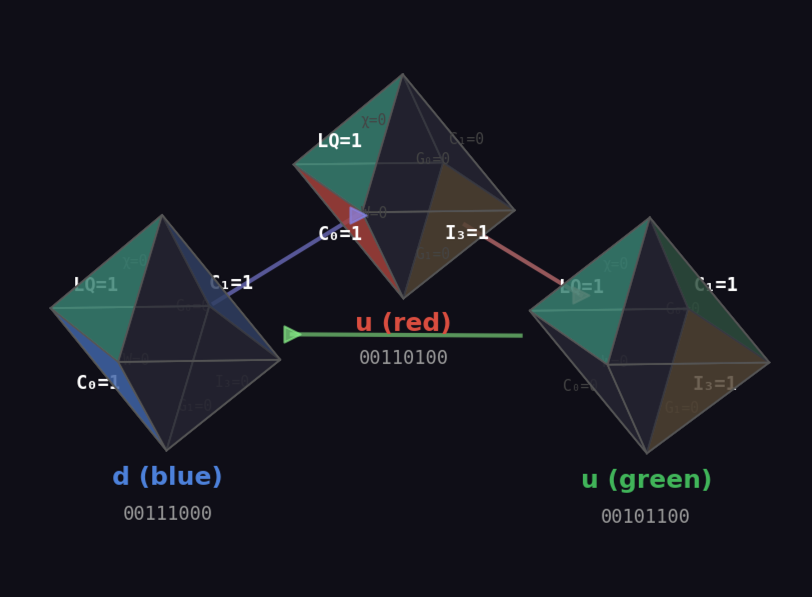
Recall from Article 4 that two of the 8 code bits — C₀ and C₁ — encode the colour charge. Their three non-zero combinations map to the three quark colours:
C₀ = 1, C₁ = 0 corresponds to Red. C₀ = 0, C₁ = 1 corresponds to Green. C₀ = 1, C₁ = 1 corresponds to Blue.
Now recall from Article 5 that these bits live on the triangular faces of the octahedral void, and that C₀ and C₁ sit on opposite faces — the antipodal pair at maximum distance on Q₃. The octahedron has three natural axes (±x, ±y, ±z), and the colour bits’ excitation pattern corresponds to which axis is activated.
A red quark has its colour excitation oriented along the x-axis. A green quark is oriented along the y-axis. A blue quark along the z-axis. Colour charge is not a mysterious abstract label. It is the direction that the qubit excitation points within the octahedral void.
This is why there are exactly three colours: the octahedron lives in three-dimensional space, and there are exactly three independent directions. Not four, not two, not seventeen. Three spatial dimensions give three colours. The number is not a coincidence or a parameter — it is the dimensionality of the space the lattice fills.
What Is a Gluon?
In QCD, the strong force between quarks is mediated by gluons — massless particles that carry colour charge themselves, making the strong force fundamentally different from electromagnetism (where the photon carries no electric charge).
On the lattice, a gluon is something much simpler: it is a colour-changing face-flip propagating along a bridge edge.
Consider two adjacent octahedral voids connected by a bridge. One void contains a red quark (C₀ = 1, C₁ = 0). The other contains a green quark (C₀ = 0, C₁ = 1). When the walk operator propagates amplitude across the bridge, it can exchange colour information between the two voids. The quark in void A changes from red to green; the quark in void B changes from green to red.
What travels along the bridge? The difference between the two colour patterns. And the difference is computed by the simplest possible binary operation: XOR (exclusive OR).
Red XOR Green = (1,0) XOR (0,1) = (1,1) = Blue.
The gluon carries the third colour — the one that neither quark had before the exchange. When a red quark becomes green, a blue gluon travels down the bridge. When a green quark becomes blue, a red gluon travels. When a blue quark becomes red, a green gluon travels.
This is not an analogy. It is the exact arithmetic. Here are all six colour-changing gluon types:
Red (1,0) → Green (0,1): gluon = (1,1) = Blue. Green (0,1) → Blue (1,1): gluon = (1,0) = Red. Blue (1,1) → Red (1,0): gluon = (0,1) = Green. Green (0,1) → Red (1,0): gluon = (1,1) = Blue. Blue (1,1) → Green (0,1): gluon = (1,0) = Red. Red (1,0) → Blue (1,1): gluon = (0,1) = Green.
In every case, the gluon carries the missing third colour. The pattern is universal: only the C₀ and C₁ bits change during a gluon exchange. All other 6 bits are identical between the source and target quarks. The gluon modifies only the colour faces of the octahedron; the generation, chirality, isospin, weak charge, and lepton/quark flag are completely untouched.
The Standard Model’s SU(3) gauge group has 8 generators — 8 independent gluon types. Six are the colour-changing ones listed above. The remaining two are “diagonal” gluons that rotate the quantum phase of the colour bits without flipping their values. On the lattice, these correspond to phase excitations on the C₀ and C₁ faces — the qubit amplitudes rotate on the Bloch sphere without the classical bit value changing. Same faces, different dynamics. The full 8-gluon structure is present.
The Rubber Band
Now we can see why quarks are trapped.
A single quark sitting alone in the vacuum has colour bits (C₀, C₁) ≠ (0,0). Its colour faces are excited — one direction of the octahedron is lit up while the vacuum around it is in the colourless ground state (all colour bits zero on every void).
If the quark tries to move — propagating from one void to the next via the walk operator — it must carry its colour excitation with it. But each bridge it crosses connects the excited void to a previously colourless void. The receiving void now has non-zero colour bits, which means it too is in an excited state. The void the quark just left may return to its ground state, but the void it enters is now excited.
So far, this just describes a quark moving through space. But what happens if we try to separate two quarks that were originally close together?
Imagine a quark-antiquark pair (a meson) sitting on adjacent voids. The quark has colour (1,0) = red. The antiquark has anticolour (0,1) = antired (which is green in our convention). The pair is colour-neutral: their colour bits XOR to (0,0). The vacuum around them is undisturbed.
Now try to pull them apart. Move the quark one bridge to the right. Between the quark’s new position and the antiquark’s position, there is now one void that is in neither the quark state nor the antiquark state — but it cannot be in the colourless ground state, because the colour flux must be continuous from quark to antiquark. That intermediate void must carry a colour excitation to bridge the gap.
Each excited intermediate void costs energy — it is in a state above the vacuum ground state, separated by the spectral gap Δ ≥ 2 of the lattice band structure. Every bridge you stretch between the quark and antiquark adds one unit of gap energy.
The force between them is constant (one gap unit per bridge length), and the energy grows linearly with distance: V(r) = σr, where σ is the string tension (the energy per bridge of maintaining a colour excitation in the vacuum).
This is the confining potential. It is not an abstract consequence of SU(3) gauge theory. It is the direct, countable energy cost of maintaining a chain of colour-excited voids through a vacuum that prefers to be colourless. The “rubber band” connecting the quarks is a physical chain of lattice bridges, each one carrying a colour excitation that costs a fixed amount of energy.
Pull hard enough, and you might expect the rubber band to snap, freeing the quark. But it doesn’t snap — it breeds. When the energy stored in the stretched flux tube becomes large enough, it is energetically cheaper for the vacuum to create a new quark-antiquark pair from the tube’s energy than to continue stretching. The tube breaks, but each broken end immediately caps itself with a newly created quark or antiquark, producing two mesons instead of two free quarks.
You tried to free a quark and got two mesons instead. This is exactly what happens in particle colliders. It is why free quarks have never been observed. The lattice gives this a geometric explanation: the colour flux tube is a chain of excited bridge voids, and breaking the chain always creates new endpoints rather than free ends.
Building a Proton
To avoid the linear energy cost of a colour flux tube, quarks must combine into a colourless composite — a state where the total colour charge vanishes. On the lattice, “colourless” has a precise meaning: the colour bits of all the quarks in the composite must XOR to (0,0).
What is the smallest combination of quarks that achieves this?
Two quarks cannot do it. Any two of the three colour states XOR to the third, not to zero:
(1,0) XOR (0,1) = (1,1) — not colourless. (1,0) XOR (1,1) = (0,1) — not colourless. (0,1) XOR (1,1) = (1,0) — not colourless.
A quark-antiquark pair CAN do it (colour XOR anticolour = zero), giving mesons.
Three quarks, one of each colour, also do it:
(1,0) XOR (0,1) XOR (1,1) = (0,0) — colourless.
Red XOR Green XOR Blue = zero. The three directions cancel perfectly, leaving no residual orientation. The composite is rotationally symmetric — it looks the same from every angle.
This three-quark colourless combination is a baryon — and the two most important baryons are the proton (two up quarks plus one down quark) and the neutron (two down quarks plus one up quark).
On the lattice, the proton is a trimer: three adjacent octahedral voids, each carrying one quark of a different colour, connected by bridges along which gluons constantly circulate. The gluon circulation maintains the colour neutrality by perpetually swapping colours among the three voids — red becomes green, green becomes blue, blue becomes red — so that the total remains (0,0) at every instant.
The trimer is stable because it costs zero colour energy to the surrounding vacuum. There are no excited voids outside the trimer, no flux tubes stretching into empty space, no directional imbalance radiating outward. The vacuum is perfectly undisturbed. This is the lowest-energy state for three coloured quarks, and it is the state the system will naturally settle into.
Proton versus Neutron
If both are colour-neutral trimers of three quarks, what makes a proton different from a neutron?
The colour structure is identical — both have one red, one green, and one blue quark, all XORing to (0,0). The difference is in a single bit: I₃, the isospin face.
A proton contains two up quarks (I₃ = 1) and one down quark (I₃ = 0). A neutron contains two down quarks (I₃ = 0) and one up quark (I₃ = 1).
Electric charge derives from the code bits as Q = I₃ − ½(1 − LQ). For quarks (LQ = 1), this gives Q = +2/3 for up (I₃ = 1) and Q = −1/3 for down (I₃ = 0).
Proton: +2/3 + 2/3 − 1/3 = +1. Neutron: −1/3 − 1/3 + 2/3 = 0.
The charge difference between the two most important particles in the universe — the difference that makes chemistry, atoms, and life possible — is the count of lit I₃ faces across three octahedral voids. The proton has two lit; the neutron has one. That is the entire difference.
The neutron is slightly heavier than the proton (by 1.293 MeV, about 0.14%). This is because the down quark (I₃ = 0) has slightly higher spectral energy than the up quark (I₃ = 1) on the lattice — the walk operator’s eigenvalues are slightly different for the two isospin states. The neutron, having two of the heavier down quarks, pays a higher total energy. This tiny mass difference is what allows beta decay (neutron → proton + electron + antineutrino) and ultimately what makes nuclear physics, stellar fusion, and the periodic table of elements possible.
The Nuclear Force: Spare Bridges
Inside the proton trimer, each quark void uses 2 of its 6 available bridge connections for internal gluon circulation. The other 4 bridges point outward, into the surrounding vacuum.
These “spare” bridges are not inert. The walk operator is always propagating — even in the vacuum ground state, there are zero-point fluctuations along every bridge. When two nucleons (say, a proton and a neutron) sit close enough that their spare bridges point toward each other, something happens: the vacuum fluctuations on the outward-pointing bridges can correlate between the two trimers.
The mechanism is identical to the Casimir effect described in Article 1 — but now operating between nucleon surfaces rather than metal plates. The vacuum between two nearby nucleons has fewer available fluctuation modes than the vacuum outside them (because the trimers’ colour structures constrain what the intermediate voids can do). The imbalance in vacuum fluctuation density creates a net attractive force pulling the nucleons together.
This residual attraction is the nuclear force — the force that binds protons and neutrons into atomic nuclei. In the Standard Model, it is described as pion exchange: a virtual quark-antiquark pair (the pion) hopping between nucleons. On the lattice, the pion is a transient colour-neutral excitation propagating along the spare bridges between two trimers. It is colour-neutral (otherwise it would create a flux tube and cost too much energy), but it carries isospin (the I₃ bit can flip during the exchange, converting a proton to a neutron or vice versa).
The force is attractive at medium range (about 1–2 femtometres, corresponding to 1–2 bridge lengths beyond the trimer surface) because correlated vacuum fluctuations lower the total energy. But it becomes violently repulsive at short range (when the two trimers are pushed so close that they physically overlap) because overlapping trimers cannot simultaneously satisfy the colour XOR = (0,0) constraint. Six quarks on six adjacent voids cannot all cancel each other’s colour — the code literally cannot accommodate it. The resulting parity-check violations create a massive energy spike that pushes the nucleons apart.
This short-range repulsion followed by medium-range attraction is exactly the shape of the measured nuclear potential — the “Goldilocks zone” that allows atomic nuclei to exist without either flying apart or collapsing into a point.
What Is a Force?
Throughout this article, we have used the word “force” repeatedly — the confining force, the nuclear force, the repulsive force. But on the information lattice, there are no forces in the Newtonian sense. There are no invisible pushes or pulls acting at a distance. There are only three things: voids carrying bit patterns, bridges connecting them, and the walk operator propagating amplitude.
So what is a “force”?
It is an energy gradient. The walk operator propagates amplitude through the lattice. Some spatial configurations of bit patterns have lower total spectral energy than others (fewer lattice violations, fewer excited voids, fewer broken parity checks). The walk operator’s unitary dynamics naturally concentrate amplitude on lower-energy configurations — not because anything “wants” to minimise energy, but because low-energy eigenstates oscillate slowly and reinforce through constructive interference, while high-energy states oscillate rapidly and cancel through destructive interference.
Over time, the probability of finding the system in a low-energy configuration grows, and the probability of finding it in a high-energy configuration shrinks. We perceive this as an “attractive force” pulling the system toward the low-energy arrangement — but it is really just the walk operator doing arithmetic on bit patterns, and some arrangements costing fewer violations than others.
Newton’s F = −dE/dx is not a law imposed on the lattice. It is a theorem of the walk operator’s spectral structure. The “force” is the energy saved per unit distance when two objects move from a high-energy configuration to a low-energy one. On a discrete lattice, this becomes a finite difference: F = −[E(d+1) − E(d)]/a, where d is the separation in bridge lengths and a is the bridge spacing.
Feynman spent a career teaching that forces arise from the exchange of virtual particles. On the lattice, we can see what that exchange actually is: it is the walk operator propagating bit-pattern excitations along bridges between voids, and two voids finding that their combined energy is lower when the patterns between them correlate. The “virtual particle” is the propagating excitation. The “force” is the energy gradient it creates.
The Summary
Colour charge is spatial direction. Gluons are face-flips propagating along bridges. Confinement is the linear energy cost of maintaining a chain of excited voids through a colourless vacuum. The proton is a rotationally symmetric trimer of three colour-complementary voids. The neutron differs from the proton by a single bit on a single face. The nuclear force is the Casimir-like correlation of vacuum fluctuations between the spare bridges of adjacent trimers. And force itself is nothing but an energy gradient — the walk operator finding that some bit-pattern arrangements cost fewer lattice violations than others.
None of this requires SU(3) gauge theory, path integrals, or the mathematical apparatus of quantum chromodynamics. It requires 2 bits per void (C₀ and C₁), binary XOR, and the spectral gap of the lattice band structure. The million-dollar question — why do quarks confine? — has a five-word answer: colour flux tubes cost energy.
Whether this answer is correct is for experiment and computation to decide. Whether it is clear is, we hope, beyond dispute.
Coming Next
Article 7: “The Numbers That Fall Out” — The fine-structure constant from counting faces. The weak mixing angle from counting elements. The Planck mass from balancing the vacuum. And the dark energy equation of state from counting constraints.
The gluon exchange diagrams, proton trimer visualisation, and nuclear binding figures referenced in this article are available at neusym.ai/research.
Dave Elliman is the founder of Neuro-Symbolic Ltd and was a Professor of Computer Science at the University of Nottingham, he has since had a successful research career in industry. His research spans information theory, neuro-symbolic AI, and quantum information.
The title of this series nods to Richard Feynman’s “Six Easy Pieces” (1995). Feynman needed six. The octahedron needs eight.