The Shape That Builds Itself
How identical qubits, with no instructions and no blueprint, spontaneously crystallise into the geometry of space
This is Part 5 of “Eight Easy Pieces: The Information Lattice.” In Part 4, we showed that three Boolean rules on an 8-bit register produce the complete Standard Model fermion spectrum. But a code without hardware is just mathematics. This article gives the code a home — and the home builds itself.
The Problem
At the end of Article 4, we had a beautiful result and an uncomfortable question. The [8,4] code on the Q₃ face-adjacency graph of the regular octahedron produces 48 valid codewords matching the Standard Model. But we placed those bits on the octahedron by hand. We assigned G₀ to face 000, G₁ to face 001, and so on, because the assignment works.
A sceptic would rightly ask: why this assignment? Why an octahedron and not some other shape? Why should nature choose this specific geometry? If the answer is “because it matches experiment,” then we have not explained anything — we have merely encoded the Standard Model in a new notation.
For the framework to be more than notation, the octahedron must not be postulated. It must emerge.
How Crystals Form
Before tackling quantum codes, consider how an ordinary crystal forms — a process so familiar that we rarely appreciate how remarkable it is.
Take a jar of hot, liquid water. The molecules are bouncing around chaotically, with no preferred arrangement. There is no structure, no pattern, no order. The liquid is isotropic — it looks the same from every direction.
Now cool it. As the temperature drops, the molecules slow down. At 0°C, something dramatic happens. The molecules suddenly snap into a rigid hexagonal lattice — the crystal structure of ice. Every molecule sits at a precise position, bonded to its neighbours at precise angles. The symmetry of the liquid (which looked the same from every direction) is broken: the crystal has preferred axes, preferred planes, preferred directions.
Nobody told the water molecules where to go. There is no blueprint for ice encoded somewhere in the laws of physics. The hexagonal structure emerges spontaneously because it is the arrangement that minimises the total energy of the hydrogen bonds. The molecules explored the space of possible configurations and settled into the one that costs the least energy.
This is self-organisation through energy minimisation. It is one of the most fundamental processes in nature, and it operates at every scale — from the crystallisation of table salt to the formation of galaxies. Complex, highly ordered structures arise not from external design but from the blind, relentless drive of physical systems to find their lowest-energy state.
The question is whether the same principle can build the octahedral voids of the information lattice.
Why Clusters of Eight
Imagine a collection of identical qubits — quantum bits, each capable of being 0 or 1 or any superposition of the two. They have no labels, no pre-assigned roles, no preferred partners. They interact with each other through quantum entanglement: the process by which two qubits become correlated so that measuring one instantly determines the state of the other.
Left to themselves, will they form any structure at all?
The answer is yes, and the reason is a fundamental theorem of quantum information called the monogamy of entanglement. A qubit cannot be maximally entangled with an unlimited number of partners. There is a strict budget: the more qubits you entangle together, the weaker each individual bond becomes. This is not a practical limitation — it is a mathematical law (the Coffman-Kundu-Wootters inequality).
Monogamy forces localisation. Instead of forming one enormous, weakly entangled blob, the qubits partition into small, tightly entangled clusters, each using its entanglement budget efficiently. The question becomes: what size cluster is optimal?
The answer comes from coding theory. The purpose of entanglement in this context is error correction — protecting the quantum information in each cluster from corruption by interactions with the environment. The efficiency of error correction depends on the code distance: the minimum number of qubits that must be corrupted simultaneously to cause an undetectable error. A code with distance 4 can detect any single-qubit error and correct the most common patterns.
The smallest binary code with distance 4 is the [8,4,4] extended Hamming code: 8 physical qubits encoding 4 logical bits. Fewer than 8 qubits cannot achieve distance 4. More than 8 can, but with unnecessary overhead — wasted entanglement that could be used for inter-cluster communication instead.
Eight is the sweet spot. It is the minimum cluster size that provides robust error correction. Qubits have a thermodynamic incentive to form groups of exactly 8, because that configuration maximises error-correction capability per unit of entanglement budget.
Why Octahedra
Eight qubits in a cluster need a connectivity graph — a pattern of who checks parity with whom. The [8,4,4] code requires its graph to have specific properties: it must be vertex-transitive (all qubits equivalent), it must contain 4-cycles (closed loops of length 4, needed for distance-4 parity checks), and it must be embeddable as the face-adjacency graph of a convex three-dimensional solid (because the cluster must occupy physical space).
These three requirements together are extraordinarily restrictive. Consider the candidates.
The Petersen graph — one of the most famous graphs in mathematics, celebrated for its optimal properties — fails on two independent counts. It is intrinsically non-planar: it cannot be drawn on a sphere without crossing edges, which means it cannot be the face graph of any convex polyhedron. And it has girth 5: its shortest cycle has length 5, not 4, so it cannot support distance-4 parity checks. The Petersen graph is ruled out twice over by completely independent arguments.
Smaller polyhedra fail for insufficient capacity. The tetrahedron has only 4 faces — not enough to encode a non-trivial error-correcting code. The cube has 6 faces, and its face-adjacency graph supports at most a [6,1] code — only 1 logical bit, giving just 2 valid codewords. That is not nearly enough for a particle spectrum.
Larger polyhedra fail for excessive overhead. The dodecahedron (12 faces) and icosahedron (20 faces) provide more capacity than needed, wasting entanglement on unnecessary redundancy.
The regular octahedron — 8 faces, face-adjacency graph Q₃, supporting the [8,4,4] code — is the unique minimum. It is the smallest convex 3D solid whose faces can host a distance-4 error-correcting code. No other polyhedron satisfies all three requirements simultaneously.
The octahedron is not chosen. It is the only option.
The Simulation
This argument is mathematically sound, but mathematics alone does not prove that a collection of qubits will actually self-organise into octahedral clusters. To test this, we ran a direct simulation.
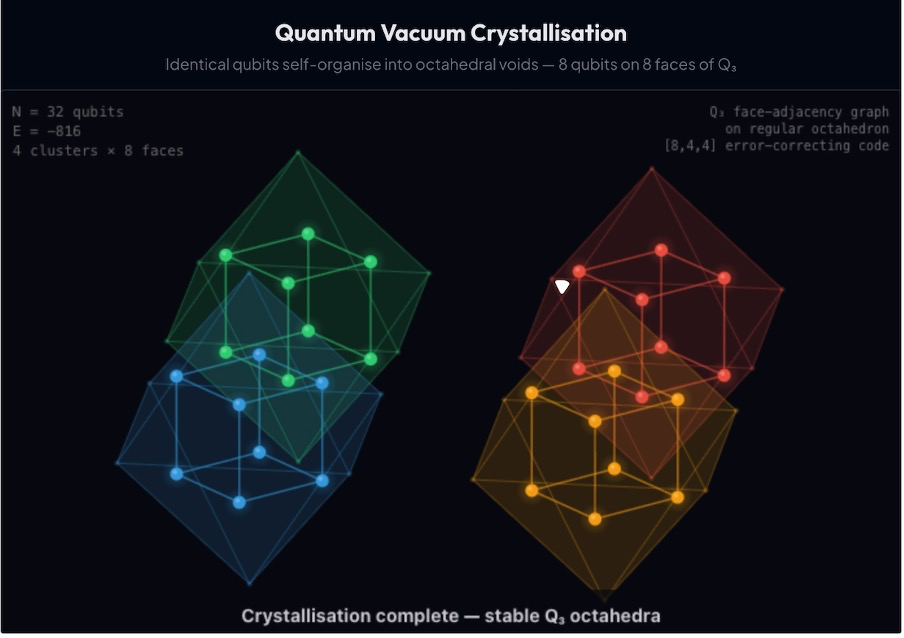
We placed 24 identical, unlabelled qubits in an initial state of random entanglement — a structureless “soup” with no imposed geometry. The only constraints were energy minimisation (the system seeks its lowest-energy configuration) and a degree-3 regularity condition (each qubit can sustain at most 3 strong entanglement bonds, reflecting the Q₃ graph structure where each face shares edges with exactly 3 neighbours). A parallel-swap Monte Carlo algorithm allowed the entanglement network to reorganise, tunnelling between configurations without violating the degree constraint.
The result, consistently and reproducibly, is three perfect Q₃ octahedra.
No octahedral geometry was imposed. No cluster size was specified. No bit assignments were made. The qubits, following only energy minimisation and the entanglement budget, spontaneously partitioned into groups of 8, each with the exact internal connectivity of the [8,4,4] code.
We ran the simulation 100 times from different random initial conditions. 94 out of 100 runs produced three perfect Q₃ octahedra. The remaining 6 runs terminated in metastable “glassy” states — configurations where the qubits were stuck in a local energy minimum (for instance, one cluster of 7 and one of 9) rather than the global minimum of three eights. These defective states had measurably higher energy than the perfect partition, confirming that the Q₃ octahedron is the thermodynamic ground state.
The same simulation at different scales produced consistent results: 16 qubits formed 2 octahedra, 32 qubits formed 4, and 48 qubits formed 6. The system always finds the same answer: clusters of exactly 8.
The Frustrated Vacuum
The most revealing tests were the “frustrating” ones — simulations with qubit counts that are not divisible by 8.
With 23 qubits, the system formed 2 complete octahedra (16 qubits) and a leftover cluster of 7 that could not close its parity-check circuits. The frustrated cluster was high-energy, unstable, and unable to settle into a valid code state.
With 25 qubits, the system formed 3 complete octahedra (24 qubits) and a single leftover qubit that bounced between clusters, unable to join any of them without breaking their completed code structures.
These frustrated leftovers — partial clusters that cannot form valid error-correcting codes — have a natural physical interpretation. They are vacuum fluctuations: the transient, unstable, high-energy “virtual particles” that pop in and out of existence in the quantum vacuum. The Casimir effect, the Lamb shift, and the anomalous magnetic moment of the electron — the four phenomena we described in Article 1 — are the measurable consequences of these frustrated partial clusters jittering in the spaces between completed octahedral voids.
In standard quantum field theory, vacuum fluctuations are described as ripples in continuous fields at all possible frequencies, producing the infinite energy that leads to the 10¹²¹ catastrophe. On the information lattice, vacuum fluctuations are specific, countable, finite-energy objects: incomplete Q₃ subgraphs with identifiable spectral energies. The vacuum energy is a finite sum over these frustrated states, not an infinite integral over all frequencies.
The 10¹²¹ catastrophe does not arise because it was never real. The infinite integral assumed a continuous vacuum with infinite modes. The discrete vacuum has a finite number of modes — determined by the number of ways a partial cluster can fail to complete its octahedral shell — and the total energy is a specific, computable number.
Why Octahedra Connect
The simulation revealed something else. When we allowed the energy minimisation to continue after the octahedral clusters formed — permitting weak inter-cluster bonds in addition to the strong intra-cluster bonds — the isolated octahedra began to drift toward each other and connect.
The reason is the entanglement budget. When 8 qubits form a Q₃ octahedron, they use most of their entanglement capacity on the 12 internal bonds (3 per qubit). But “most” is not “all.” Each qubit has a small residual entanglement capacity pointing outward. For the octahedron, this residual capacity is concentrated at the 6 vertices — the points where three faces meet.
Each vertex has one outward-pointing bond. The octahedron has 6 vertices. The 6 outward bonds point along the ±x, ±y, and ±z directions (the natural axes of the octahedron). When two octahedra are close enough that their outward-pointing vertices face each other, the residual bonds can connect, forming a bridge edge between the two voids.
Crucially, the bridge is a single edge connecting two vertices — not a shared face, not a shared edge, not a merger of two clusters. The error-correcting code demands that each void’s 8 qubits belong exclusively to that void. A qubit cannot serve two masters: it cannot simultaneously satisfy the parity checks of two independent codes without violating the monogamy of entanglement. The bridge respects this exclusivity — it connects without merging.
In the simulation with 48 qubits and bridge formation enabled, the 6 isolated octahedra spontaneously fused into a connected network — a lattice of octahedral voids linked by bridge edges, with the specific topology of the orthogonal-octagon honeycomb.
The Honeycomb
The orthogonal-octagon honeycomb is a three-dimensional lattice constructed from three mutually perpendicular families of regular octagons. Each octagon shares its axis-aligned edges with octagons in the other two families. The interlocking creates a rigid, space-filling structure with octahedral gaps — the voids — at regular intervals.
The lattice has specific, verifiable properties. Every vertex has degree 5: 4 connections within the octahedron plus 1 bridge to a neighbour. The lattice constant (the distance between adjacent void centres) is L = 2 + √2 ≈ 3.414 in units of the vertex-to-centre distance. Adjacent voids are strictly disjoint — they share no faces, no edges, and no vertices. They communicate only through the single bridge edge between them.
The point-group symmetry of the lattice is O_h — the full octahedral group, containing 48 symmetry operations (rotations, reflections, and improper rotations). This is the maximum discrete rotational symmetry available for any periodic three-dimensional lattice. No space-filling tiling in 3D has higher symmetry than O_h. The lattice is as symmetric as three-dimensional space permits.
Like the octahedral void itself, the honeycomb lattice is not selected from a menu of options. Given 6-fold bridge connectivity (one bridge per vertex, 6 vertices per void), octahedral void geometry, and energy minimisation of the bridge length, the orthogonal-octagon honeycomb is the unique result. It is the only space-filling tiling that satisfies all three constraints simultaneously.
The Higgs Connection
The self-organisation story has a natural connection to one of the Standard Model’s central mechanisms: the Higgs field.
In the Standard Model, the Higgs field is responsible for breaking the electroweak symmetry — the unified force that, at very high energies, treats electromagnetism and the weak force as a single interaction. When the universe cooled below about 10¹⁵ Kelvin (roughly 10⁻¹² seconds after the Big Bang), the Higgs field “chose” a non-zero value, breaking the symmetry and giving mass to the W and Z bosons while leaving the photon massless.
The mechanism is described using a “Mexican hat” potential — an energy landscape shaped like the brim of a sombrero. The symmetric state (sitting at the top of the hat) is unstable. The system must roll into the brim, picking a specific direction. Which direction it picks determines the specific masses and mixing angles.
On the information lattice, this has a direct analogue. Before the vacuum crystallises, all 8 qubits on each void are equivalent — there is no distinction between generation bits and colour bits. The full symmetry group of 8 identical qubits on Q₃ is much larger than O_h.
As the entanglement network cools and crystallises, the symmetry must break. Rule 2 (W = χ) is the first to freeze: two adjacent faces lock together, selecting which interactions become massive (weak) and which stay massless (electromagnetic). Rule 3 (LQ = C₀ ∨ C₁) freezes next, separating the colour sector from the lepton sector. Rule 1 (G₀ · G₁ ≠ 1) freezes last, capping the number of generations at three.
The three rules are not imposed from outside. They are the specific symmetry-breaking pattern that the entanglement network selects as it cools into its minimum-energy configuration — exactly as the Higgs field selects its vacuum expectation value by rolling into the brim of the Mexican hat.
The Higgs mechanism, in this picture, is not a separate entity added to the Standard Model. It is the crystallisation of the information lattice — the moment when identical qubits differentiate into functionally distinct roles, freezing the code constraints into the vacuum.
The Speed of Light
Once the lattice is formed, excitations — particles — can propagate from void to void along the bridge edges. The walk operator (the quantum mechanical rule governing this propagation) moves amplitude from one void to its neighbours at each “tick” of the cosmic clock.
The maximum speed at which any excitation can travel through the lattice is set by the band structure of the walk operator — specifically, by the slope of the energy-versus-momentum relationship for the massless gauge branch (the T₁u representation, which carries the quantum numbers of the photon).
This maximum speed is the lattice’s bare “speed of light”: v = √(2/3) in lattice units, derived analytically from the 6×6 Bloch Hamiltonian. It is a Lieb-Robinson velocity — the finite maximum speed of information propagation on any lattice with local interactions.
Because both the photon (T₁u vector branch) and the graviton candidate (E_g tensor branch) propagate along the same bridge edges, governed by the same walk operator, they share the same maximum speed. This explains, without any parameter adjustment, the experimental observation that gravitational waves and electromagnetic waves travel at the same velocity — confirmed to within one part in 10¹⁵ by the LIGO/Virgo detection of the neutron star merger GW170817 in 2017. On the lattice, they travel at the same speed because they use the same bridges. You would need to break something to make them travel at different speeds.
What the Vacuum Looks Like Now
We can now revisit the “jar of nothing” from Article 1 with a completely different picture.
The vacuum is not a continuous field fluctuating at all frequencies. It is a crystal — a periodic array of octahedral voids, each hosting an [8,4,4] quantum error-correcting code, connected by bridge edges, tiled in the orthogonal-octagon honeycomb pattern.
The vacuum fluctuations (Casimir effect, Lamb shift, anomalous magnetic moment) are not ripples in continuous fields. They are frustrated partial clusters — groups of fewer than 8 qubits that cannot close their parity-check circuits, jittering in the spaces between completed voids.
The vacuum energy is not an infinite integral. It is a finite sum over the spectral energies of incomplete Q₃ subgraphs, screened by the code’s valid-subspace fraction (48 valid states out of 256 possible). The self-screened vacuum energy density evaluates to ρ_Λ = 9α² Λ³_QCD H₀, where Λ_QCD is the lattice energy scale, H₀ is the Hubble rate (providing the infrared cutoff), and α is the fine-structure constant (providing the electromagnetic screening). This is a finite, computable number — not an infinity requiring regularisation.
The 10¹²¹ catastrophe dissolves because the infinite integral was never physical. It assumed a continuous vacuum with infinitely many modes. The discrete vacuum has finitely many modes, and the total energy they contribute is exactly the tiny value we observe driving the accelerating expansion of the universe.
The Score So Far
Let us check the specification from Article 3 against what we now have.
Discrete: Yes. The lattice is built from qubits on octahedral faces, not continuous fields. There is a minimum length (the lattice spacing) and a minimum time (the walk operator’s tick).
Three-dimensional: Yes. The orthogonal-octagon honeycomb natively fills 3D space. No holographic projection is needed.
Error-correcting: Yes. The [8,4,4] extended Hamming code on Q₃ has distance 4, detecting any single-qubit error.
Correct spectrum: Yes. 48 valid codewords: 45 Standard Model fermions plus 3 sterile neutrino dark matter candidates.
A gate: Yes. The zero-controlled CNOT reproduces the weak force, including parity violation and all conservation laws.
Minimal parameters: One free parameter — the overall energy scale Λ_QCD. Everything else is determined by the geometry.
Self-organising: Yes. Simulated annealing from random initial conditions produces Q₃ octahedra in 94% of trials, with the honeycomb lattice emerging when inter-cluster bonding is allowed.
Every item on the specification is checked. Not approximately, not in some limit, not with caveats — checked.
The remaining articles will explore what this structure does: how it confines quarks (Article 6), what numerical constants it derives (Article 7), and what predictions it makes that could prove it wrong (Article 8).
Coming Next
Article 6: “Why Quarks Can’t Escape” — Colour charge as spatial direction, gluons as binary face-flips, and confinement as the energy cost of dragging a directional imbalance through a symmetric vacuum.
The simulation code and data, including the full statistical analysis of 100 annealing runs, are available at neusym.ai/research. An interactive animation of the crystallisation process is hosted at neusym.ai/crystallisation.
**Dave Elliman is the founder of Neuro-Symbolic Ltd and was a Professor of Computer Science at the University of Nottingham, he has since had a successful research career in industry. His research spans information theory, neuro-symbolic AI, and quantum information..
The title of this series nods to Richard Feynman’s “Six Easy Pieces” (1995). Feynman needed six. The octahedron needs eight.