Wheeler's Dream and Why Nobody Could Build It
The forty-year quest to build the universe from information — and the one thing everyone was missing
This is Part 3 of “Eight Easy Pieces: The Information Lattice.” In Part 1, we showed that “empty” space is full of measurable energy whose total value is wrong by 10¹²¹. In Part 2, we surveyed the Standard Model — spectacularly precise, spectacularly unexplanatory, and blind to 95% of the universe. This article traces a different path: the idea that information, not matter, is the foundation of reality.
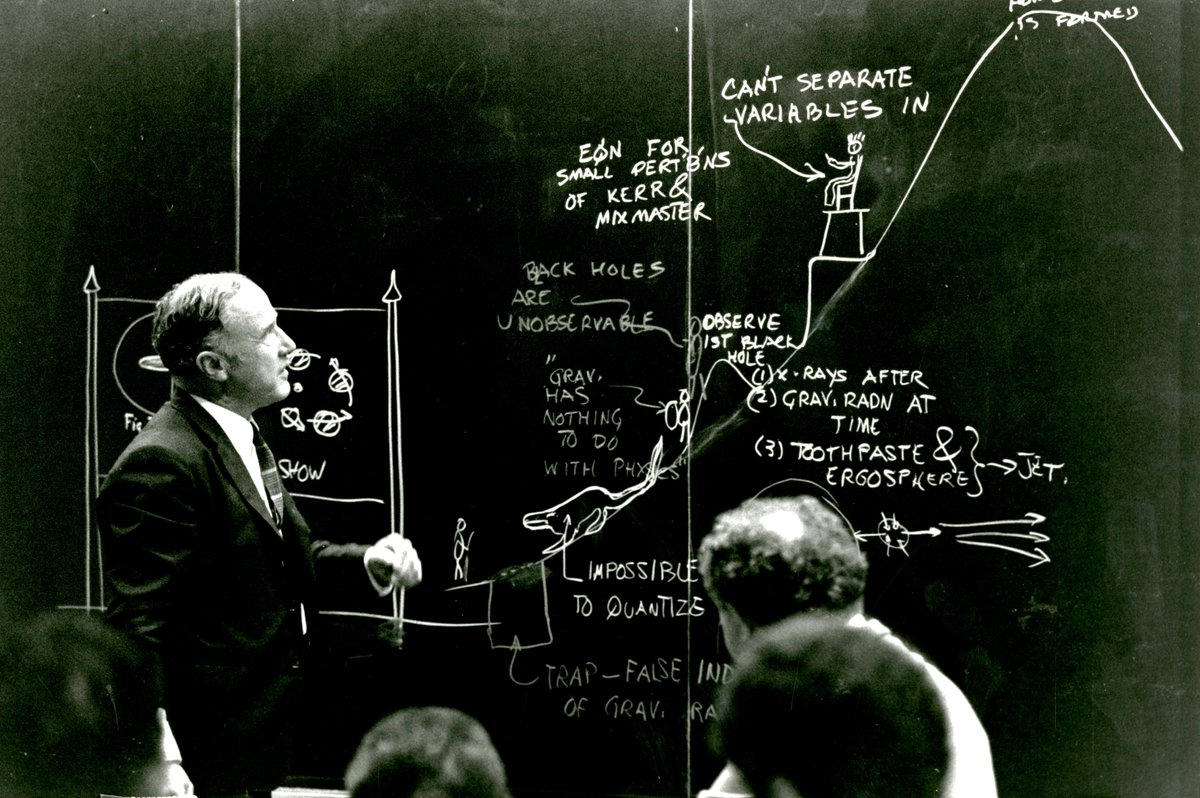
The Mentor’s Last Idea
John Archibald Wheeler had an unusual career, even by the standards of theoretical physics. He helped develop the theory of nuclear fission. He worked on the Manhattan Project. He supervised Richard Feynman’s doctoral thesis. He coined the terms “black hole,” “wormhole,” and “quantum foam.” He was, by any measure, one of the most influential physicists of the twentieth century.
And at the end of his career, he threw all of it into question.
In 1990, at the age of 79, Wheeler published a paper with the title “Information, Physics, Quantum: The Search for Links.” In it, he proposed a radical idea that he summarised in three words: “It from Bit.”
The argument was deceptively simple. Every measurement in physics, Wheeler observed, ultimately comes down to a yes-or-no question. Does the detector click? Is the spin up or down? Did the photon pass through the left slit or the right? At the deepest level, every physical quantity — mass, charge, position, momentum — is extracted from binary answers. Bits.
From this, Wheeler made a leap. What if the bits aren’t just how we measure reality? What if the bits ARE reality? What if every particle, every force, every law of nature derives its existence from information — from binary choices, processed according to rules we haven’t yet discovered?
“Every it — every particle, every field of force, even the space-time continuum itself — derives its function, its meaning, its very existence entirely from binary choices, bits,” Wheeler wrote. “What we call reality arises in the last analysis from the posing of yes-no questions.”
The physics community’s reaction was polite, interested, and ultimately noncommittal. The idea was beautiful. It was also empty. Wheeler gave no specific mechanism. He couldn’t say how many bits make an electron, or what rules govern them, or how the bits produce the specific particles and forces we observe. “It from bit” was a slogan in search of a theory.
Wheeler died in 2008. The theory was still missing.
The First Hint: Black Holes Know How to Count
Wheeler’s intuition didn’t come from nowhere. There was already a powerful clue that information and physics were deeply connected, and it came from the most extreme objects in the universe: black holes.
In 1972, Jacob Bekenstein — then a graduate student of Wheeler’s — asked what seemed like a simple question. If you throw a book into a black hole, the information in the book disappears behind the event horizon, irretrievably lost to the outside universe. But thermodynamics has a law — the second law — that says the total entropy (roughly, the total amount of disorder or missing information) of a closed system can never decrease. If the book’s information vanishes, doesn’t the total entropy of the universe go down, violating the second law?
Bekenstein’s answer was startling. The black hole itself must carry entropy, and that entropy must increase by at least as much as the information in the book. He calculated how much entropy a black hole should have, and found that it was proportional to the surface area of the event horizon — not the volume of the black hole’s interior.
This was profoundly strange. For every other physical system — a box of gas, a bucket of water, a room full of furniture — the entropy is proportional to the volume. Double the box, double the entropy. But a black hole’s information content scales with its surface, not its bulk. A black hole the size of the solar system contains no more information per unit area than one the size of a football.
Stephen Hawking initially set out to prove Bekenstein wrong. Instead, he proved him right — and discovered something even more remarkable. Using quantum field theory in curved spacetime, Hawking showed that black holes radiate. They have a temperature. They evaporate. And the total entropy of a black hole is given by a precise formula:
S = A / (4 × Planck length²)
where A is the area of the event horizon. This is the Bekenstein-Hawking entropy, and it is one of the most important equations in theoretical physics. It says, in plain language: the maximum information that can be stored in a region of space is finite, and it is counted by the boundary of that region, not the interior.
Information isn’t just a metaphor for physics. Information is countable, and the universe does the counting on surfaces.
The Holographic Principle: The Universe as a Projection
In the mid-1990s, Gerard ‘t Hooft and Leonard Susskind took Bekenstein’s insight and pushed it to its logical extreme. If the information content of any region of space is determined by its boundary, then maybe the three-dimensional interior is, in some sense, a projection of a two-dimensional boundary.
They called this the holographic principle: all the physics happening inside a volume of space can, in principle, be completely described by information encoded on the boundary of that volume. The three-dimensional world we experience might be a holographic image projected from a two-dimensional surface — much as a hologram on a credit card encodes a three-dimensional image on a flat surface.
This sounds like philosophy, but in 1997, Juan Maldacena made it mathematically precise. He discovered a specific example — called the AdS/CFT correspondence — in which a theory of gravity in a five-dimensional anti-de Sitter space is exactly equivalent to a quantum field theory (without gravity) living on the four-dimensional boundary of that space. Every calculation you can do in the gravitational theory has a precisely corresponding calculation in the boundary theory, and vice versa.
The correspondence has passed every mathematical test thrown at it for nearly thirty years. It is one of the most important results in theoretical physics this century. And its deepest implication is this: gravity, geometry, and spacetime might not be fundamental. They might be emergent — arising from the information structure of a lower-dimensional system, the way a hologram arises from an interference pattern on a flat plate.
Wheeler’s intuition was looking more prescient by the year.
Digital Physics: The Universe as a Computer
While the holographic programme was developing within mainstream string theory, a more radical group of physicists was pursuing Wheeler’s idea directly. What if the universe is not just described by information, but IS information — specifically, a computation?
Edward Fredkin, an MIT computer scientist, proposed in the 1980s that the universe is a cellular automaton — a giant grid of cells, each in a definite state, updating according to simple local rules at each tick of a cosmic clock. The laws of physics, in this view, are the update rules. Particles are patterns in the grid. Motion is the propagation of patterns from cell to cell.
Konrad Zuse, the German engineer who built one of the world’s first programmable computers, had actually proposed this idea even earlier, in 1969. He called it “Rechnender Raum” — Computing Space. But Zuse’s idea was largely ignored at the time; the physics community wasn’t ready for it.
Gerard ‘t Hooft — the same ‘t Hooft who co-developed the holographic principle, and a Nobel laureate for his work on the Standard Model — spent years developing a “Cellular Automaton Interpretation of Quantum Mechanics.” He argued that quantum mechanics, with all its apparent randomness and non-locality, might arise from a completely deterministic, classical automaton operating at the Planck scale. The apparent randomness we observe would be a consequence of our inability to access the underlying deterministic states — much as a coin flip appears random to someone who can’t measure the exact initial conditions.
Stephen Wolfram, the creator of Mathematica, launched a highly publicised research programme in 2020 proposing that the universe is a hypergraph — an abstract network of connections — evolving through simple replacement rules. Wolfram’s programme generated a great deal of public interest and some genuine mathematical results, particularly around the emergence of spacetime geometry from graph dynamics.
Each of these programmes captured something important. Fredkin and Zuse showed that computation could be a metaphor for physics. ‘t Hooft showed that determinism could underlie quantum mechanics. Wolfram showed that complex geometry could emerge from simple rules.
But none of them produced the Standard Model. None of them could say: “Here is a specific computation that generates exactly these particles with exactly these quantum numbers.” The programmes offered frameworks — ways of thinking about physics as computation — without identifying the specific computation that our universe is running.
Error Correction: The Deepest Clue
The most important development in the “it from bit” programme came not from digital physics but from an unexpected direction: quantum error correction.
In quantum computing, information is stored in qubits — quantum bits that can exist in superpositions of 0 and 1. Qubits are fragile; they are easily corrupted by interactions with their environment (a process called decoherence). To protect quantum information, physicists encode it using quantum error-correcting codes — schemes that distribute the information across multiple physical qubits so that errors on individual qubits can be detected and corrected without destroying the encoded information.
In 2015, Ahmed Almheiri, Xi Dong, and Daniel Harlow published a remarkable paper showing that the holographic principle — the correspondence between a gravitational theory in the bulk and a quantum theory on the boundary — has the mathematical structure of a quantum error-correcting code. The three-dimensional interior of a region of spacetime is, in a precise mathematical sense, the “encoded” version of the two-dimensional boundary information, protected against local errors by the same mathematical structures that protect qubits in a quantum computer.
This result electrified the theoretical physics community. It suggested that the connection between information and physics wasn’t merely metaphorical. The universe might literally be running an error-correcting code, and the geometry of spacetime might be the code’s structure made manifest.
Independently, Sylvester James Gates — a physicist working on supersymmetry — discovered that the mathematical equations describing fundamental particles contain structures identical to the error-correcting codes used in computer science (specifically, doubly-even self-dual binary codes). The same mathematics that protects your phone’s data from corruption appears to be woven into the fabric of particle physics.
Wheeler’s dream was converging from multiple directions. Information is physical (Bekenstein). The universe counts it on surfaces (holographic principle). Spacetime might be a quantum error-correcting code (AdS/CFT). And the equations of particle physics contain literal computer science (Gates).
But nobody had put the pieces together into a single, specific, testable structure.
What Was Missing
By the mid-2020s, the “it from bit” programme had accumulated an impressive collection of clues, insights, and partial results. But it was stuck on a single, crucial question:
Which code?
If the universe is an error-correcting code, what code is it? How many bits (or qubits) per unit cell? What are the check equations? What is the code distance? What geometry does it live on? Which particles does it produce?
The holographic programme (Maldacena, AdS/CFT) provided a mathematical framework but only in anti-de Sitter space — a spacetime with a negative cosmological constant. Our universe has a positive cosmological constant. The framework didn’t directly apply.
The digital physics programme (Fredkin, Wolfram) provided computational models but couldn’t identify which specific automaton or hypergraph produces the Standard Model. Wolfram’s programme, despite extensive computational searches, has not found a specific rule that generates quarks, leptons, or gauge bosons.
The error-correction programme (Almheiri-Dong-Harlow, Gates) showed that codes appear in physics but didn’t specify which code produces which particle spectrum.
The missing piece was brutally specific: a concrete code, on a concrete geometry, that generates the concrete list of 45 known fundamental fermions with their concrete quantum numbers — three generations, two chiralities, three colours for quarks, colourless leptons, parity-violating weak interactions, and all the associated conservation laws.
Not a framework. Not a philosophy. Not a class of models. A single, specific, verifiable structure.
The Specification
What would such a structure need to look like? The requirements are surprisingly constrained.
It must be discrete — made of bits or qubits, not continuous fields. Otherwise, the vacuum energy integral diverges and we’re back to the 10¹²¹ catastrophe.
It must be three-dimensional — our universe has three spatial dimensions, and any lattice or code must fill 3D space without requiring holographic projection from a lower dimension.
It must be error-correcting — the particles we observe are extraordinarily stable (the proton has a lifetime exceeding 10³⁴ years), which means the code must protect against errors with a minimum distance large enough to prevent spontaneous corruption.
It must produce exactly the right spectrum — 45 active fermions in three generations, with the correct charges, colours, and chiralities, plus whatever dark matter candidates the code naturally generates.
It must have a gate — some local operation that produces the particle interactions we observe, including the parity-violating weak force, without violating the code’s error-correcting properties.
And ideally, it should have as few free parameters as possible — the whole point of Wheeler’s programme was to derive physics from information, not to fit information to physics.
These constraints are extraordinarily restrictive. Most codes fail immediately on one or more criteria. The space of candidates is not vast — it is tiny.
In the next article, we describe one that works.
Coming Next
Article 4: “What If Particles Are Just Error-Correcting Codes?” — An 8-bit register, three Boolean rules, one quantum gate, and the 48 fermions that fall out of the arithmetic.
For readers who want to explore the ideas in this article further: Bekenstein’s original 1973 paper “Black Holes and Entropy” (Physical Review D 7, 2333) is technical but readable. Susskind’s “The Black Hole War” (2008) tells the story of the holographic principle accessibly. Wheeler’s original “It from Bit” paper appears in the 1990 volume “Complexity, Entropy, and the Physics of Information” (ed. W. H. Zurek). Almheiri, Dong, and Harlow’s 2015 paper “Bulk Locality and Quantum Error Correction in AdS/CFT” (JHEP 04, 163) is the key technical reference for the error-correction connection.
The supporting research papers for this series are available at neusym.ai/research.
Dave Elliman is the founder of Neuro-Symbolic Ltd and was a Professor of Computer Science at the University of Nottingham, he has since had a successful research career in industry. His research spans information theory, neuro-symbolic AI, and quantum information.
The title of this series nods to Richard Feynman’s “Six Easy Pieces” (1995). Feynman needed six. The octahedron needs eight.