The Most Successful Failed Theory in Science
The Standard Model of particle physics gets everything right — and explains nothing
This is Part 1 of “The Information Lattice,” an 8-part series exploring whether the universe might be built from error-correcting codes rather than continuous fields.
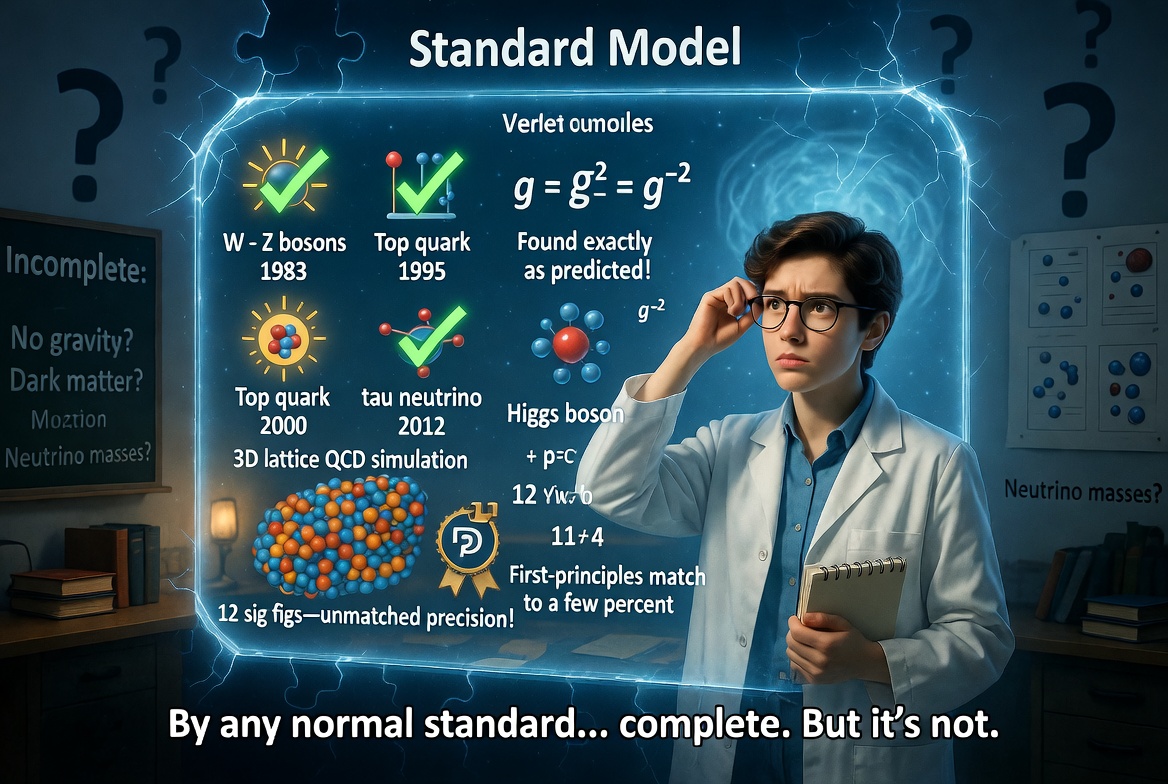
In 2012, physicists at CERN announced the discovery of the Higgs boson. Champagne was popped. Nobel Prizes were awarded. The final piece of the Standard Model of particle physics had fallen into place, confirming a theoretical framework assembled over fifty years by hundreds of physicists.
The Standard Model is, by any reasonable measure, the most precisely tested scientific theory in human history. Its prediction for the magnetic moment of the electron agrees with experiment to better than one part in a trillion — the equivalent of predicting the distance from London to New York to within the width of a human hair.
And yet, almost every particle physicist will tell you, usually after their second drink, that the Standard Model is deeply, fundamentally unsatisfying.
Not because it’s wrong. Because it doesn’t explain.
What the Standard Model Gets Right
To appreciate the scale of the problem, we first need to appreciate the scale of the achievement.
The Standard Model describes three of the four fundamental forces of nature — electromagnetism, the weak nuclear force, and the strong nuclear force — within a single mathematical framework called quantum field theory. It catalogues all known matter particles: six quarks (up, down, charm, strange, top, bottom), six leptons (electron, muon, tau, plus their three associated neutrinos), and the force-carrying bosons (photon, W⁺, W⁻, Z⁰, eight gluons, and the Higgs boson).
Its experimental track record is extraordinary:
Particle predictions. The Standard Model predicted the existence of the W and Z bosons (found 1983), the top quark (found 1995), the tau neutrino (found 2000), and the Higgs boson (found 2012) — each discovered with properties matching the theoretical predictions to high precision.
Precision measurements. The anomalous magnetic moment of the electron — the quantity g−2 — has been calculated from the Standard Model to twelve significant figures and measured experimentally to the same precision. The two numbers agree. Twelve decimal places. No other theory in any branch of science achieves this level of agreement between prediction and measurement.
Quark confinement. Using a technique called lattice QCD (where the equations are solved numerically on a supercomputer), physicists have calculated the masses of protons, neutrons, and other hadrons from first principles, reproducing the measured values to within a few percent.
By any normal standard, a theory this successful would be considered complete. The Standard Model is not considered complete. Here is why.
The Seven Gaps
Gap 1: The Nineteen Numbers Nobody Can Explain
The Standard Model contains at least 19 free parameters — numbers that must be measured experimentally and fed into the theory by hand. These include:
- 9 fermion masses (why is the top quark 340,000 times heavier than the electron?)
- 4 parameters of the CKM matrix (governing how quarks mix)
- 3 gauge coupling constants (the strengths of the three forces)
- The Higgs vacuum expectation value (246 GeV)
- The Higgs boson mass (125 GeV)
- The QCD theta parameter (governing CP violation in the strong force)
If neutrino masses are included (and they must be — neutrino oscillations prove neutrinos have mass), the count rises to 26, adding three neutrino masses and four parameters of the PMNS mixing matrix.
No principle within the Standard Model determines any of these numbers. They are inputs, not outputs. If you change them, you get a different universe — one that might not support atoms, chemistry, or life. Why these specific values? The Standard Model is silent.
Gap 2: Why Three Generations?
The fundamental particles come in three “generations” or families. The first generation (up, down, electron, electron neutrino) makes up all ordinary matter. The second (charm, strange, muon, muon neutrino) and third (top, bottom, tau, tau neutrino) are identical in every respect except that they are progressively heavier.
Why three? Why not two, or four, or seventeen? Nothing in the Standard Model forbids a fourth generation. Experiments at the Large Electron-Positron Collider in the 1990s showed that there are exactly three light neutrinos, but this is a measurement, not an explanation. The theory provides no structural reason why the pattern stops at three.
Gap 3: Why This Specific Gauge Group?
The Standard Model’s mathematical structure is built on three intertwined symmetry groups: SU(3) for the strong force, SU(2) for the weak force, and U(1) for electromagnetism. Together they form the combined gauge group SU(3) × SU(2) × U(1).
This combination is postulated — written down at the top of the Lagrangian because it works. But why these groups? Why not SU(4) × SU(3) × U(1), or SO(10), or E₈? The mathematical landscape of possible gauge groups is vast. The Standard Model selects one specific combination without explaining the selection.
Gap 4: Why Does the Weak Force Violate Parity?
In 1957, Chien-Shiung Wu performed an experiment that shocked the physics community. She showed that the weak nuclear force distinguishes between left and right — it interacts only with left-handed particles and right-handed antiparticles. Every other force in nature is perfectly ambidextrous.
This “parity violation” is one of the deepest mysteries in physics. The Standard Model accommodates it — the mathematics is built to include it — but it doesn’t explain it. The left-handedness of the weak force is an input, not a derivation.
Gap 5: The Hierarchy Problem
Gravity is roughly 10⁴⁰ times weaker than electromagnetism. In practical terms, a small bar magnet can lift a paperclip against the gravitational pull of the entire Earth. Why is the ratio so enormous?
In the Standard Model, the Higgs boson mass (125 GeV) is sensitive to quantum corrections from all heavier particles. These corrections should push the Higgs mass up toward the Planck mass (10¹⁹ GeV) — the natural scale of quantum gravity. To keep the Higgs mass at its observed value requires fantastically precise cancellations among the corrections, to roughly one part in 10³⁴. This looks like fine-tuning, and fine-tuning makes physicists deeply nervous.
Gap 6: The Cosmological Constant Problem
Quantum field theory predicts that empty space should have an energy density — the “vacuum energy” — arising from the zero-point fluctuations of all quantum fields. When you calculate this energy using the Standard Model, you get a number that is approximately 10¹²¹ times larger than the observed value (measured through the accelerating expansion of the universe).
This is sometimes called the worst prediction in the history of physics. The mismatch isn’t a factor of 2 or even a factor of 100. It is a factor of a 1 followed by 121 zeros. Something is catastrophically wrong with our understanding of the vacuum, and the Standard Model offers no resolution.
Gap 7: The Missing 95%
Astronomical observations — galaxy rotation curves, gravitational lensing, the cosmic microwave background — consistently show that ordinary matter (everything described by the Standard Model) accounts for only about 5% of the total energy content of the universe. The remaining 95% consists of dark matter (~27%) and dark energy (~68%), neither of which is explained by the Standard Model.
The Standard Model literally describes only 5% of what exists.
The Attempted Fixes
These gaps have not gone unnoticed. For fifty years, some of the most brilliant minds in physics have tried to extend, modify, or replace the Standard Model. Here is an honest summary of the main attempts.
String Theory
The most ambitious approach. String theory proposes that all particles are tiny vibrating strings, and that the universe has 10 or 11 spacetime dimensions (the extra ones curled up too small to see). It naturally unifies gravity with the other forces and, for a time in the 1980s and 1990s, was widely expected to become the “theory of everything.”
The problem: string theory permits an estimated 10⁵⁰⁰ different possible universes (the “landscape”), each with different particles and constants. It has not produced a single testable prediction that distinguishes it from the Standard Model. After fifty years of development, no experiment has confirmed or falsified any specific version of string theory.
Supersymmetry
A more focused proposal: for every known particle, there exists a heavier “superpartner” (selectrons, squarks, photinos, and so on). Supersymmetry elegantly solves the hierarchy problem by providing natural cancellations that stabilise the Higgs mass.
The problem: the LHC has searched extensively for superpartners and found none. The most natural versions of supersymmetry predicted superpartners below about 1 TeV (1000 GeV). The LHC has now excluded superpartners up to several TeV with no signal. Either supersymmetry operates at energies far above what we can reach, or it doesn’t exist.
Loop Quantum Gravity
Rather than adding new particles, loop quantum gravity proposes that spacetime itself is discrete — made of tiny interlocking loops of gravitational field, forming a “spin foam” at the Planck scale. It produces a finite, calculable theory of quantum gravity.
The problem: loop quantum gravity says nothing about the particle spectrum. It has no mechanism to produce quarks, leptons, or any specific particle. It solves the gravity problem but ignores the particle problem.
Wolfram’s Hypergraph Programme
Stephen Wolfram proposed that the universe is a computation running on a hypergraph — an abstract network that evolves through simple replacement rules. The programme has generated enormous public interest and some interesting mathematical results.
The problem: no specific version of the hypergraph has been identified that produces the Standard Model particles. The programme offers a computational philosophy rather than a specific, falsifiable model.
The Common Thread
All of these approaches share a strategy: start from the Standard Model and go deeper — more dimensions, more symmetry, more abstraction. None has produced a testable prediction beyond what the Standard Model already provides.
This raises an uncomfortable question: what if the answer isn’t deeper mathematics, but simpler information?
A Different Direction
In 1990, the physicist John Archibald Wheeler — who coined the term “black hole” and supervised Richard Feynman’s doctoral thesis — proposed a radical idea. He called it “It from Bit.”
Wheeler suggested that the physical universe is not fundamentally made of matter or energy or fields. It is made of information. Every particle, every force, every law of nature derives its existence from binary choices — yes or no, on or off, 0 or 1.
The idea was intoxicating. It was also frustratingly vague. Wheeler gave no specific mechanism. He couldn’t say how many bits make an electron, or why bits should form particles at all. For three decades, “it from bit” remained a slogan rather than a theory.
But the intellectual tide has been shifting. In 2015, Almheiri, Dong, and Harlow showed that in certain theoretical settings, the geometry of spacetime can be understood as a quantum error-correcting code — the same kind of redundancy scheme that protects data on your phone from corruption. The connection between information, codes, and physics is becoming mainstream.
What has been missing is a specific code, on a specific geometry, that produces specific particles with specific quantum numbers.
In the next article, we will propose one.
Coming Next
Article 2: “It from Bit — Wheeler’s Dream and Why Nobody Could Build It” — The history of information-theoretic approaches to physics, from Bekenstein’s black hole entropy to the holographic principle, and why the programme stalled.
Dave Elliman is the founder of Neuro-Symbolic Ltd and was an emeritus Professor of Computer Science at the University of Nottingham, and since then has enjoyed a successful career in industry. His research spans ML, information theory, neuro-symbolic AI, and quantum information.