The Frozen Scars of Creation
Could dark matter be flaws frozen into the fabric of space?
A plain-language account for the curious reader. The full, rigorous version — with the mathematics and the computer-checked proofs — is the paper “Dark Matter as a Frozen Defect Network” at neusym.ai.
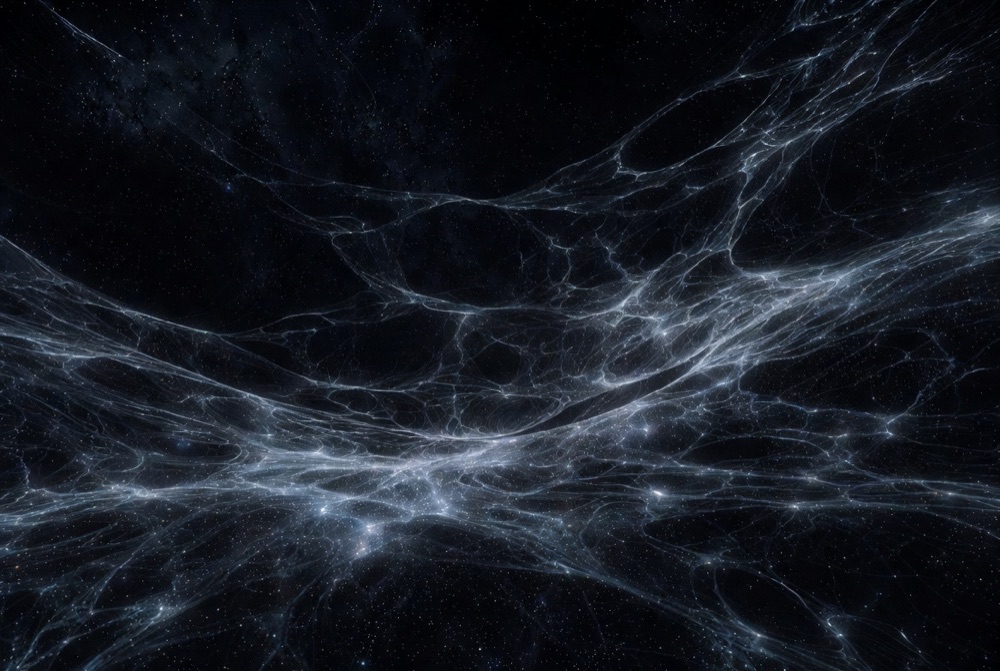
The missing five-sixths of the universe
Look up on a clear night and almost everything you can see — every star, every galaxy, the glowing clouds of gas between them — adds up to only about one part in six of the matter in the cosmos. The other five parts are invisible. They give off no light, absorb none, and ignore the everyday forces that make ordinary stuff tangible. We cannot see this “dark matter,” touch it, or catch it in any detector. We know it is there for one reason only: it pulls.
This is not a fringe worry at the edge of physics. It is one of the central, stubborn facts of modern science, and it has been staring astronomers in the face for ninety years.
Why the equations simply demand it
In the 1930s the astronomer Fritz Zwicky measured how fast galaxies were hurtling around inside a great cluster. They were moving so fast that the cluster’s own gravity — counting only the matter he could see — should never have been able to hold them together. The cluster ought to have flown apart long ago. It hadn’t. Something unseen was holding it.
Forty years later Vera Rubin found the same scandal in individual galaxies. Stars at the outer edge of a spinning galaxy orbit far too quickly; by the rules of gravity they should be flung off into space like mud off a fast wheel. They aren’t. Something unseen is gripping them.
And it is not just motion. When light from distant galaxies passes a massive object, it bends — exactly as Einstein’s general relativity predicts. But it bends too much for the visible matter to explain. The early universe’s faint afterglow, the cosmic microwave background, carries a pattern that only fits if there was roughly five times more matter than we can see. The very way galaxies clumped together out of the smooth early cosmos needed that extra gravity to get going in time.
Here is the crucial point. These are not five vague hints; they are five independent measurements, using different physics, that all land on the same answer: the gravitational books of the universe do not balance unless you add about five times as much matter as we can observe. Einstein’s theory of gravity, meanwhile, has passed every other test thrown at it — the wobble in Mercury’s orbit, the bending of starlight, the ticking of GPS satellites, the ripples of gravitational waves from colliding black holes. Physicists trust those equations. So when the matter on one side of the equation comes up short by a factor of five, the natural conclusion is not that the equations are broken, but that there is matter we have not yet found.
(Einstein himself once added an extra term to his equations to make the universe behave - the “cosmological constant” — and called it his greatest blunder. That term turned out to describe a different dark puzzle, dark energy, which pushes the cosmos apart. Dark matter is the opposite problem: unseen stuff that pulls things together. This piece is about the pulling kind.)
Forty years of hunting a particle — and finding nothing
If five-sixths of matter is missing, what is it made of? For decades the favourite answer has been: a new kind of particle, one we simply haven’t detected yet. Several candidates have had their turn, and each has run into trouble.
-
WIMPs (Weakly Interacting Massive Particles) were the front-runner for a generation — heavy new particles predicted by elegant extensions of particle physics. Enormous, exquisitely sensitive detectors were built deep underground to catch one drifting by; the Large Hadron Collider hunted for them. After decades and billions spent, nothing. The theory’s most attractive versions are now largely ruled out.
-
Axions are a featherweight particle originally invented to fix an unrelated wrinkle in the theory of the strong nuclear force. They remain a live possibility, and clever experiments are searching — but again, none has been found.
-
Sterile neutrinos — a heavier, shyer cousin of the familiar neutrino — have produced a few tantalising hints over the years, none confirmed, and the simplest versions are squeezed by observations.
-
Dim ordinary objects (faint stars, stray planets, modest black holes) were once a tempting idea: maybe the dark matter is just normal stuff that doesn’t shine. Surveys that watch for the tiny brightening as such an object drifts in front of a star have now largely closed this door. There simply aren’t enough of them.
-
Changing gravity instead of adding matter is the boldest alternative. Perhaps Newton’s and Einstein’s laws are slightly wrong on galactic scales. One such proposal, MOND, describes the rotation of galaxies beautifully — better, in some ways, than dark matter does. But it struggles with clusters and with the early-universe afterglow, and it stumbles badly on one famous collision (below).
The pattern is hard to miss. Every route is either a new particle nobody can detect despite heroic effort, or a tweak to gravity that fixes one scale and breaks another. After ninety years of mystery and forty of intensive searching, it is reasonable to ask whether we have been looking for the wrong kind of thing entirely.
A different kind of answer: not a thing in space, but a flaw in space
The idea explored at neusym.ai starts from a radical premise about space itself.
Imagine that space is not the smooth, featureless backdrop we usually picture, but something more like the memory of a vast self-correcting computer — a discrete fabric woven from tiny cells that constantly check and repair themselves, the way modern hardware uses error-correcting codes to fix stray glitches. In its calm, ordered state this fabric settles into a regular honeycomb of identical cells (each, in this model, shaped like two little pyramids joined base to base). That orderly honeycomb is the empty space we know.
Now think about how things freeze. Cool water slowly and you can grow a single flawless crystal of ice. Cool it fast — or cool a metal fast — and you trap a mess: cracks, mismatched grains, boundaries where one orderly region meets another that settled the wrong way. The flaws get locked in, because there is no time to heal them before everything stiffens.
In this picture the newborn universe crystallised — and it did so very fast. Distant regions, too far apart to “agree” on how to line up, each froze into the ordered pattern in their own way. Where mismatched regions met, the fabric could not knit together cleanly, and the seams were frozen in place. Those frozen seams are the dark matter.
Why would they be dark? Because the flaws live in the gaps between the orderly cells, in fabric that keeps no records — so they cannot emit or absorb light, or feel the ordinary forces. Yet a flaw still costs energy, and energy gravitates. Heavy and invisible: precisely the two job requirements for dark matter. And they cannot move: the same stiffness that locked them in means no realistic push — not even the gravity of an entire galaxy — can drag them through the lattice. They are frozen exactly where the young cosmos left them.
Why this candidate is worth taking seriously
What lifts this above yet another “maybe it’s X” story is that, once you accept the starting premise, the rest is calculated rather than assumed — and several of the answers are unusually clean.
-
It is frozen structure, not a new particle. That sidesteps the whole forty-year impasse. There is nothing extra to detect drifting through a laboratory, because the dark matter isn’t stuff in space — it is flaws in space. It is dark for a structural reason, not because we tuned it to be shy.
-
It wasn’t invented to solve dark matter. The discrete, self-correcting picture of space was built for entirely separate reasons; dark matter falls out of it as a by-product. An explanation you didn’t bolt on for the occasion is more convincing than one you did.
-
It produces sharp, exact numbers. Most dark-matter proposals come with dials to turn. This one, in places, hands back plain fractions. For example, of all the freeze-in mismatches, exactly four out of seven turn out to be the permanent, gravitating kind — a clean fraction, not a fitted parameter. The model also insists the indestructible flaws are never tiny points: the only ones that survive are extended — threads and sheets that run right across the structure, like a crack that spans a pane of glass rather than a chip in it. Dark matter, in this view, is less a swarm of particles than a frozen web.
-
It borrows physics we have already confirmed. The rule for how many flaws a fast freeze leaves behind — known as the Kibble–Zurek mechanism — is not speculative. It has been watched directly in the laboratory, in freezing liquid crystals, in superfluid helium, and in chains of trapped ions, and it is the same idea cosmologists use for hypothetical “cosmic strings.” Reaching for established physics rather than new particles counts in its favour.
-
It is testable, and one early sign is encouraging. Standard particle dark matter predicts galaxies with sharp, dense centres; what astronomers actually see in many small galaxies are broad, soft cores. Frozen, extended structure naturally makes soft cores rather than sharp spikes — a point where the new picture sits more comfortably with the data than the old one.
The honest caveats
This is a young, frankly speculative idea, and it would be a disservice to oversell it.
-
The foundation is unproven. The whole edifice rests on the premise that space is a discrete, error-correcting fabric. That is a bold hypothesis, not an established fact.
-
There is a real test it must still pass. In the famous “Bullet Cluster,” two clusters of galaxies smashed through each other; the dark matter (mapped by its gravity) sailed straight through and separated cleanly from the ordinary gas, which got left behind. That is the classic evidence that dark matter can flow through a collision. Frozen, pinned structure cannot obviously do that — so this is exactly the kind of observation that could falsify the idea, or force it to be only part of the story. An honest scorecard lists this as an open question, not a victory.
-
Two numbers are still missing. To turn the picture into a precise prediction of how much dark matter there should be, the model needs two further ingredients — how fast the early universe cooled, and how its internal units convert to familiar physical scales. Both are works in progress. So the idea currently predicts the shape of the answer cleanly, but not yet the exact measured amount.
-
It is one strand, not the whole rope. Within the wider framework, frozen flaws are one of several proposed contributions to the dark sector, and the final accounting has to be shared out carefully.
Why it matters anyway
Even with those caveats, the proposal does something most dark-matter ideas do not: it is calculable and falsifiable. It hands back exact fractions instead of free dials, it borrows mechanisms already confirmed in the laboratory, it lines up with the soft galaxy cores we actually observe, and it stakes out clear predictions that future observations can confirm or kill. That is the hallmark of a genuine scientific candidate rather than a comfortable story.
And it reframes the oldest invisible question in cosmology in a strikingly simple way. For ninety years we have assumed the missing matter must be some thing we have not yet caught. This idea suggests we may have been searching the wrong category all along — that the dark matter holding the galaxies together is not hidden stuff drifting through space, but the frozen scar tissue of a universe that crystallised too fast.
This is a popular summary of a technical result in the finite quantum-error-correction substrate programme. For the full account — the model, the proofs, the exact numbers, and the open problems stated plainly — see https://neusym.ai.